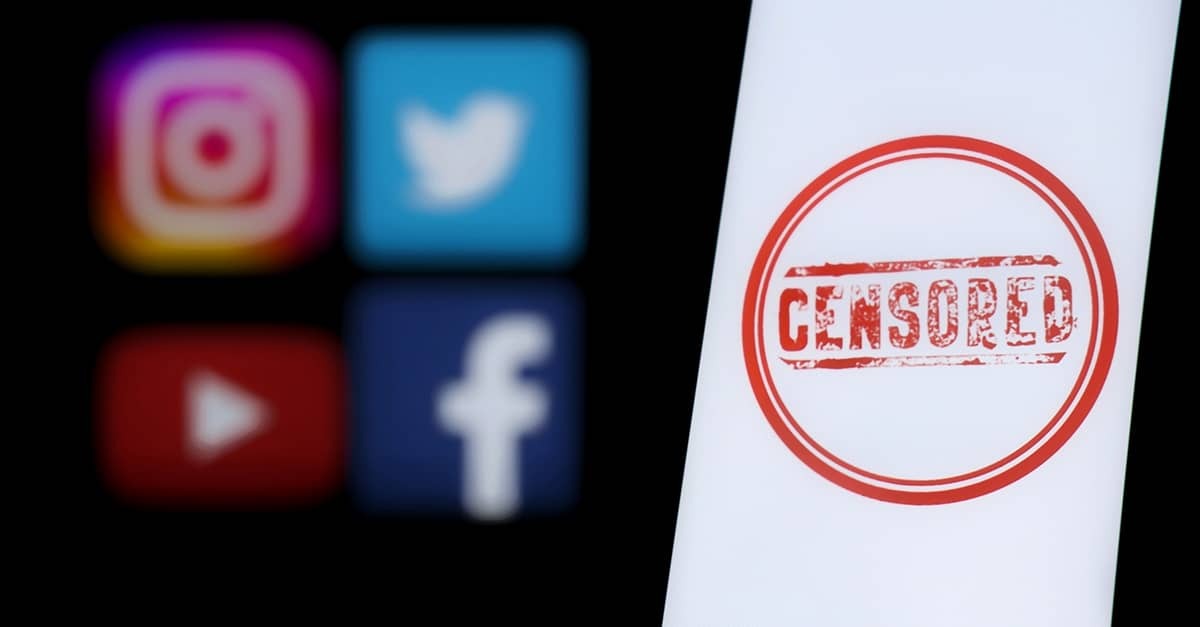
The Trump administration agrees to settle Missouri v. Biden, a years-long free speech case involving heavy-handed government censorship of dissenting social media posts, by banning federal agencies from censoring the plaintiffs on YouTube, Facebook, X, and Instagram for the next 10 years.
On Tuesday, the Trump administration agreed to a consent decree in the case of Missouri v. Biden, a years-long free speech case that involved the government’s unconstitutional effort to coerce social media companies into censoring posts related to COVID treatment and vaccines, election security, the Hunter Biden laptop, and other controversies.
The federal government admitted that the Biden administration conducted an unconstitutional censorship and coercion effort and banned the federal government from censoring the case’s plaintiffs on X, YouTube, Facebook, and Instagram. Those plaintiffs are Joe Hoft, publisher of The Gateway Pundit; Jill Hines, co-director of Health Freedom Louisiana; Dr. Aaron Kheriaty, a psychiatrist and director of the Bioethics, Technology, and Human Flourishing Program at the Ethics and Public Policy Center; and the states of Missouri and Louisiana.
Under the consent decree, which will last for 10 years, the Centers for Disease Control and Prevention (CDC), the Cybersecurity and Infrastructure Security Agency, the Office of the Surgeon General, and other federal agencies “shall take no actions, formal or informal, directly or indirectly—except as authorized by law—to threaten Social-Media Companies with some form of punishment (i.e., an adverse legal, regulatory, or economic government sanction) unless they remove, delete, suppress, or reduce, including through altering their algorithms, posted social-media content containing protected free speech. Nor shall Enjoined Defendants unilaterally direct or veto social media content moderation decisions of Social Media Companies.”
In addition, the government agreed that “modern technology does not alter the Government’s obligation to abide by the strictures of the First Amendment” and the “government, politicians, media, academics, or anyone else applying labels such as ‘misinformation,’ ‘disinformation,’ or ‘malinformation’ to speech does not render it constitutionally unprotected.”
Quoting President Donald Trump’s executive order on government censorship, the agreement summarized the censorship scheme as follows:
“Under the guise of combatting ‘misinformation,’ ‘disinformation,’ and ‘malinformation,’ the Federal Government infringed on the constitutionally protected speech rights of American citizens across the United States in a manner that advanced the Government’s preferred narrative about significant matters of public debate.”
An article in The Gateway Pundit noted that at the height of the censorship effort, the Biden administration was labeling an estimated 2.5 percent of all posts on Twitter as “potential misinformation.”
The Trump administration concluded that “Unrelenting pressure from certain government officials likely had the intended result of suppressing millions of protected free speech postings by American citizens.”
The consent decree now ends one of the most important free speech cases in American history.
Missouri v. Biden was later merged with Murthy v. Missouri when the cases appeared before the U.S. Supreme Court in 2024.
Both cases dealt with what U.S. District Court Judge Terry Doughty called a “dystopian scenario” in which the U.S. government had taken on the role of the “Orwellian ‘Ministry of Truth’” and perpetrated the “most massive attack against free speech in United States’ history.”
The U.S. Court of Appeals for the Fifth Circuit upheld much of Doughty’s injunction, ruling that the government forced social media companies to censor users’ posts on matters of public debate, among them the efficacy of masking during COVID, the origins of COVID, the safety and efficacy of COVID treatments and vaccines, any questioning of transgenderism, the Hunter Biden laptop, January 6, and election integrity.
The Biden administration conducted a massive-scale, multi-agency effort in which it labeled channels, posts, videos, and articles as “misinformation,” “disinformation,” or “malinformation,” the latter being defined as factual information that was used in a way that went against the administration’s approved narrative. Once the information was labeled under one of these categories, administration officials would send emails demanding that social media companies remove it, even threatening executives and employees. The FBI had weekly meetings with social media companies, telling them what specifically to censor.
Medical professionals, politicians, news outlets, satire sites, and average citizens had their posts taken down, their accounts locked, or found themselves banned outright from social media — not because they did anything wrong or illegal or posted anything clearly false but because they posted facts or an opinion that the administration did not like.
Yet after agreeing to hear the case, the U.S. Supreme Court ruled that plaintiffs did not have standing to keep the preliminary injunction in effect. In a scathing dissent, Justices Neil Gorsuch, Samuel Alito, and Clarence Thomas strongly condemned the ruling, accusing the other justices of shirking their duty and permitting “the successful campaign of coercion in this case to stand as an attractive model for future officials who want to control what the people say, hear, and think.”
That decision, however, did not end the case. It was headed to open discovery this week, and the government was facing a deadline for argument submissions when it agreed to the terms of the consent decree.
Kheriaty, one of the five plaintiffs, celebrated the settlement on X, writing, “I am delighted to report that we finally achieved victory today in Missouri v. Biden, our case challenging government censorship on social media. CDC, CISA and the U.S. Surgeon General are now barred from threatening social media companies into censoring constitutionally protected speech on their platforms.”
In 2022, the censorship, most notably of the Christian satire site The Babylon Bee, had gotten so bad that it grabbed the attention of Elon Musk. Within months, he purchased Twitter (later renaming it “X”) with the promise and goal of restoring free speech to the platform. Musk, a self-described “free speech absolutist,” has followed through on his promise. For his troubles, though, Musk and his companies have since been smeared, attacked, fined, threatened, or censored by far-left activists in the U.S. and a number of progressive “democratic” governments who are now actively and openly censoring their own citizens, most notably Brazil, France, Canada, the U.K., and Finland.
ORIGINAL ARTICLE
Supreme Court Takes Missouri v. Biden – Can Agencies Silence You Online?
{Published on October 24, 2023} The Supreme Court will hear Missouri v. Biden, a case involving what lower courts called a “coordinated campaign” by high-level federal officials to censor Americans based on the content of their speech. The Court granted certiorari, meaning that it will hear arguments from both sides during its 2023-24 session and rule on the case based on the merits.
The case was brought against federal agencies by the states of Missouri and Louisiana, a web-based news organization, a healthcare advocate, and three doctors.
There has been a flurry of activity on this case in recent months. In July, U.S. District Court Judge Terry Doughty issued an injunction against numerous federal agencies and officials. In his 155-page opinion, he stated:
“This targeted suppression of conservative ideas is a perfect example of viewpoint discrimination of political speech. American citizens have the right to engage in free debate about the significant issues affecting the country. Although this case is still relatively young, and at this stage the Court is only examining it in terms of Plaintiffs’ likelihood of success on the merits, the evidence produced thus far depicts an almost dystopian scenario. During the COVID-19 pandemic, a period perhaps best characterized by widespread doubt and uncertainty, the United States Government seems to have assumed a role similar to an Orwellian ‘Ministry of Truth.’ The Plaintiffs have presented substantial evidence in support of their claims that they were the victims of a far-reaching and widespread censorship campaign.”
On Sept. 8, the U.S. Court of Appeals for the Fifth Circuit weakened Doughty’s injunction, removing many of those barred from contacting social media companies. One of the agencies removed from the injunction was the Cybersecurity and Infrastructure Security Agency (CISA).
Following that ruling, the Supreme Court agreed to hear the case but before it did so, the Fifth Circuit agreed to reevaluate whether CISA should be added back to the injunction. On Oct. 3, it did exactly that, finding,
“CISA was the ‘primary facilitator’ of the FBI’s interactions with the social-media platforms and worked in close coordination with the FBI to push the platforms to change their moderation policies to cover ‘hack-and-leak’ content. Second, CISA’s ‘switchboarding’ operations, which, in theory, involved CISA merely relaying flagged social-media posts from state and local election officials to the platforms, was, in reality, ‘[s]omething more.’
CISA used its frequent interactions with social media platforms to push them to adopt more restrictive policies on censoring election-related speech. And CISA officials affirmatively told the platforms whether the content they had ‘switchboarded’ was true or false. Thus, when the platforms acted to censor CISA-switchboarded content, they did not do so independently. Rather, the platforms’ censorship decisions were made under policies that CISA has pressured them into adopting and based on CISA’s determination of the veracity of the flagged information. Thus, CISA likely significantly encouraged the platforms’ content-moderation decisions and thereby violated the First Amendment.”
Last Friday, the Supreme Court stated it would hear the case on emergency appeal from the Biden administration. The administration also petitioned that the Court issue a stay on the injunction until the Court could hear the case. The Supreme Court granted that stay, to the dismay of Justices Clarence Thomas, Neil Gorsuch, and Samuel Alito.
All three wanted to keep the injunction in place, with Justice Alito writing in a dissent to the majority decision,
“This case concerns what two lower courts found to be a ‘coordinated campaign’ by high-level federal officials to suppress the expression of disfavored views on important public issues. To prevent the continuation of this campaign, these officials were enjoined from either ‘coerc[ing]’ social media companies to engage in such censorship or ‘active[ly] control[ling]’ those companies’ decisions about the content posted on their platforms. Today, however, a majority of the Court, without undertaking a full review of the record and without any explanation, suspends the effect of that injunction until the Court completes its review of this case, an event that may not occur until late in the spring of next year. Government censorship of private speech is antithetical to our democratic form of government, and therefore today’s decision is highly disturbing.”
The justices stated that the government’s argument of irreparable harm due to the injunction was faulty. Alito also claimed the injunction does not stop the government from carrying out any of its necessary functions.
“The injunction applies only when the Government crosses the line and begins to coerce or control others’ exercise of their free-speech rights. Does the Government think that the First Amendment allows Executive Branch officials to engage in such conduct? Does it have plans for this to occur between now and the time when this case is decided?” Alito questioned.
“At this time in the history of our country, what the Court has done, I fear, will be seen by some as giving the Government a green light to use heavy-handed tactics to skew the presentation of views on the medium that increasingly dominates the dissemination of news. That is most unfortunate.”

The Supreme Court deciding to hear this case is a major win for free speech because it elevates the issue into the public eye regarding the widespread actions of government officials to censor the speech of Americans and to control the policies of social media companies. According to previous rulings and a House subcommittee finding, the government has unquestionably, and brazenly, violated the First Amendment by telling social media companies to remove posts that the government didn’t approve.
That’s called tyranny.
The government cannot be allowed to censor content or Americans’ opinions.
Many of the posts, particularly those around COVID-19, were actually true, and what the government was telling Americans about virtually every aspect of COVID-19 was either incorrect or a blatant lie. It censored speech, ideas, and potential medical solutions that should have been debated, not silenced. By forcing social media companies to violate the First Amendment, U.S. federal agencies put Americans in more danger, not less.
This whole idea that the U.S. government and its unelected bureaucrats need to act as a Ministry of Truth to protect American citizens from “misinformation” and “disinformation” or their own belief system is more in line with the Soviet Union and the Chinese Communist Party than a free America whose cornerstone principle is the First Amendment, which codifies our God-given rights to exchange information, to freely associate, and to follow the dictates of our religious beliefs and principles.
This is a fateful moment for our country, and the Supreme Court must get this one right — guided by the Constitution, not by the government’s fear-mongering about how the American people are too stupid to use their own minds to decide for themselves. If our Justices don’t, they will have told the government that the Constitution isn’t worth the parchment it was first written on and bureaucratic tyrants will be loosed to rule exactly like Communist China and other totalitarian governments.
If this article informed and equipped you, make a tax-deductible gift to the Standing for Freedom Center today. Your support fuels fearless journalism, biblical worldview analysis, and bold defense of faith, family, free speech, and the Constitution when America needs it most.