The Trump Justice Department says the Southern Poverty Law Center secretly funneled more than $3 million in donor funds to people tied to extremist groups. Christians should see the indictment not merely as vindication, but as a warning against false witness, fear-driven fundraising, and the corruption of justice.
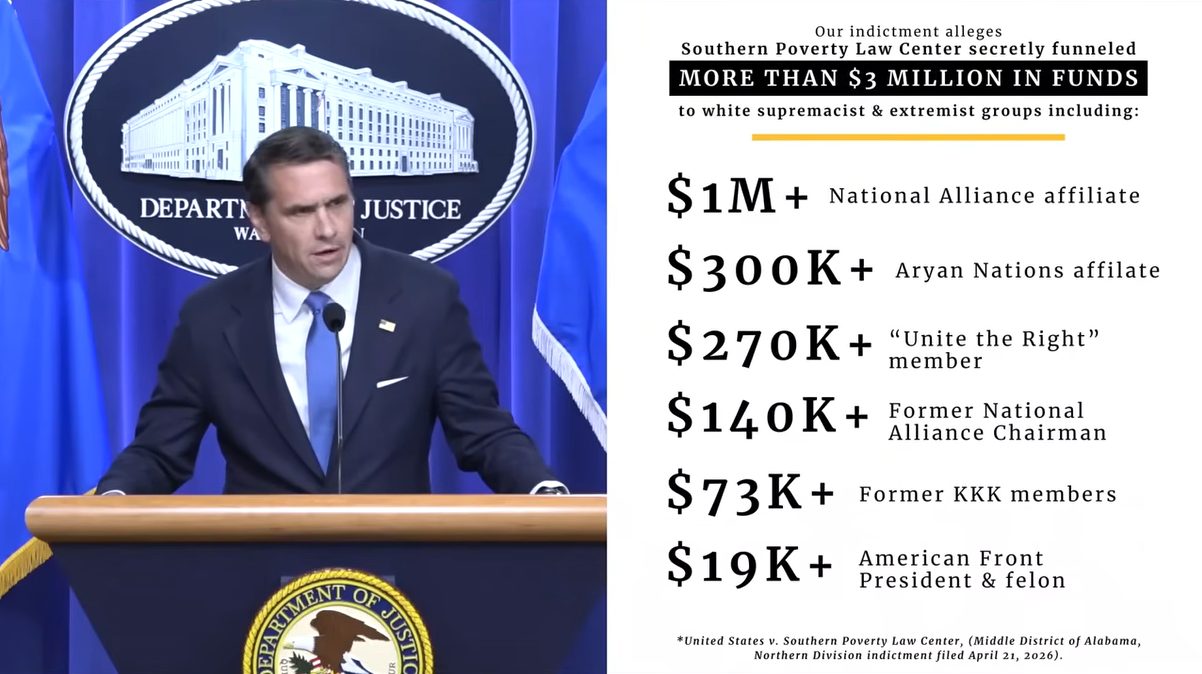
A federal grand jury in Montgomery, Alabama, recently handed down an 11-count indictment against the Southern Poverty Law Center for wire fraud and conspiracy to commit money laundering. According to the Department of Justice, the SPLC secretly moved more than $3 million in donor money between 2014 and 2023 to individuals affiliated with the Ku Klux Klan and other violent extremist groups. To hide the trail, prosecutors say, the payments were routed through fictitious entities such as “Fox Photography.”
According to the indictment, a 55-year-old organization that built a brand on hunting hate has actually been bankrolling it. The temptation for conservative Christians will be to read that as simple vindication, and to a degree, it is. But that reading is too small. The SPLC did not collapse into alleged fraud because it found some exotic evil; it collapsed because it surrendered to an ordinary one. Fear is easier to sell than hope, and an enemy keeps the donations coming. This indictment is as much a mirror as a verdict, and the Church should be the first to look into it.
The Manufactured Enemy
Remember Jussie Smollett? When the actor could not find the racism he wanted to be the victim of, he manufactured it himself, hiring two men to stage an attack that never happened. When reality refuses to deliver the villain you need, you invent one.
“The SPLC is manufacturing racism to justify its existence,” Acting Attorney General Todd Blanche said in announcing the charges. The alleged operation was Jussie Smollett on an industrial scale. While the SPLC raised money by promising to expose racist movements, prosecutors say it was quietly paying the leaders of those movements, among them an Imperial Wizard of the United Klans of America and a National Alliance figure who reportedly collected more than a million dollars. One paid source helped organize the Unite the Right rally in Charlottesville, where a young woman died.
This is an old American business model. Jesse Jackson built a career on a quiet threat to corporate boardrooms: welcome him inside and pay a protection fee or see him on the sidewalk during a corporate boycott against your “racist” company. Black Lives Matter brought the model to its purest form, raising more than $90 million in 2020 to fight racism while one of its co-founders purchased for multi-million dollar mansions and the communities it claimed to serve kept burying their sons.
The pattern never varies. Reconciliation is the promise; dependency is the product.
The SPLC industrialized the model into a closed loop. Paid informants embedded in extremist groups fed intelligence to the SPLC’s Hatewatch division, which spun it into alarming public reports. Those reports drove the donor appeals, and the donations bankrolled the next round of payments to informants. The “hate map” they created was not advocacy; it was inventory.
The “But the FBI Knew” Defense
Lawyers for the SPLC now argue that the prosecution is a misunderstanding. The FBI knew about the informant program all along, they say, and the tips from those paid sources helped put violent extremists behind bars; the SPLC has produced a 45-page dossier it says reached the bureau before the Charlottesville rally.
Consider what that actually concedes. The defense is not, “We did not pay Klan leaders.” It is, “We paid them, and the federal government knew.” That is not a denial but a confession.
For years, conservative Christians have argued that the SPLC functioned as an unofficial deputy of the federal security state, supplying ideological targeting data dressed up as research. Congressional investigators have now documented at least 13 FBI intelligence products that leaned on SPLC sourcing to flag religious Americans as potential domestic threats. The most notorious, a 2023 Richmond field office memo, drew on the SPLC’s “radical traditionalist Catholic” list to propose surveilling Catholic parishes and recruiting informants among the clergy. That is not the work of a healthy republic. It is the soft theocracy of the secular state, with the SPLC providing the index of heretics and the federal bureau enforcing it.
That is why the Trump administration’s posture matters. President Trump’s Justice Department has refused to treat the SPLC as untouchable merely because it speaks in the language of civil rights; Acting Attorney General Todd Blanche said, “No entity is above the law.” The administration has also made it formal policy to protect religious liberty and end anti-Christian weaponization of government. Christians should welcome that restoration of equal justice while remembering that the same standard must bind us as well: truth is not a tribal weapon.
The Receipts on the Christian Side of the Ledger
The cost of that index has not been theoretical. In August 2012, Floyd Lee Corkins II walked into the lobby of the Family Research Council in Washington, D.C., armed and carrying a bag of Chick-fil-A sandwiches he wanted to smear on the faces of the staff members he came to kill. He told the FBI he had found his target on the SPLC’s “hate map” and said his goal was to intimidate those who opposed gay marriage. After lying his way in, he shot an unarmed security guard named Leo Johnson once in the arm, but Johnson managed to tackle Corkins and shut down his planned killing spree.
Corkins was sentenced to 25 years, but SPLC officials felt no remorse or responsibility. Instead, they kept the Family Research Council on the hate map for at least another decade.
The Family Research Council was never an outlier on that list. The SPLC has also labeled Alliance Defending Freedom, a constitutional law firm that has won numerous religious liberty and free speech cases at the Supreme Court, as an “extremist group,” even ranking it next to the Ku Klux Klan. Think about that: An organization that prosecutors now say was wiring money to actual Klansmen told the public that Christians who hold the historic view of marriage are indistinguishable from neo-Nazis.
The rot was not only outward-facing. In 2019, the SPLC fired its own co-founder, Morris Dees, after staff complaints of a workplace culture steeped in racism and harassment; a Pulitzer Prize-winning newspaper series had long ago documented the same pattern in 1994. The kettle, it turns out, had been calling the pot black for 30 years.
The Cost to the Common Trust
An operation like this does not just damage the Christians and conservative groups it targets; it also bleeds into the civic water table. Every time a self-described neutral arbiter of truth turns out to be a partisan operation, the ordinary citizen gains another reason to assume the institutions asking for his trust are quietly keeping a record of his actions. He has watched it happen to the press and to federal law enforcement. Now it has happened to a celebrated civil rights group caught laundering donor money to Klansmen.
A republic runs on trust the way an engine runs on oil. The political class and its allied nonprofits have been draining the tank for years, but then act surprised when the engine seizes.
What the Church Must See
None of these events are new. Solomon wrote that both the one who justifies the wicked and the one who condemns the righteous are an abomination to the Lord (Proverbs 17:15). Justifying the wicked by paying Klansmen and condemning the righteous by branding faithful Christian ministries as hate groups were not two operations at the SPLC but one.
Bearing false witness is not a small sin; it desecrates God’s design for a justice that depends on words meaning what they mean.
The Church, then, should hold this indictment up as a mirror rather than as a trophy. The temptation that destroyed the SPLC does not announce itself; it arrives dressed as zeal for the truth. The discovery that fear is more profitable than charity can settle into a Christian ministry or a conservative magazine as easily as into a progressive nonprofit in Montgomery. The cure is not a fiercer tribe, but the fear of God and the discipline of telling the truth, even when the truth costs a successful fundraising cycle.
Church leaders and Christian institutions can also take a specific action. They can stop outsourcing to advocacy groups the authority to define what counts as “hate.” Whether the label is stamped by the SPLC or by whatever better-funded successor learns its playbook, the Church does not need a secular agency to tell it which of its neighbors are dangerous. It has the Scriptures, and they are enough.
The evidence will be weighed by a jury, and the legal verdict remains unwritten. The SPLC has pleaded not guilty, arguing that its informant program helped law enforcement monitor and prevent extremist violence. But the moral question remains: If an organization raises money by warning donors about hatred while secretly paying leaders and insiders connected to the very movements it condemns, the public deserves the truth. A house built on false witness does not stand.
When the loudest accusers are caught in the very corruption they claimed to fight, truth needs defenders with backbone. Your tax-deductible gift helps the Standing for Freedom Center expose false witness, confront institutional overreach, and equip Christians to stand for faith, liberty, and justice without surrendering the public square.