In Louisiana v. Callais, the Court rejected race-based districting and exposed the false god behind the fury: the belief that skin color should organize American political life.
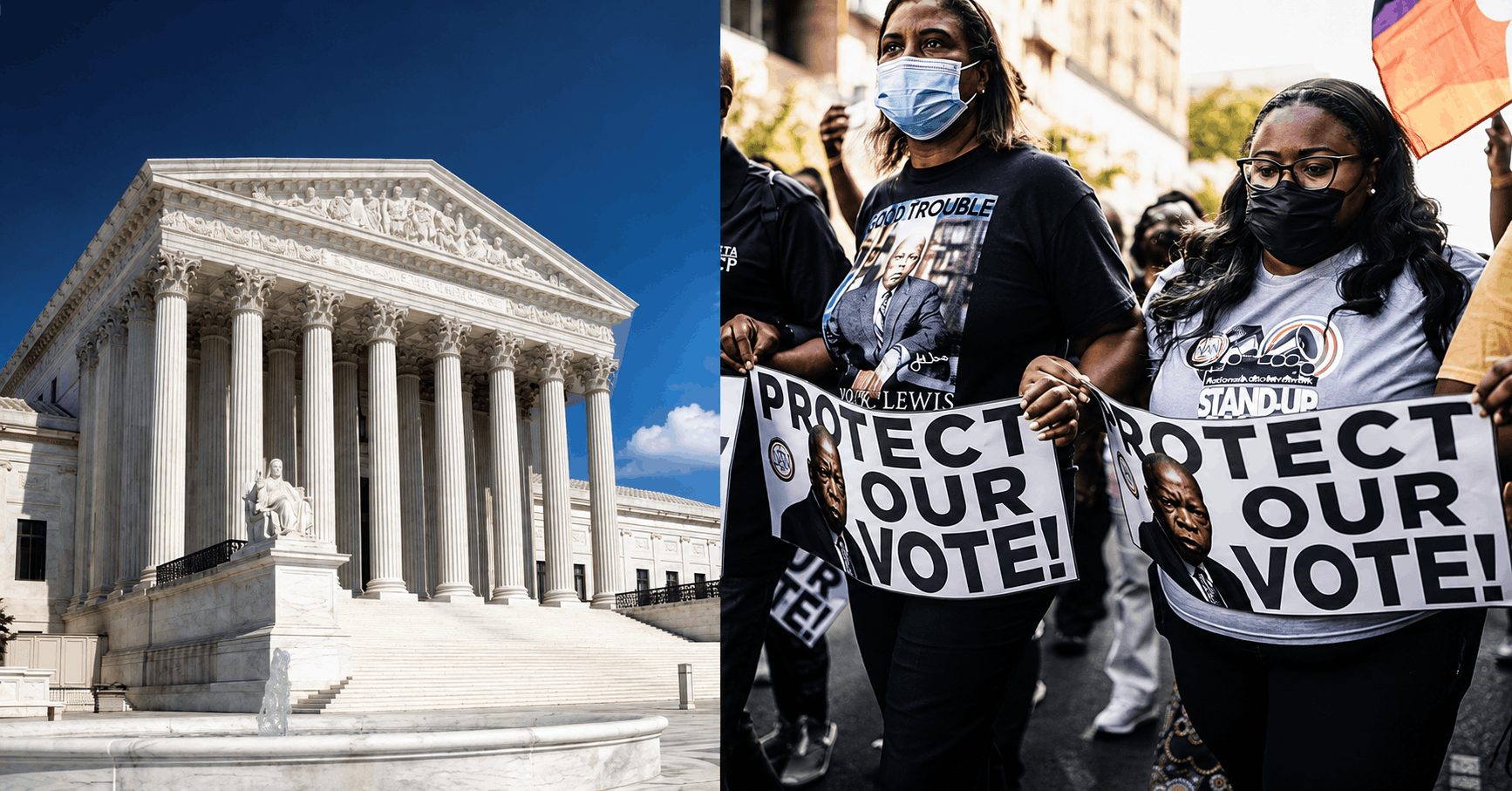
Last month, the Supreme Court announced its decision in Louisiana v. Callais, and the 6-3 ruling said something the political class did not want to hear: A state may not sort its citizens into voting districts according to the color of their skin, not even when the sorting is dressed in the language of remedy.
Justice Samuel Alito opened the majority opinion with a sentence that frames the whole matter: Section 2 of the Voting Rights Act “was designed to enforce the Constitution — not collide with it.” The Court concluded that Louisiana had not been required by the Voting Rights Act to create an additional majority-minority district, and therefore the state had no compelling interest that justified using race to draw SB8. The decision did not abolish the Voting Rights Act; it rejected the idea that the Act can be read to require unconstitutional racial sorting.
A nation that had spent a year redrawing its maps was suddenly forced to look at what those maps revealed, and the long-term implications arrived within days. Tennessee fired the opening volley by calling a special session to dismantle the black-majority Memphis-anchored Ninth District. Other states have since followed with similar legislative efforts.
Scripture unravels the entire premise of race-based districting before the argument even begins. Every human being is made in the image of God, and from one man God made every nation that dwells on the earth. Race-based redistricting assumes the opposite. It treats skin color as a reliable proxy for conviction, predicting that voters of a given ancestry share a political mind so uniform that a mapmaker can capture it.
That assumption is not flattering. It reduces a neighbor to a pattern and then calls the reduction justice. The Christian already knows better, and he should not let an election-year quarrel talk him out of what he confesses every Lord’s Day.
Borrowed Grief in Memphis
Nowhere has the reaction been more theatrical than in Tennessee. State Rep. Justin Pearson, a Memphis Democrat, told the legislature that the new maps were “racist tools of white supremacy” and warned that Memphis was being stripped of its voice.
Colleagues invoked the Edmund Pettus Bridge, the assassination of Dr. King, poll taxes, and literacy tests, draping the moral weight of the Civil Rights era over a partisan dispute about congressional seats. The performance was emotionally powerful to those who are moved more readily by feeling than by fact. It was also an act of borrowed grief.
Consider the seat that sits at the center of the controversy. Tennessee’s Ninth District has been represented for nearly two decades by Rep. Steve Cohen, D-Tenn., a white man and the first Jewish person to represent the state in Congress. A majority-black district returned him to Washington again and again, often with 70 to 80 percent of the vote, even as activists mounted primary challenges, arguing that the seat ought to belong to a black candidate.
The voters of Memphis did not need a racial quota to choose their representative. They chose him freely and repeatedly over the years. The district’s own history rebuts the claim that black Tennesseans cannot be represented unless the map is engineered to guarantee it.
Cohen has even said the Ninth District was never a Voting Rights Act creation. Memphis grew into a majority-black city through ordinary migration and birth, and the legislature recognized a city that deserved a congressman, not a racial entitlement that demanded one.
That distinction dissolves the central claim of the protest. None of this excuses partisan gerrymandering, and the believer need not pretend otherwise. The prior Tennessee map was drawn to advantage one party, and its architects admitted as much on the senate floor. The honest position holds two truths at once. Power-hungry mapmaking deserves rebuke, and the charge of white supremacy is a borrowed garment that does not fit the facts.
The Promise That Became a Lie
The same instinct shows up in Virginia, though the facts have nothing to do with race. National Democrats have folded the commonwealth into the post-Callais outcry as though the Supreme Court’s voting rights decision somehow injured Virginia, but the timeline alone rebuts that framing.
The first legislative vote on Virginia’s redistricting amendment came in late October 2025, six months before the Callais ruling. The second vote followed in January, the bill was signed in February, early voting started in March, and the referendum was held on April 21 — eight days before the Callais opinion was handed down.
Every consequential step of the Virginia push happened before the Supreme Court had ruled on anything. What is happening now is a retrofit, the dressing of a partisan loss in the borrowed language of civil rights.
What did happen in Virginia was a naked political gerrymander, undertaken in a hurry and undone by its own shortcuts. During her campaign, Gov. Abigail Spanberger, D-Va., assured voters that she had “no plans” to redraw the commonwealth’s congressional map. The bill authorizing exactly that redrawing became one of the first she signed in office.
The defense offered for the reversal was that the move was temporary and merely responsive, a necessary answer to redistricting elsewhere.
Listen to the moral logic beneath the politics. Spanberger’s argument was that it’s righteous to break a promise when the circumstances feel urgent and the other side starts it. Scripture holds the opposite standard. Psalm 15 asks who may dwell in the presence of God and answers, among other marks, that it is the one who keeps an oath even when keeping it costs him, “who swears to his own hurt and does not change.”
A leader’s word is supposed to be bound to something steadier than the news cycle.
The deeper problem was not what Virginia Democrats wanted to do but how they tried to do it. The state constitution requires that any amendment pass the General Assembly in two consecutive sessions with an election in between. Democrats convened a special session on October 27, 2025, and took the first full vote on the amendment on October 31, while early voting in the November 2025 election was already underway and roughly 1.3 million Virginians had already cast ballots.
In a 4-3 decision, the Supreme Court of Virginia ruled that this short-circuited the constitutional process, and the United States Supreme Court declined to revive it. The flaw was procedural, and that is the point: The rule of law is mostly about procedure, requiring patient insistence that even a desired destination must be reached by a lawful road.
When some Virginia Democrats responded by floating a plan to lower the justices’ retirement age from 73 to 54 (the age of the youngest justice to vote with the majority) and clear the court so the case could be retried, they confirmed the deeper problem. A movement convinced of its own righteousness will, when checked, reach for the machinery of the institution itself.
What the Simulations Confess
Strip away the fury and the empirical claim underneath, and it does not hold.
The accusation is that race-neutral maps will erase minority representation. Analysts who ran the numbers found something different. Drawing thousands of simulated maps with no consideration of race at all, using only compactness and respect for county and city lines, they produced roughly as many districts favorable to minority-preferred candidates across the South as existed under the Voting Rights Act. In Memphis, more than 99 percent of 5,000 colorblind simulations still produced a plurality or majority-black district anchored in Shelby County, where Memphis sits, simply because that is where the people live.
A fair, race-blind process would have preserved most of what the activists say is being destroyed. The districts that genuinely vanish under neutral rules are the ones that could only ever exist by deliberate racial engineering. The protest, then, is not chiefly against losing representation; it is against losing a method, specifically the method of treating race as the organizing principle of political life.
A method elevated above the people it claims to serve has become something the Bible names with precision: an idol.
The Civil Rights Movement at its best appealed to a Christian conscience, to the truth that a man should be judged by his character because he bears the image of his Creator. What is defended now inverts that appeal, insisting that a man’s ancestry settles his politics for him and that any system refusing to treat him that way is wickedness.
The Church’s Witness in a Divided Hour
A believer who views this fight solely as a political event will misjudge it. Paul warned in Ephesians 6:12 that our struggle is not against flesh and blood but against the spiritual forces of evil, and that warning is the lens this moment requires.
The enemy of souls has always worked by division. Satan cannot create, so he counterfeits and separates, and one of his oldest strategies is to take a real wound and refuse to let it heal. Notice the shape of the race-baiting rhetoric: It offers no path to reconciliation, no horizon at which the grievance is satisfied, no day on which a brother might be received simply as a brother. That is not the fruit of the Spirit. It is the fruit of something else, and the Church was given discernment for exactly this kind of hour.
So the Church must decide what kind of people she will be while the maps are being redrawn. She must refuse to be stampeded. When a voice insists that disagreement with race-based policy is itself racism, the believer should answer with clarity and without rancor, declining both the false guilt and the false comfort.
Capitulation for the sake of peace is not love; it is cowardice wearing love’s coat, and it abandons the very neighbors it pretends to protect because no one is served by a lie. The Church must also resist the opposite temptation to gloat, because a ruling that favors one’s political side is not a Gospel victory, and partisan gerrymandering remains an ugly business whichever party holds the pen.
The world will keep drawing its lines, and those lines will keep failing, because no boundary on a map can do what only the Cross has done.
At Calvary, Christ tore down the dividing wall of hostility and made one new man out of groups that had every earthly reason to hate each other. He has already drawn the line that matters, straight through the middle of human history, and He has invited every nation and tribe to cross it into one redeemed family.
That is the map the Church carries. Hold it up. Hold it high. Hold it until the One who drew it returns to make every crooked thing straight.
When politicians draw lines that divide Americans by race, the Church has a better story to tell – one rooted in truth, dignity, and the image of God. Your tax-deductible gift helps the Standing for Freedom Center defend constitutional order, expose racialized power plays, and equip Christians to carry biblical truth into the public square with courage, clarity, and hope.