They turned the tide of the Revolutionary War in less than an hour. Here’s what the Overmountain Men of Kings Mountain can teach Americans today about courage, tactics, and exceptionalism.
As Americans celebrate the 250th anniversary of our beloved country, national enthusiasm for recovering the overlooked elements of our history has skyrocketed.
One such example happened just a mile from the home I grew up in. On October 7, 1780, roughly 900 Patriot militiamen from the Appalachian frontier surrounded and utterly destroyed a much larger, more well-equipped British Loyalist force atop a wooded South Carolina ridge.
Even more amazingly, they did it in just over an hour.
The Battle of Kings Mountain, as it was known, reversed a string of Southern disasters, shattered British confidence, and helped set the stage for Britain’s surrender at Yorktown. Thomas Jefferson reportedly called it “the turn of the tide of success” for the American Revolution. President Herbert Hoover, speaking at the 150th anniversary (which drew a crowd of 30,000), lamented that “History has done scant justice to its significance, which rightly should place it beside Lexington and Bunker Hill, Trenton and Yorktown.”
President Hoover would be disappointed to find that today, most Americans have never even heard of the Battle of Kings Mountain, much less understood its significance.
This is lamentable. The men who fought there — the Overmountain Men — were not Continental regulars in uniform. They were regular everyday Americans, frontiersmen in hunting shirts, armed with long rifles, and motivated by home, family, and a refusal to be intimidated. Their victory is not just a footnote in history. It is a legend worth passing on, offering lessons in courage, grassroots actions, and American exceptionalism that remains highly relevant today.
The Southern Crisis and Ferguson’s Threat
By 1780, the British Southern Strategy looked promising. Savannah and Charleston had both fallen to the British. Banastre Tarleton’s forces massacred the American forces at Waxhaws. American Gen. Horatio Gates was crushed at Camden. Lord Cornwallis now believed the South was nearly secure, especially with Maj. Patrick Ferguson, a capable British officer leading about 1,100 Loyalists, protecting Cornwallis’s western flank while recruiting new soldiers and pacifying the backcountry.
But then came a fatal misstep. Ferguson issued a threat to settlers west of Appalachia in what is now Tennessee, Virginia, and the Carolinas: If they didn’t desist from opposing British arms, he would “march over the mountains, hang their leaders, and lay their country to waste with fire and sword.” Given Britain’s successful track record, Ferguson likely thought his threat would be effective against a demoralized foe.
Instead, it produced the opposite of its intended effect.
Isaac Shelby, John Sevier, and William Campbell, and other leaders mustered roughly 1,000 men at Sycamore Shoals. They crossed mountains, linked with additional militia, and pursued Ferguson. After learning his position on the evening of October 6, a select force of the best horsemen rode through the night.
Ferguson set up camp with his men on Kings Mountain, a ridge rising only about 60 feet above the surrounding terrain near the border of the two Carolinas. He believed the high ground was unassailable and that reinforcements would soon arrive.
None ever did. The Patriots reached and surrounded his position. Their single reported order was simple and characteristically American: “Don’t wait for the word of command. Let each one of you be your own officer and do the very best you can.”
The 65 Minutes That Changed History
On the morning of October 7, the Patriot forces began slowly making their way up the slope. As experienced hunters, they used the damp fall leaves to quiet their ascent. At about 3 p.m., British scouts finally spotted them and the assault began. Patriot sharpshooters leveraged the wooded slopes and their superior marksmanship with Kentucky long rifles to deadly effect. Loyalist bayonet charges temporarily pushed the attackers back into hand-to-hand combat, but the Patriots kept pressing.
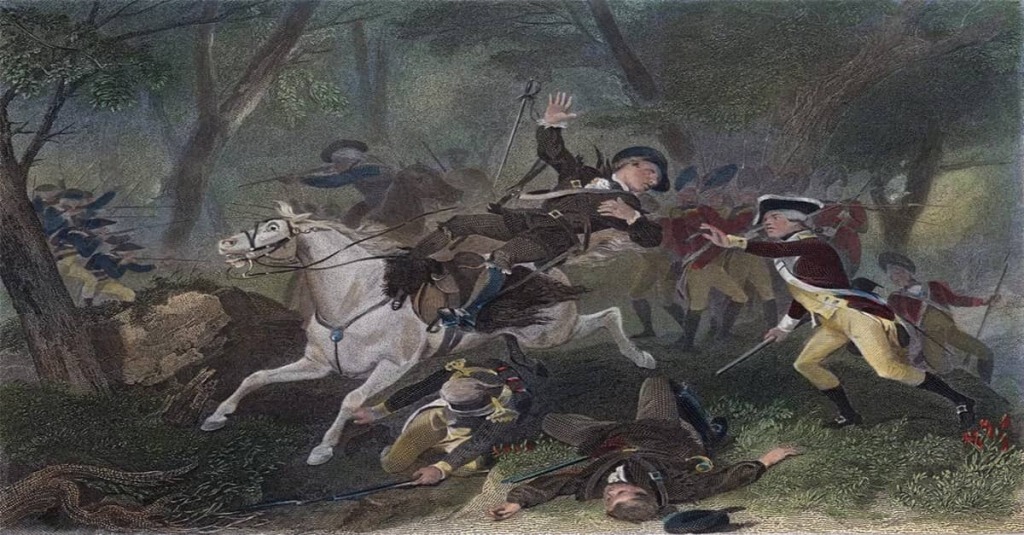
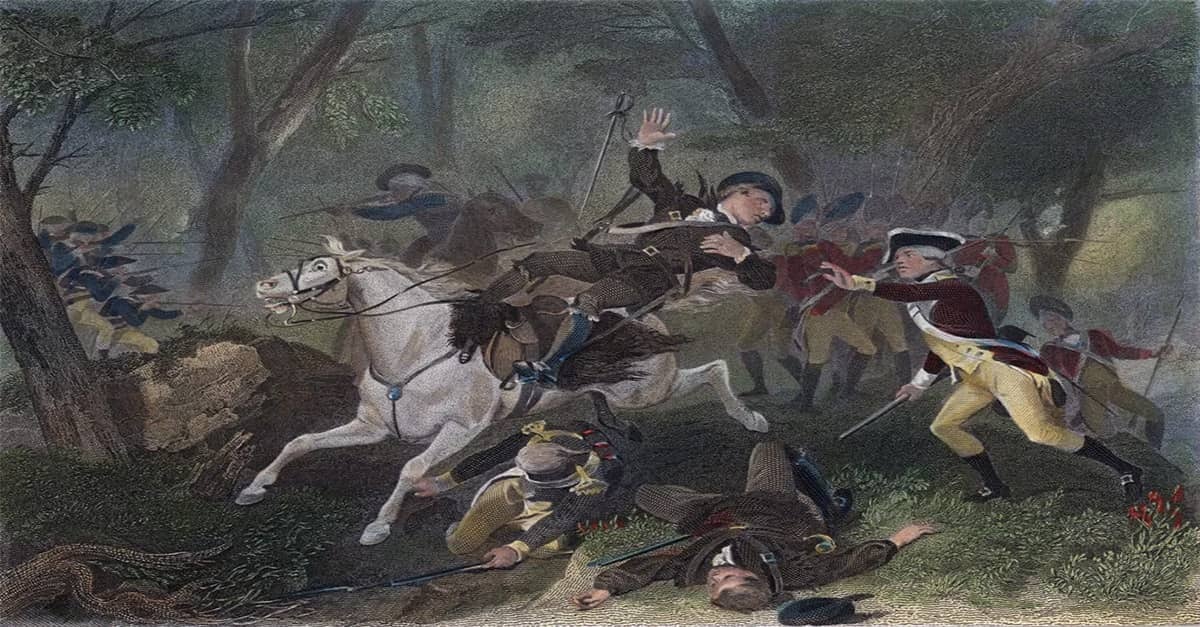
Ferguson, the only non-American present, rode the battlefield atop his horse, trying to keep control of the smoke-filled chaos. He was eventually shot while trying to escape, with his own horse dragging his body away. His second-in-command, Capt. J.W. Depeyster, immediately raised a white flag. Some Patriots, recalling Waxhaws, continued firing amid cries of “Remember Buford’s Quarter” until officers restored control. The fighting ended in roughly an hour.
Casualties were heavily lopsided. The Patriots had less than 100 casualties, with 28 dead and 62 wounded. The British suffered roughly 290 killed, 163 wounded, and nearly 700 captured or missing. Ferguson was buried at the foot of the mountain under a pile of stones that remains today. Cornwallis abandoned Charlotte, his army eventually clashing with the Americans at Cowpens before heading for Virginia.
The Patriot victory revived morale across the colonies and demonstrated that British control of the backcountry was nothing more than an illusion. Combined with later American victories, the Battle of Kings Mountain helped push the war towards the final surrender at Yorktown. George Washington praised “the crude, spirited, hardy determined volunteers who crossed the mountains” as proof of the country’s spirit and resourcefulness.
The Lessons of the Past for Today’s Battles
I grew up not far from where this battle took place, just over the border in the North Carolina town that shares its name. I have walked the trails, seen the monuments, and learned a lesson that all Americans should heed: Kings Mountain was not just another clash of professional armies. It was a victory of exceptional Americans, citizen-soldiers defending their homes against an invading force and its local allies. Several lessons stand out for us today.
Courage in the face of intimidation: Ferguson’s threat was calculated, meant to produce fear and submission from a seemingly inferior force. The Overmountain Men answered by marching straight to him. In an age when cultural and institutional pressure often rewards silence or accommodation, the battle reminds us that bold, collective refusal can reverse momentum. As Daniel Schmid noted in his reflections on American exceptionalism and the 250th anniversary, the Republic’s long endurance has always depended on people willing to act, even in the face of incredible odds.
Decentralized initiative and individual excellence: The order to “be your own officer” rewarded competence, local knowledge, and marksmanship over a pure, rigid hierarchy. Frontiersmen who lived by hunting and tracking applied those skills with devastating results against a force that expected conventional tactics. Today, we see modern institutions try to control individuals through centralized rules and restrictions. Kings Mountain shows the power of capable people exercising judgment under a clear shared purpose.
Love of place and people as the foundation of ordered liberty: The men who fought at Kings Mountain did not fight primarily for an abstract theory. They did not give their lives for a proposition or idea. They fought because an enemy had threatened to hang their leaders and burn their homes. The same attachment to home, family, and ordered liberty that animated them still undergirds the American experiment today. These Patriots were Christian men, driven by the same inescapable Christian influence that inspired the founding of the nation they loved. They are heroes to be revered by the modern American, demonstrating that the founding generation’s courage was not accidental. It was formed by faith, character, and a conviction that liberty is worth defending.
The Overmountain Men were exceptional in the literal sense: a distinctively American type of self-reliant citizen, formed by the frontier, who could reverse the course of a war in an afternoon. Their story is not just nostalgic; it is evidence that ordinary free men, when provoked and properly motivated, are capable of extraordinary results.
Remembering What Matters
Kings Mountain has long been forgotten by most outside of locals and a handful of historians, exactly as Hoover observed. That obscurity is itself a warning. A people that has forgotten the concrete acts of courage and competence that secured its own freedom and independence is poorly equipped to defend it now. The men who crossed the mountains in October of 1780 did not wait for a perfect plan or a guarantee of success. They rallied, moved, fought, and won.
Modern Americans face different threats within the culture, institutions, and political arena, but the underlying requirements for combating them have not changed: courage under pressure, competence that does not require constant permission, and a willingness to defend the places and principles that make ordered liberty possible. The Overmountain Men turned the tide once. Their example remains available to those willing to study it, learn, and act accordingly.
If you like this article and other content that helps you apply a biblical worldview to today’s politics and culture, consider making a donation here.