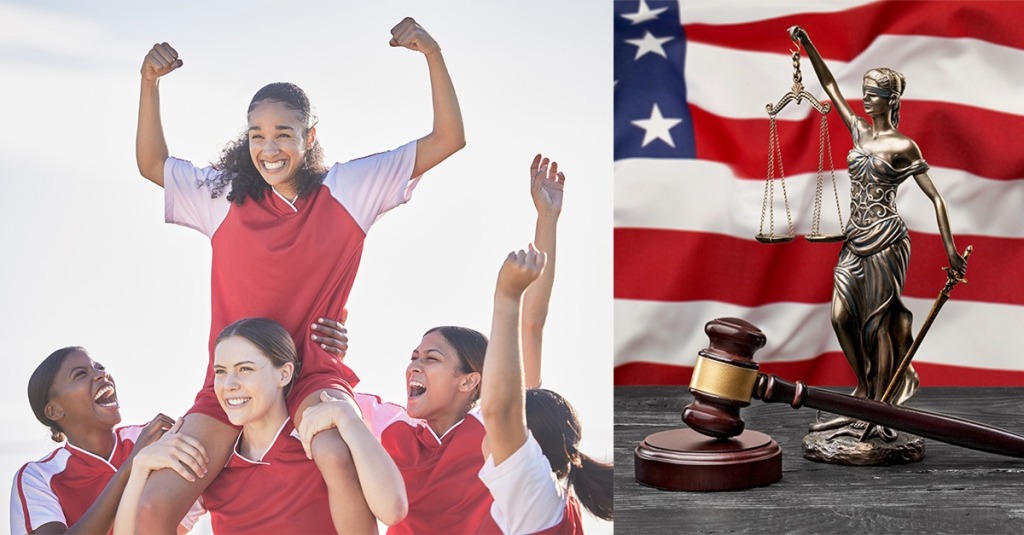
In a 6-3 decision, the justices ruled that under Title IX and the 14th Amendment states have the right and the responsibility to maintain sports teams according to biological sex, not gender identity.
[UPDATE] In a massive win for women’s rights, fairness, and common sense, the Supreme Court ruled in a 6-3 decision that states have the right to separate sports teams based on biological sex and to bar all males — even those who claim to be women and have taken puberty blockers, female hormones, and testosterone suppressants — from women’s sports.
In ruling on this case, which combined challenges to both West Virginia’s Save Women’s Sports Act and Idaho’s Fairness in Women’s Sports Act, the Court finally answered the question of whether schools under Title IX and the Equal Protection Clause of the Fourteenth Amendment can maintain women’s and girls’ sports for biological females.
West Virginia’s law was challenged by B.P.J., a male who identifies as female, and his family. B.P.J. started identifying as female in third grade and began taking puberty blockers. In sixth grade, he started taking cross-sex hormones.
A U.S. district court ruled in favor of West Virginia, but a panel of judges from the U.S. Court of Appeals for the Fourth Circuit ruled that the state had discriminated against “transgender girls” and blocked the law. B.P.J. has since been permitted to compete in girls’ sports since and even won a state championship in shotput.
Idaho’s law was challenged by a male who wanted to compete on the women’s track and field team at Boise State University. A U.S. district court granted him an injunction and the U.S. Court of Appeals for the Ninth Circuit upheld that injunction, claiming Idaho’s law violated the Equal Protection Clause.
However, the majority for the Supreme Court vehemently disagreed with the appellate courts’ reasoning. Justice Brett Kavanaugh, writing for the majority, explained that Title IX was written with sex, not gender identity in mind.
“Title IX prohibits discrimination on the basis of sex. Title IX’s implementing regulations expressly permit schools to maintain separate teams for ‘members of each sex.’ The term ‘sex’ in the 1972 Title IX statute, the 1974 Javits Amendment, and the 1975 Title IX regulations cannot plausibly be interpreted to refer to anything other than biological sex. The ordinary meaning of the term ‘sex’ at the time of enactment in the early 1970s was biological sex and not gender identity, particularly in the sports context.”
The Court reasoned that under Title IX states have both the right and the responsibility to provide sex-segregated sports teams based on biological sex, not on a case-by-case basis of a male’s athletic prowess or at what age they began taking puberty blockers and cross-sex hormones. Throughout the majority opinion, Kavanaugh noted both the safety hazards and the loss of opportunity women experience when forced to compete against males.
The Court also rejected the plaintiff’s Equal Protection Clause arguments, explaining that in the context of sports it is permissible for a state to discriminate on the basis of sex as a category rather than make determinations on an individual basis.
According to the Court, it is the legislature that is more qualified to create any exemptions to such class-based rules, not the judiciary.
Kavanaugh postulated that if judges carved out exemptions for female-identifying male athletes who claim not to have a physical advantage over female athletes, wouldn’t “exemptions also be required for biological males who still identify as male but contend that they, too, are no taller, no stronger, no faster than the typical females in their chosen sport?”
He continued, “Would those males also be entitled to play on a women’s or girls’ team? If not, why not? We need not belabor the point. In the sports context, starting down the road of judicially managed individualized exemptions based on physical capabilities of individual athletes could fundamentally undermine women’s and girls’ sports—especially if the number of biological males who seek to play women’s and girls’ sports increases significantly over time. The questions would be endless (and bitter) and yield few, if any, principled answers. The Equal Protection Clause and this Court’s precedents do not require such a judicial quagmire.”
The Court noted on several occasions that 27 states, the International Olympic Committee, the U.S. Olympic and Paralympic Committee, and the NCAA have all adopted rules banning men from women’s sports, and amidst the debate over what advantages males who take puberty blockers and testosterone suppressants might possess, it would be improper for courts to interject themselves into such decisions.
Interestingly, the courts three liberal justices, Sonia Sotomayor, Elena Kagan, and Ketanji Brown Jackson, all agreed that the West Virginia law does not violate Title IX but also argued vehemently that the Equal Protection Clause protected the right of men claiming to be women to compete in women’s sports.
The written opinions delved into the larger debate that has been raging throughout society for more than a decade now: Can men and women actually change their sex?
Sotomayor, who wrote the dissent, said the Court had made it such that “West Virginia, and any other state actor, can deny B. P. J. and others like her” the benefits of playing sports “simply because it thinks they have an inherent athletic advantage, even if the facts show that they do not.” She accused the Court of “contorted logic” and being “unencumbered by fact or law,” even though, in this case, B.P.J. had utterly dominated the women’s competition, defeating 470 girls over 1,400 times.
Justice Thomas in a concurring opinion answered the larger societal question with an unequivocal statement: “Men and boys with gender dysphoria are not women or girls, even if they believe that they are. Sex is an immutable “biological” characteristic.” Drawing from Josef Pieper’s Abuse of Language, Abuse of Power, he also countered Sotomayor’s accusations against the Court while seemingly calling out her insistence on using female pronouns to discuss the male plaintiff. “To use language to obscure reality—to show ‘indifference regarding the truth’—is to lie to the public and cease to treat our fellow citizens ‘as equal[s].’”
To Sotomayor’s question of what harm results from permitting male athletes in women’s sports, Justice Kavanaugh, who previously coached his daughters’ middle school basketball team, wrote poignantly about the impact girls and women experience when forced to endure unfair contests. Sports, he noted, are “highly competitive and generally zero sum,” such that one additional male player can be the difference between winning and losing, between making the roster and not, between going to college on an athletic scholarship or not going at all. He explained,
“Women and girls who play sports care deeply about all of those things. They obsess about them. They spend extraordinary time and effort to train in the heat and in the cold, to work out early in the morning and late at night, to get a little faster, to become a little stronger, to jump a little higher, to shoot a little better, to watch a little more video, to make the lonely journey back from an ACL tear, to scrap for playing time, to start, to win the game, to win a championship, to hang a banner, to bring home a medal, to be all-tournament, all-county, all-State, or all-American. They put a championship trophy or all-league award on their bedroom shelf—and it stays there forever as a reminder of their love of the game and pride in their achievements.
They learn to endure losses with grace, to lift up their teammates, and to respect opponents who have beaten them fairly and squarely. They learn to win with class—to look a defeated opponent in the eye, shake her hand, and congratulate her on her effort. Whether the star of the team or the last player on the bench, they form lifelong friendships and lifetime memories. They savor their athletic accomplishments and cherish them for years, even decades, after their playing days are over.
The two States here—along with 25 other States, the IOC, the USOPC, and the NCAA—have concluded at this time that women and girls should be allowed to compete for those life-changing opportunities on an equal playing field, without fear of physical injury from biological males or being forced to compete against biological males. Consistent with Title IX and the Equal Protection Clause, we hold that the States may maintain women’s and girls’ sports for biological females. They may determine eligibility for women’s and girls’ sports based on biological sex. The Constitution and Title IX do not require an overhaul of women’s and girls’ sports throughout America.”
Kristen Waggoner, CEO, president, and chief counsel for Alliance Defending Freedom (ADF), which has brought numerous suits on behalf of female athletes forced to compete against men claiming to be women, celebrated the ruling, calling it “a win for biological reality” that will now empower states across the country to enact and enforce similar laws protecting female athletes.
“This is a victory for every girl who refused to stay quiet in the face of injustice,” she stated, noting that the male plaintiff in the West Virginia case not only dominated the female competition but had also been accused of sexually harassing ADF client Adaleia Cross in the locker room. “Policies that ignore biological truth hurt people…After today’s decision, the 23 states still on the sidelines have run out of excuses. Protect women’s sports. Our girls have waited long enough.”
ORIGINAL ARTICLE
Will the Supreme Court Save Women’s Sports?
{Published on January 13, 2026} The State of West Virginia v. B.P.J., a landmark case that will determine whether states can protect women’s sports from biological males is being heard today at the Supreme Court in the opening oral arguments. The case centers on West Virginia’s “Save Women’s Sports Bill,” which requires student athletes to compete in sports matching their biological sex.
A biological male student challenged the law seeking to compete on girls’ track teams. Lower courts blocked the law, but the Supreme Court will now decide whether states have the constitutional authority to maintain sex-separated sports.
The stakes are enormous. This case affects athletic programs across all 50 states, impacting millions of female athletes from elementary school age all they way up to college. It will determine whether biological reality or gender ideology shapes American sports policy. Make no mistake: This isn’t just about athletics. It’s about whether our nation will recognize fundamental biological truths or surrender to ideology that denies reality itself. So how should Christians think about this? Consider these three points:
First, we must recognize what has been true since creation: There are only two biological sexes.
Scripture is clear. “God created man in His own image, in the image of God He created him; male and female He created them” (Genesis 1:27). This isn’t religious preference, it is biological fact, written into every cell of our bodies. Every human being is either male or female, determined at conception by chromosomes. No amount of hormone therapy, surgical intervention, or ideological assertion can change this fundamental reality.
Gender is not a social construct. Male and female represent distinct biological categories with real, measurable differences — differences that matter tremendously in athletic competition. As Christians, we cannot compromise on this truth. When we deny the reality of male and female, we’re rejecting God’s creative design.
Second, transgender ideology in sports causes real harm to women and children.
Natural anatomical differences between males and females create insurmountable advantages in athletic competition. Males have larger hearts and lungs, greater muscle mass, denser bones, and higher testosterone — these are advantages that begin at puberty and persist throughout life. Sports medicine research shows that even after testosterone suppression, biological males retain 80 to 90 percent of their physical advantages over females.
We’ve seen this at the Olympic level. At the 2024 Paris Games, Italian boxer Angela Carini abandoned her match against biological male Imane Khelif after 46 seconds, saying she’d never been hit so hard. She left in tears, withdrawing for her own safety. Both Khelif and Taiwan’s Lin Yu-Ting — biological males who failed gender eligibility tests — competed in women’s boxing and won gold medals.
This isn’t just about lost medals. When biological males compete against females in contact sports, women get injured. Female athletes who’ve trained their entire lives are displaced by biological males with inherent advantages. Girls are forced to change in locker rooms with biological males, violating their privacy and safety. When we tell young girls their safety matters less than someone else’s feelings, we teach them their dignity is negotiable. That’s not compassion. That’s cruelty.
Third, protecting women’s sports is not partisan: It’s an issue where most Americans agree.
Polling consistently shows overwhelming support for keeping women’s sports for biological females. A 2024 Gallup poll found that 69 percent of Americans oppose allowing transgender athletes to compete based on gender identity rather than biological sex. That includes majorities of Democrats, Independents, and Republicans. This isn’t manufactured culture war. This is common sense shared across the political spectrum.
Even many who support other transgender policies draw the line at women’s sports. They recognize fairness in athletics requires sex-separated categories. They understand women fought for decades to secure equal opportunities through Title IX, and those opportunities are now threatened.
President Trump understood this. His Executive Order 14201, “Keeping Men Out of Women’s Sports,” directed federal agencies to protect female athletics. His leadership created pressure that forced international bodies like the International Olympic Committee to finally act.
This Supreme Court case represents a critical moment. If the Court upholds West Virginia’s law, it affirms that states can protect women’s sports based on biological reality. If it strikes down the law, it forces every state to allow biological males intp women’s athletics — regardless of what citizens want or what science says.
So, what should we do? Christians must speak the truth with courage. We cannot be silent while women and girls are harmed.
Support organizations like Alliance Defending Freedom fighting these battles in court. Pray for the justices hearing this case, that they would have wisdom to rule justly. Teach the next generation that truth matters, that reality is not negotiable, that God’s design for male and female is good, and that protecting women isn’t hatred but love.
Jesus said: “You will know the truth, and the truth will set you free” (John 8:32). The truth is God created us male and female. The truth is women deserve fair competition and safe spaces. The truth is love requires us to speak clearly — even when culture demands silence.
This is our moment. God has placed us here for such a time as this. Pray for this case. Support those fighting for women’s sports. And speak the truth — without apology, without fear, and without compromise. Women’s sports are worth defending. And by God’s grace, we will defend them.
This article is a lightly edited transcript of the “Here’s the Point” podcast by Ryan Helfenbein, executive director of the Standing for Freedom Center.
If you like this article and other content that helps you apply a biblical worldview to today’s politics and culture, consider making a donation here.