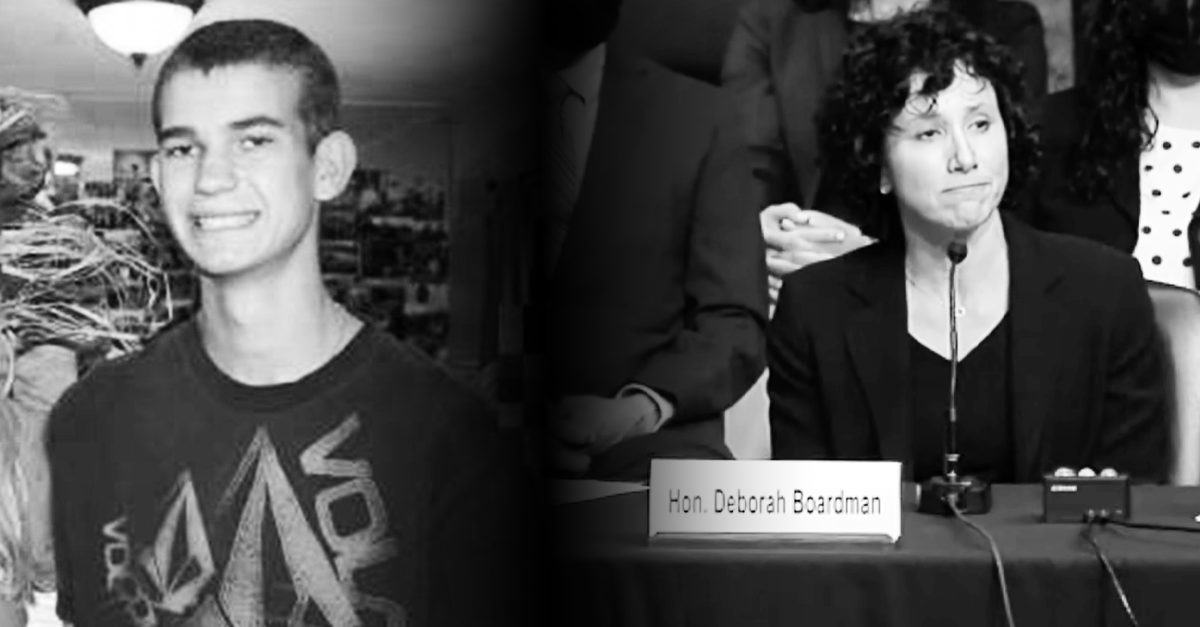
In sentencing a would-be killer of a Supreme Court justice to minimal prison time, Judge Deborah Boardman exchanged discernment for ideology, put her colleagues at even greater risk, and betrayed her duty to render fair and impartial justice.
A U.S. district court judge’s decision to impose a very light punishment on a man who took steps to try and kill a sitting Supreme Court justice in his family home is yet another instance of judicial activism — but this one could go a long way towards destroying the already disintegrating foundations of the judicial branch.
Earlier this month, Judge Deborah Boardman sentenced Nicholas John Roske to an eight-year prison sentence for his planned assassination of Supreme Court Justice Brett Kavanaugh in June 2022. Roske could now be released in as little as four years for good behavior.
The sentence is remarkable considering that federal sentencing guidelines, and the request from the Department of Justice (DOJ), called for Roske to get 30 years to life in prison.
The crime began in early May 2022 after Politico published the leaked draft opinion of the Supreme Court’s ruling in Dobbs v. Jackson showing that the Court would likely overturn Roe v. Wade. Roske — who had previously been placed under psychiatric evaluation for fantasizing about knifing his sister — was furious when he heard about the leak. He decided to do something about it and began researching methods for how to kill up to three conservative Supreme Court justices.
His planning, which you can read about in sentencing documents, was meticulous. Roske studied everything from the anatomy of the human neck to how to assassinate someone from long-range to U.S. extradition agreements. He used media reports and Google maps to locate Kavanaugh’s home.
Roske planned his crime so carefully that he was able to buy a trove of weapons and tools, get them through an airport, and arrive at Kavanaugh’s address on the evening of June 8.
There was one problem he hadn’t anticipated, however: Threats against the justices following the leaked opinion had resulted in U.S. Marshals being stationed outside Kavanaugh’s residence.
When Roske saw the law enforcement officers, he walked further down the street. While he was trying to decide what to do, his sister called. At that point, he dialed 911 and turned himself into police.
Roske’s messages with friends showed that he intended to use assassination to change the balance of the Court in the left’s favor, potentially for decades.
And adding to the seriousness of the charges was that a later threat against the justices invoked Roske’s name, proving that his plan had inspired further potential terrorism.
But it wasn’t these facts that influenced Boardman’s decision to let Roske get off easy.
In September, just a few short weeks before sentencing, Roske’s defense attorneys informed the court that he now goes by the name “Sophie” and is transgender.
That was the moment that the defendant became the victim.
Boardman, tipping her ideological sympathies, went out of her way to honor Roske’s request and also communicate her disgust President Donald Trump’s policy of housing prisoners according to their biological sex rather than gender identity.
“Let’s not hide the fact that President Trump issued an executive order saying transgender inmates would be assigned to prisons with their biological sex,” she said at a hearing.
The prosecution noted that an injunction from another activist judge had halted enforcement of much of that order and that transgender inmates are currently still able to receive hormone treatments while in prison.
When sentencing Roske, Boardman stated, “With the injunction in place, Ms. Roske could receive gender affirming care, but if that injunction goes away, she could be denied it. So when I sentence her, I take into account that she is a transgender woman.”
Apparently, to Boardman’s thinking, timely provision of cross-sex hormone therapy and a short period of reflection are all that’s necessary to cure Roske of his homicidal ways.
“Any prison time is punishment for her. The length doesn’t need to be particularly long… unduly harsh conditions make a difference, too. She will be imprisoned in a male facility even though she is a transgender prisoner, pursuant to an executive order from the president. Before the executive order, that wasn’t the case,” Boardman stated.
Don’t overlook the absurdity: Boardman thinks that putting a man into a men’s prison qualifies as unduly harsh conditions.
“Ms. Roske came out to herself as transgender in 2020 but kept it secret. Ms. Roske’s sister came out as gay two years prior but Ms. Roske saw that their parents struggled to reconcile her sexuality with their religious beliefs. I am heartened that this terrible infraction has helped the Roske family… accept their daughter for who she is,” Boardman argued.
In this case, Boardman’s decision to apply leniency to a would-be judge killer is especially reckless since it comes at a time when violence and threats against judges are skyrocketing.
According to the U.S. Marshals Service, there were 926 threats against U.S. judges in 2015, but that number jumped to 4,511 in 2021, a more than 400 percent increase. In 2022, after the Dobbs leak, mobs of left-wing protesters were allowed to swarm outside the homes of Supreme Court justices in an attempt to harass and intimidate them, even going so far as to show up at the Catholic school attended by the children of Justice Amy Coney Barrett.
Those threats are taking their toll. A survey in 2024 revealed that 82.7 percent of judges agreed that they worry for their safety due to their role as a judge.
And it’s certainly not all in their heads. In 2024, there were 1,090 possible or actual situations that disrupted judicial proceedings or required heightened security.
It seems that Boardman’s light sentence may already have had an effect. Just days after Roske’s sentencing, police arrested a radical leftist outside of St. Matthew the Apostle’s Cathedral in Washington, D.C., before its annual Red Mass, which the Supreme Court justices are known to attend.
Louis Geri, 41, had 200 explosives and a manifesto recording his hatred for Supreme Court justices, the Catholic Church, Jews, ICE agents, and more.
But it isn’t just the safety of Supreme Court justices that’s at stake — it’s the pillars of the institution itself.
When the framers of the U.S. Constitution were creating our system of government their grand experiment was shaped in part as a response to injustices committed by both the current British government and centuries of abuses by European powers.
One of their primary concerns was a fair and impartial judiciary, something lacking in Great Britain, where judges were reliant on the king for their station and Parliament for their salary.
That’s why the Founding Fathers put such an emphasis on a separate branch of the judiciary and why Alexander Hamilton and others pushed for lifetime appointments for judges. This would give them the security and the freedom to be non-political and impartial.
As the framers saw it, the entirety of the American system of government would rest on having an impartial judicial branch that would provide justice in civil and criminal cases and protect against the encroachment of the Executive and Legislative branches on citizens’ liberties.
A judicial branch made up of apolitical, wise, and principled judges would underpin the entire system, according to John Adams. “The dignity and stability of government in all its branches, the morals of the people, and every blessing of society depend so much upon an upright and skillful administration of justice,” he explained.
In order to ensure impartial judges, Hamilton wrote in Federalist No. 78, “[Judges] should be bound down by strict rules and precedents, which serve to define and point out their duty in every particular case that comes before them.”
Boardman herself pointed to this truth during the Roske sentencing arguments.
When the defense in this case stated that “What makes this case unique is not that Ms. Roske tried to kill a political figure, it’s that she stopped and turned herself in,” Boardman responded by insisting, “Judges are not political!”
Neutrality and the pursuit of truth and justice is understood to be the very bedrock of the office of a judge.
In Deuteronomy 16:18-20 God told Israel to appoint judges who “‘shall judge the people with righteous judgment. You shall not distort justice; you shall not be partial, and you shall not take a bribe, for a bribe blinds the eyes of the wise and perverts the words of the righteous. Justice, and only justice, you shall pursue, that you may live and possess the land which the Lord your God is giving you.”
Partiality in a judge has always been detested as unjust, even corrupt.
But that has changed in recent years as ideological bias in the form of “compassion” has invaded the bench.
And perhaps no issue reflects the ideological bias of left-leaning judges quite like the transgender movement.
In case after case, judges that utilize and embrace the transgender movement’s language and logic routinely rule in favor of the pro-transgender party.
Boardman herself ruled in the case of Mahmoud v. Taylor that religious parents do not have the right to opt their young children out of sexually explicit lessons at a public school that wants to instill LGBTQ orthodoxy. Boardman argued that the school had a vital interest in fostering LGBTQ acceptance.
The Supreme Court rightly reversed that ruling.
Such extra-legal rulings shouldn’t be acceptable. Whether judges that rule according to their ideological beliefs realize it or not, they are eroding the foundations of their office.
The judicial branch’s power exists solely on public trust and its credibility. And polling shows that public trust in the judiciary is cratering.
Part of that is because the public now believes that judges are no longer impartial but deeply political figures who use their power to pick winners and losers.
And more and more that’s not just perception but reality.
Boardman should have never given Roske a light sentence just because his defense team claimed he was transgender. That’s unequal treatment under the law.
But just as importantly, she should not have allowed herself to be guided by her own feelings rather than the facts of the case and the law.
Boardman had the opportunity to send a clear message that the U.S. government will not tolerate political violence; instead she tacitly endorsed future political violence against other judges who don’t rule the way someone else wants them to.
And in so doing, she didn’t just put her colleagues, and even herself, at greater risk — she undermined the entire judicial system.
When a judge trades truth and discernment for ideology, she doesn’t render justice, she invites judgment. Boardman’s decision was more than a legal error. It was a moral collapse. Justice was meant to be blind, not woke. The moment our courts begin to see through the lens of ideology, they stop defending truth and start enforcing lies.
When the gavel falls without righteousness behind it, it doesn’t bring order. It only brings chaos and destruction.
If you like this article and other content that helps you apply a biblical worldview to today’s politics and culture, consider making a donation here.