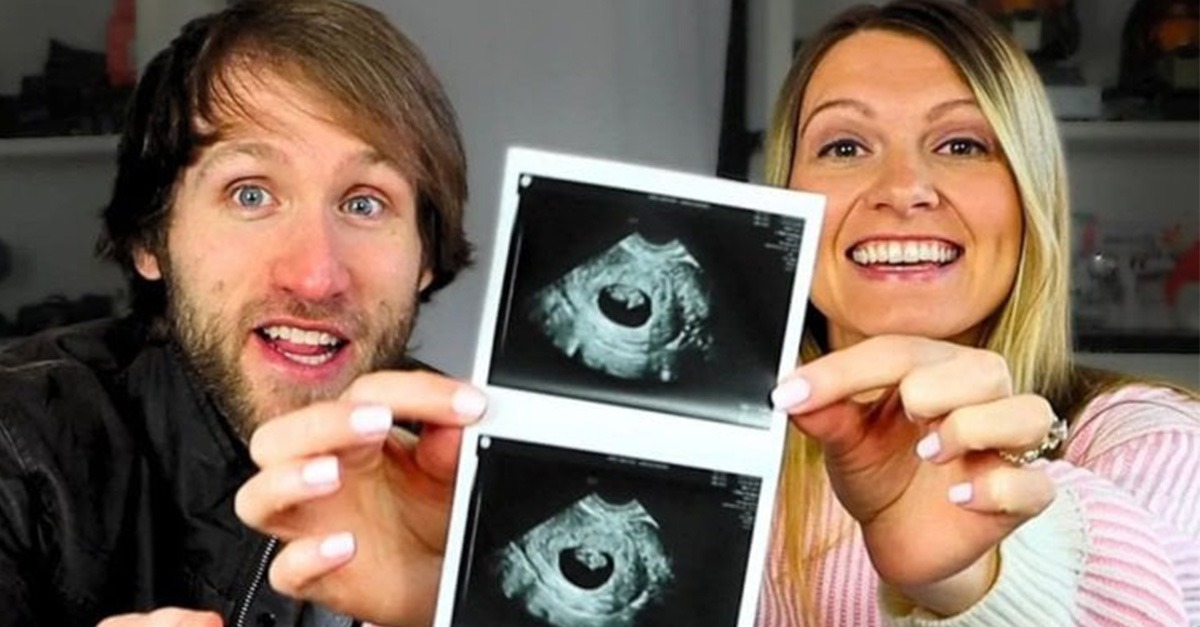
YouTuber Jesse Ridgway and his wife, Ashley, announced that they had aborted their unborn son after a Down syndrome diagnosis. In doing so, they exposed how comfortable our secular culture has become with sorting God’s image-bearers into “fit” and “unfit” categories.
For more than a decade, YouTuber Jesse Ridgway, better known as @McJuggerNuggets, has earned his living by displaying his life to an audience. So, when he and his wife, Ashley, learned that the son she was carrying had tested positive for Trisomy 21, better known as Down syndrome, the couple did what their careers had trained them to do.
They filmed the moment and posted it — then told their millions of followers that they had ended their son’s life at 21 weeks’ gestation.
The announcement drew more than 17 million views on X and a torrent of condemnation. House Speaker Mike Johnson, R-La., called the act “the deliberate murder of their own precious child” and prayed for an end to “this evil.” The couple reported death threats and public comparisons to Hitler, and the controversy only grew louder from there.
When Grief Becomes Content
The first thing many onlookers asked was why anyone would broadcast something so intimate in the first place. The answer is that a man who has spent 20 years of his life online no longer finds privacy instinctive because the camera has long since taken its place. Fame of that sort runs on a steady supply of moments worth watching, and it slowly trains its subjects to perform even their grief.
An audience rewards the curated and the photogenic, and it just as quietly punishes the inconvenient. The Ridgways had already turned the pregnancy into content, including the gender reveal and prenatal testing, so when the diagnosis arrived, the unfolding sorrow was filmed and posted as well. When a family’s days are packaged and sold as a brand, a child who threatens the picture of a frictionless and admirable life begins to look less like a son and more like a stumbling block.
Look past the spectacle, though, and Jesse’s own explanation reveals something more troubling than mere cruelty. He wrote that he had been optimistic at first and had signed on to be a parent “come what may,” but he never grasped what the diagnosis would mean. He went scrolling online and found out that heart defects affect roughly half of these children and many of them face hearing and vision difficulties.
From there, he concluded that Down syndrome “isn’t a ‘blessing’” but “objectively” miserable for both the child and the family. He framed the whole decision as an act of compassion. The question he never thought to ask was, “Compassion for whom?” Certainly not the child whose life is about to be ended through the painful, horrifying reality of a second trimester dismemberment abortion.
The Sorting the World Refuses to Name
That single missing question turns out to be the heart of the matter. Even within the secular press, disability advocates objected, noting that Jesse’s grim prediction was hyperbolic and incomplete and that the medical establishment too often frames the diagnosis in the worst possible light.
The fuller truth is that most of Down syndrome’s associated conditions are treatable and that people with the syndrome lead meaningful, connected, and happy lives. The deeper irony is that disability advocacy often makes its peace with abortion as a right, raising its voice only when the child marked for death carries the very condition it exists to defend. Without quite intending to, those advocates were testifying against the pipeline that produced the Ridgways’ choice — a system built to render its verdict before the child has drawn a single breath.
It is tempting to reduce a decision like this to plain selfishness, but beneath the cold calculus of inconvenience sits a quieter fear: the dread of a life that will not turn out the way it was supposed to. The culture no longer even demands a high-achieving child, only a normal one who will not complicate the household or fall short of the perfect family the parents imagine, and a child with visible limitations threatens that expectation in full public view. Embarrassment and inconvenience are not separate motives, because each one treats the child as a reflection of his parents rather than as a person whose worth is his alone.
Jesse insisted that his post exploded only because “nobody talks about it,” and on that narrow point, he spoke more truth than he realized. Roughly two-thirds of American women who receive a prenatal Down syndrome diagnosis go on to end the pregnancy. In France, the figure climbs to 77 percent, and in Denmark it reaches 98 percent.
In Iceland, where most expectant mothers accept the free screening, nearly every positive result ends in abortion, so that the entire nation now welcomes only a child or two with the condition each year. A prominent geneticist there unflinchingly described the outcome as the near-eradication of Down syndrome from his society.
There is an old and ugly word for deciding which human beings are fit to live: eugenics. Yes, eugenics, the elite, scientific ideology practiced by the Nazis, who killed millions of those deemed “unworthy of life,” and advanced by Planned Parenthood founder Margaret Sanger, who described the “unfit” as “human weeds.”
In the modern world, its practitioners aren’t quite so menacing or candid. They wear white coats and speak in gentle, therapeutic tones about safe “reproductive options” that are “medically validated” while carefully reassuring parents that they will be able to “try again.”
The Source of Human Worth
Strip away the clinical vocabulary, and a single question stands exposed in the open: Where does a person’s worth actually originate? The secular culture the Ridgways inhabit believes that worth is something earned, a worth that rises and falls with a child’s projected health and the demands he will place on everyone around him.
By that accounting, a prenatal diagnosis becomes a condemnation; a child who will need too much of his parents’ time, energy, and resources is quietly recast as a child that’s not worth having. The fatal problem is that such a scale has no floor beneath it anywhere. Once usefulness is allowed to set the value of a human life, every life takes its place in the line to be appraised, and the only question is: Which ones are worth the price?
Scripture rejects that scale from top to bottom. It grounds the worth of a human being not in what he can accomplish but in whose image he bears, a dignity stamped upon him before he has done a single thing to earn it. When Moses pleaded his own weakness before the Lord in Exodus 4, God answered with a series of questions that still unsettles every quality-of-life calculation:
“Who has made man’s mouth? Who makes him mute, or deaf, or seeing, or blind? Is it not I, the Lord?”
The very conditions our medicine now treats as grounds for elimination are claimed by their Maker as His own deliberate handiwork. Jesus pressed the truth even harder when His disciples assumed that a man born blind must have been the consequence for either his own sin or that of his parents. It was neither, Jesus explained, but an occasion for the works of God to be put on open display (John 9:1-3). The child knit together in secret is already fully known by the One who formed him (Psalm 139:13-16), long before any laboratory can tempt a society to sort him as either “fit” or “unfit.”
This is why the fashionable language of compassion rings false the instant you trace where it really flows. In story after story, the sympathy pours toward the suffering of the able-bodied parents, while the one party never granted standing as a person is the very child whose life is hanging in the balance. Authentic mercy runs in precisely the opposite direction.
It looks like a crippled prince named Mephibosheth, lame in both feet and certain he was worthless, who was instead lifted up and given a permanent place at the king’s own table (2 Samuel 9). He brought nothing to that table but his need, and that was precisely the point. The people of God have always been the ones who set that kind of table, who carry the weak rather than cast them down, because they follow a King who first carried them when they could do nothing for themselves.
The same lie that culls the vulnerable at the dawn of life has also learned to greet them at its dusk. The growing campaign to normalize assisted suicide and euthanasia runs on an identical premise: that a life too dependent or too costly is a life better ended early. It is a single doctrine of human worth fitted with two different doors. Whether the appraisal is carried out in the womb or in the hospital, the underlying demand never really changes — the insistence that a person justify his continued existence by his usefulness or else surrender his claim to it.
The Church and the Image of God
Christians cannot meet this moment with outrage alone because outrage was already the loudest sound in the room this week, and it changed precisely nothing.
The Church is summoned to something far harder and far more lasting: to confess without apology that every human life bears the image of God from the moment of conception and then to live as though that confession is worth a genuine cost. In practice, that will mean welcoming the very families a watching world counsels to abort and walking patiently beside the parents who are afraid and struggling. It means honoring the people our age would rather see quietly disappear and refusing to let their worth be appraised by any human standard.
A remnant that lives this way will surely look like fools to a society that has trained itself to assess its children before it will agree to love them. It will also tell the truth, bearing witness to the One who came not to discard the weak but to die in their place. That self-giving love is the heart of the Gospel and the only ground for our hope.
Let us pray that God opens the eyes and hearts of Jesse and Ashley Ridgway, so they can learn that while real love always bears a cost, the rewards are infinitely greater.
When a culture looks at a vulnerable child and sees a burden, the Church must see the image of God, and America must remember that every life is created equal in dignity. Your tax-deductible gift helps the Standing for Freedom Center tell the stories our culture would rather silence, expose the lies that make human life negotiable, and equip believers to stand with courage for every child, every family, and every life entrusted to our care.