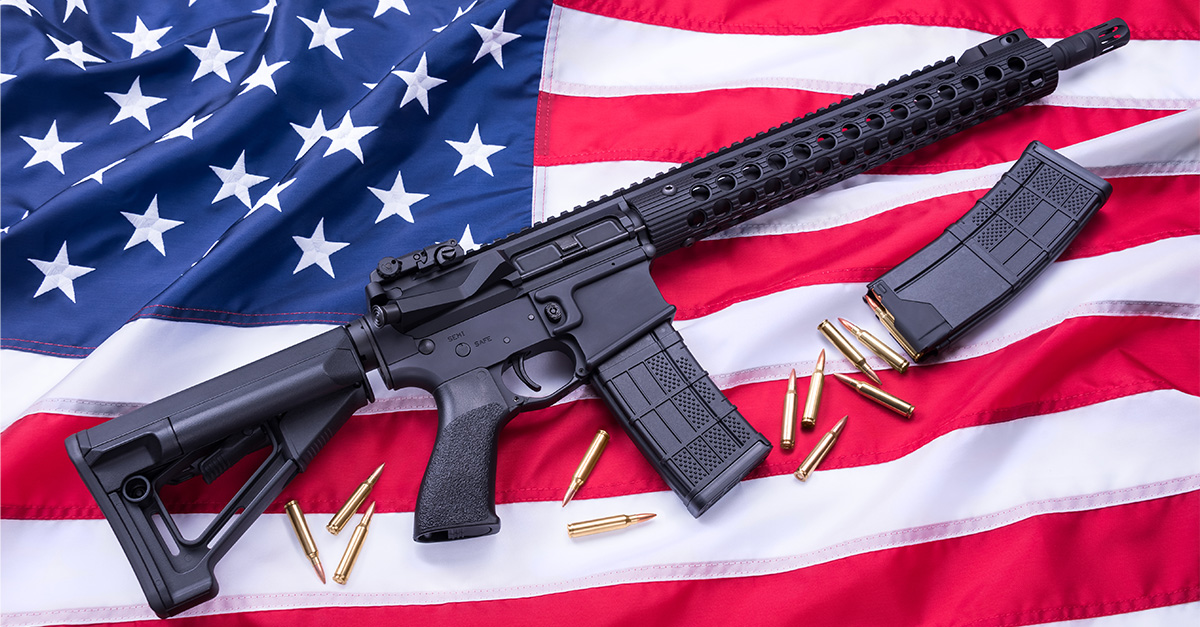
In a major Second Amendment victory, the en banc Third Circuit ruled that New Jersey cannot ban commonly owned semiautomatic rifles or magazines holding more than 10 rounds under the Supreme Court’s Bruen framework.
The Supreme Court’s landmark ruling in New York State Pistol & Rifle Association v. Bruen continues to reshape the legal landscape of gun rights. The 2022 case established a strict, two-part “text, history, and tradition” test for evaluating all Second Amendment challenges.
Based on that precedent, the U.S. Court of Appeals for the Third Circuit just reversed one of its own rulings, determining that New Jersey’s longstanding ban on so-called “assault firearms” and “large capacity magazines” is actually unconstitutional.
Violating Constitutional Rights Since 1990
New Jersey passed the Assault Firearm Provisions and the Large Capacity Magazine (LCM) Provisions in 1990, and as such, New Jersey residents have been living without their Second Amendment rights for nearly four decades.
The law banned what it defined as “assault firearms,” including AR15-style rifles and semiautomatic shotguns capable of holding more than six rounds of ammunition or that feature a pistol grip. At the time, the law banned all magazines capable of holding 15 or more rounds, defining them as LCMs; in 2018, the law was amended to prohibit magazines holding 10 or more rounds.
New Jersey supposedly has an option allowing certain citizens to receive a license to own a semiautomatic weapon; however, since 1990 no such license has been granted.
Individuals, as well as organizations like the Association of New Jersey Rifle and Pistol Clubs (ANJRPC), challenged the law in court. A district court quickly granted summary judgment in favor of New Jersey, and the ruling was then upheld by the Third Circuit in 2018.
Four years later, the Supreme Court issued the Bruen ruling, which said that for a state to justify a restriction on firearms it must demonstrate that the restriction is in keeping with the historical tradition of firearms regulation at the time of the founding of the country.
The Supreme Court instructed the Third Circuit to hear the case of ANJPRC v. Attorney General New Jersey again in light of the Bruen ruling, and last week, the Third Circuit reversed its decision.
A Return to Constitutional Sense
The Third Circuit determined that both assault weapons and LCMs are “arms” protected by the Second Amendment, as magazines are required to operate a firearm.
Pivotal in its ruling was that these weapons, as well as magazines capable of holding 10 or more rounds, are in “common use” in America. In Bruen the Supreme Court reaffirmed that the Second Amendment only protects the use of arms that are in common use by the public.
The Third Circuit noted that there are about 24 million AR-15s or similar weapons and over 100 million 30-round AR-15 magazines around the nation and that these weapons are used for lawful purposes such as self-defense, pest control, hunting, and sport shooting.
The court argued that because it is nearly impossible to get a license to own one of these firearms in New Jersey, the law is effectively a ban on constitutionally protected arms.
It also rejected New Jersey’s historical analogs of arms restriction, such as previous limitations on Bowie knives, as these weapons were not in common use for lawful purposes; what’s more, only one state, Georgia, had a ban on Bowie knives and that law was ruled unconstitutional.
Citing the most important Supreme Court cases regarding gun ownership, Bruen and the 2008 case of District of Columbia v. Heller, the Third Circuit wrote that both cases rejected bans on arms in common use for lawful purposes.
“Together, Heller and Bruen teach that bans or broad prohibitions on possessing or carrying of a class of weapons in common use for lawful purposes fail to find support in our Nation’s tradition of firearm regulation. That is so even when the regulations are passed with the intention of reducing gun violence.
That principle resolves our inquiry here. That is because the Supreme Court has already evaluated the historical analysis for the kind of regulation before us today: ‘a prohibition of an entire class of ‘arms’ that is overwhelmingly chosen by American society for [the] lawful purpose’ of self-defense. There is no historical support for such a measure.”
The court also dismissed the argument that there is a distinction between standard-capacity magazines and LCMs. It wrote that the Second Amendment says nothing to imply that the capacity of a magazine would impact whether it receives constitutional protection. Thus, the court ruled that both LCMs and assault weapons are protected under the Second Amendment.
The Third Circuit criticized some of the other appeals courts that have seized on the Supreme Court’s allowance for a “more nuanced approach” in certain cases without a historical analog to rule that similar restrictions do not violate the Constitution.
“As with the Assault Firearm Provisions, we need not employ a ‘nuanced approach’ to analogical reasoning about New Jersey’s LCM Provisions,” the court ruled. “Bans on weapons in common use for lawful purposes are unlawful. So are severe restrictions on weapons in common use for lawful purposes. However much nuance we might employ, we could not overcome the dearth of relevantly similar Founding-era restrictions.”
The Association of New Jersey Rifle and Pistol Clubs called the ruling a “stunning, long-awaited decision.”

The Long Road to Compliance
Few court rulings in American history have had as much impact on a constitutional right as Bruen.
And why? Did the High Court create a new right out of thin air, such as when it created the right to an abortion in Roe v. Wade? Did it mangle an amendment beyond recognition and stretch it to include virtually any behavior like has been done so often with the 14th Amendment? Did it act as Congress and rewrite a law like it did with the Affordable Care Act?
No. It simply said that states must adhere to the Constitution as originally designed.
Gun rights have been steadily denigrated for nearly 200 years, violating Americans’ right to keep and bear arms. But now, simply by upholding the text of the Second Amendment, the Supreme Court is having great impact.
The fight to protect Americans’ Second Amendment rights is hardly finished. The U.S. Supreme Court is set to hear consolidated challenges to assault weapons bans in Illinois and Connecticut later this year after both laws were upheld at the appellate level, in spite of the Bruen ruling. Meanwhile, New York continues to double down on its draconian restrictions and Virginia’s legislature passed a gun control package this year that, among 25 new laws, includes a near carbon copy of New Jersey’s now unconstitutional ban on AR-15s and large capacity magazines.
The Third Circuit is to be commended for changing its ruling in light of this reorientation to the Constitution. While other courts — including the Hawaii Supreme Court, the Oregon Court of Appeals, the First Circuit, the Second Circuit, and the Seventh Circuit U.S. Courts of Appeal — have chosen to defy or flat-out ignore Bruen, the Third Circuit followed it.
In reality, no court that truly follows this landmark decision, and by extension the Constitution, could possibly come away with any other ruling. Americans have the unalienable right to keep and bear arms. Period.
Freedom survives when ordinary Americans refuse to surrender the rights entrusted to them. Your gift helps the Standing for Freedom Center expose unconstitutional overreach, equip Christians with a biblical understanding of liberty, and inspire the next generation to stand courageously for their God-given rights. Give today and help keep the promise of freedom alive.