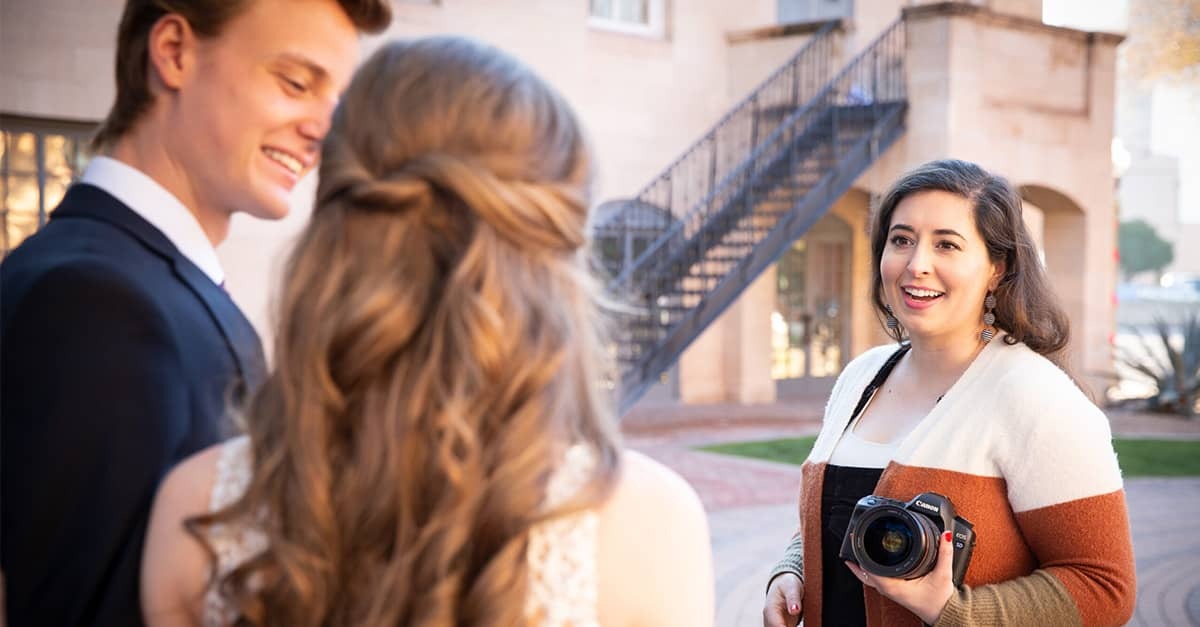
After a years-long court fight, Louisville agreed to pay $800,000 in attorney fees after photographer Chelsey Nelson won a constitutional challenge over a city ordinance that could compel her speech and penalize her Christian beliefs about marriage.
UPDATE (03/30/2026): A Christian photographer who objected to providing services for same-sex weddings has reached a settlement with the city of Louisville after years of litigation over a local nondiscrimination ordinance she said conflicted with her religious beliefs.
Under the agreement, Louisville will pay $800,000 in attorney fees to photographer Chelsey Nelson. The settlement was filed last week in the U.S. District Court for the Western District of Kentucky, Louisville Division, about six months after a federal court ruled in Nelson’s favor.
Nelson, who holds a religious belief that marriage is between one man and one woman, filed suit against the city in November 2019, arguing that the ordinance would require her to photograph same-sex weddings in violation of her convictions. She contended that the law violated the Free Speech and Free Exercise clauses of the First Amendment, as well as the Kentucky Religious Freedom Restoration Act. A federal judge ruled in her favor last fall.
The settlement was announced in a statement by Alliance Defending Freedom (ADF), Nelson’s legal representative.
“The government cannot force Americans to say things they don’t believe,” said ADF Senior Counsel Bryan Neihart. “For almost six years, Louisville officials tried to do just that by threatening to force Chelsey to promote views about marriage that violate her religious beliefs. Louisville’s threats contradicted bedrock First Amendment principles, which leave decisions about what to say with the people, not the government. This settlement should teach Louisville that violating the U.S. Constitution can be expensive.”
The case began several years ago. In 2022, a federal court barred Louisville from enforcing the ordinance against Nelson but declined to award nominal damages, prompting appeals from both sides to the 6th U.S. Circuit Court of Appeals.
While the case was pending, the U.S. Supreme Court ruled in 2023 in the case of 303 Creative v. Elenis that states may not use “expressive activity to compel speech.” The ruling became a key precedent in similar disputes and led the appeals court to send Nelson’s case back to the district court.
Two years later, the district court reaffirmed its earlier decision in Nelson’s favor and awarded nominal damages. With the settlement covering attorney fees and the damages issue now resolved, the legal dispute between Nelson and the city has concluded. ADF has described nominal damages as “a type of compensation that remedy past harm, prevent future misconduct, and vindicate constitutional freedoms.”
ORIGINAL STORY
Federal judge rules Louisville can’t force Christian photographer to shoot same-sex weddings against her religious beliefs
{Published on September 2, 2022} A U.S. District Court judge has sided with a Christian photographer who sued over a Louisville, Kentucky, ordinance that would have required her to photograph same-sex weddings and prevented her from posting a statement on her webpage expressing her religious beliefs.
Chelsey Nelson filed suit against the Louisville-Jefferson County Metro Government over its Fairness Ordinance, which would have required her to photograph same-sex weddings and make blog posts celebrating them, something she says violates her religious beliefs. Three years later, she received a ruling protecting her from Louisville’s ordinance.
Judge Benjamin Beaton ruled that Louisville’s ordinance violated Nelson’s First Amendment rights and issued an order prohibiting the city from enforcing it against her.
“This split is one result of the remarkable and rapid change in the legal treatment of same-sex relationships in this country,” he wrote. “In 2015 the Supreme Court interpreted the Constitution to require states to authorize same-sex marriages in Obergefell v. Hodges. Even before that decision, but especially since, the nation’s courts and lawmakers have struggled to reconcile the new legal orthodoxy with the dissenting views and voices of those whose religious faith leads them to maintain what was until recently the status quo.”
He noted that the Constitution protects speech in two ways: The government cannot censor Americans from expressing their views nor compel them to speak content they find objectionable. He explained, “So although Louisville may require restaurants and hotels and stores to provide services regardless of the proprietors’ views or their customers’ legal status, the government may not force singers or writers or photographers to articulate messages they don’t support.”
He specifically addressed the tension between free speech and anti-discrimination laws. “The City treats the equal status of same-sex marriages as fixed. As a matter of law, it is,” he explained. “But today’s dispute concerns whether the government may conform speech to that development. Under the First Amendment, it may not. The freedom of speech—especially for minority views—is a core premise of our democratic republic.”
Quoting West Virginia State Board of Education v. Barnette, Beaton wrote, “If there is any fixed star in our constitutional constellation, no official, high or petty, can prescribe what shall be orthodox in politics, nationalism, religion, or other matters of opinion or force citizens to confess by word or act their faith therein.”
He concluded: “The Supreme Court has continued to navigate by that star through changing currents of speech and conscience. And lower courts are bound to follow. Because the U.S. Constitution supersedes Louisville’s Fairness Ordinance as a matter of law, this Court enjoins the City from either compelling or suppressing Nelson’s photography and writing.”
Beaton stopped Louisville from enforcing the ordinance against Nelson because of her religious objections but did not block the ordinance.
Nelson celebrated the ruling, saying, “Now, I’m free to have statements on my website about the work that I’m able and willing to do and the messages that I can communicate. This is a win for every creative in the entire nation, whether or not they align with my beliefs or have very, very different views from what I believe in. We’re just excited to move forward.”
Alliance Defending Freedom (ADF) represented Nelson. ADF attorney Bryan Neihart said,
“Free speech is for everyone. No one should be forced to say something they don’t believe. We’re pleased the court agreed that the city violated Chelsey’s First Amendment rights. The court’s decision sends a clear and necessary message to every Kentuckian — and American — that each of us is free to speak and work according to our deeply held beliefs.”
Louisville Mayor Greg Fischer called the ruling “disappointing.”
“We are a city of compassion and we appreciate the many ways our LGBTQ+ family contributes to our diverse community,” he said. “Louisville Metro Government will continue to enforce to the fullest extent possible its ordinance prohibiting anti-discriminatory practices and will fight against discrimination in any form.”
The city will appeal the ruling.

This type of case has been on repeat for years now as Christian business owners have found themselves subject to laws that violate their religious beliefs. The reason is simple: The Supreme Court had the opportunity to resolve this issue and it did not. As Beaton noted,
“In Masterpiece Cakeshop v. Colorado Civil Rights Commission, the Supreme Court approached the question, but didn’t make it all the way down the aisle…It ruled narrowly that Colorado’s public-accommodations law couldn’t force a particular baker to supply a custom wedding cake for a same-sex ceremony because public officials investigating that baker expressed hostility toward his position and faith…But the Court didn’t resolve the underlying constitutional question regarding the tension between the First Amendment and Colorado’s public-accommodations law.”
The Court’s ruling, which found that Colorado acted with hostility towards baker Jack Phillips, didn’t even protect him from future persecution for his beliefs, and so he continues to find himself in court, most recently for refusing to bake a cake celebrating someone’s gender transition.
The Court now has an opportunity to rectify its mistake in 303 Creative v. Elenis, another ADF case that will be heard by the Supreme Court this fall. In that situation, Lorie Smith, a web designer, was prevented by the Colorado Civil Rights Commission from displaying a message on her own website explaining why she won’t create websites celebrating same-sex weddings.
Between anti-discrimination laws and the Constitution, the prevailing solution is obvious. Under the First Amendment, the government does not have the right to force a business owner to violate his or her religious beliefs by participating in an activity or expressing a view that goes against their religious faith.
It is hard to fathom that America now has laws requiring a person to create messages that violate their religious beliefs and prohibiting them from expressing their views regarding those messages. No person should be compelled to violate their beliefs. If a couple wants to have a same-sex wedding, they can use businesses that have no such religious convictions.
In the name of non-discrimination, governments are imposing harm on Americans by compelling speech and demanding that religious people violate their beliefs. Where is Louisville’s compassion for Nelson? The right to freedom of speech and freedom of religion are quintessential parts of America and must be protected.
For Christians, it is critical that we stand up for our religious convictions — and refuse to violate them no matter what the government says or does. We need only look at the Old Testament examples of Daniel and his three friends to see that God will bless this type of faithfulness and courage. Daniel continued to pray to God despite the fact that he was violating the king’s decree banning such worship and knowing that he would be thrown to the lions as a result (Daniel 6:10-28). His friends Shadrach, Meshach, and Abednego refused to bow before an image of the king, this time on pain of being thrown into a fiery furnace (Daniel 3:16-28). God saved all of them and, in so doing, showed that He reigns above men, including kings and their governments.
In America, we have been blessed with religious freedom, but as Americans become increasingly secular, the innate understanding and tolerance of religious practice and belief is quickly falling away. For this reason, it is critical for Christians to not only stand up for their faith, but also to boldly challenge unconstitutional laws.
In vigorously defending their own rights, Nelson, Smith, Phillips, and others are working to ensure that the ability to live, work, and worship according to one’s religious faith will remain a reality for others in America, now and in the future. Equally important, through their faith and courage, they might, like Daniel and his friends, lead others to know God’s grace and sovereignty.
If this reporting strengthened your understanding of religious liberty, free speech, and the Constitution, make a tax-deductible gift to the Standing for Freedom Center today. Your support helps defend the freedom of Americans to live, work, and speak according to biblical conviction.