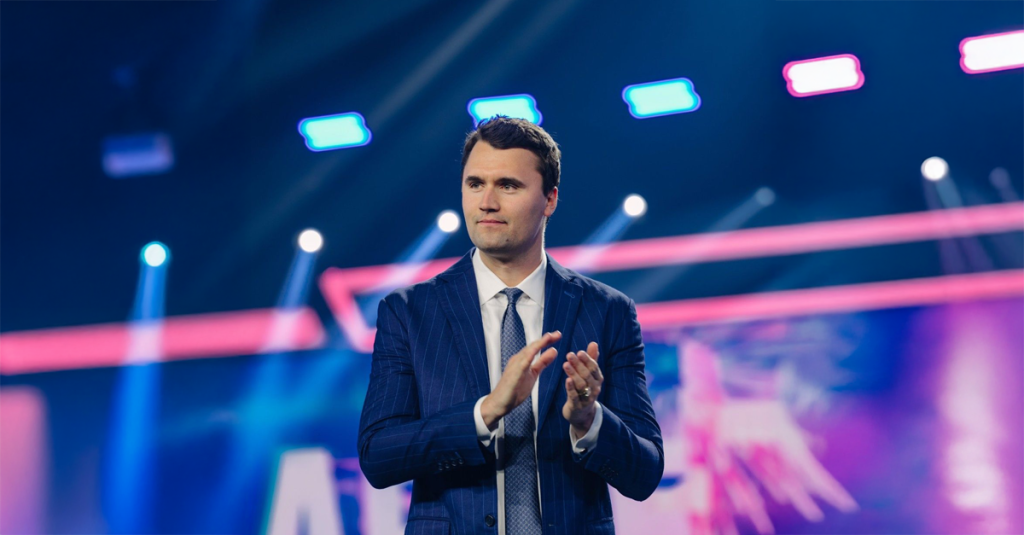
One year after Charlie Kirk’s assassination, his voice is missed, his coalition has split, and a generation of young men is deciding how to pick up the banner.
Somewhere this week, a 19-year-old will set up a folding table on a college campus quad because he watched Charlie Kirk do it.
This student will sit behind a sign that invites people to debate with him. He is prepared to get mocked, shouted down, and verbally attacked before lunch. What he may not know prior to setting up his platform is that Charlie did this for 13 years, or that the men (and women) who once stood on Charlie’s stage have spent the past 12 months at war with one another over what Charlie stood for.
He will only know that he saw Charlie do it without flinching, and that Charlie is dead, and that the table still needs to be set up.
I knew Charlie a little. I did not know him the way his staff or his pastor did, but I knew him well enough to have a sidewalk story. We had a few interactions over the years. The last time I saw Charlie, he was catching up to me as I walked outside a hotel in Florida. He had just finished speaking to a room of about 500 educators, and I had slipped out rather than crowd the line of people waiting for a handshake. I had too much respect for Charlie to step in the way of his admirers.
Then I heard it behind me: “Hey! Mr. Walker.” He remembered my name. He asked about my ministry and my writing, mentioned a piece I had written on Martin Luther King Jr., and said he wanted me on his show. People were gathering around us, and he was not rushed. He was not looking past me for someone more important. He was genuinely interested in what we were discussing. That was Charlie.
One year after a rifle round ended Charlie’s life at Utah Valley University, three things are true, and I want to say all of them with clarity. His voice is missed. The coalition he held under one banner is coming apart. And there is a generation of young men who watched him and will never be the same. The first is grief. The second is a warning. The third is why I am hopeful anyway.
The Grief: His Voice
His voice is missed, and I mean that in a very particular way. Part of it is the sound of him. But more profoundly, it is his wit, his intelligence, his calm disposition, and his command of whatever subject was in front of him.
Plenty of people can talk about politics, and some of them can handle history, economics, and what has happened to American education. A few can do all of it without notes, and Charlie was one of them. I have sat in enough green rooms waiting my turn to know that his command of a subject was encyclopedic, but the command was never the point, and neither was the delivery. What made him different was what he did with a subject once he had it. He would take an ideology apart on its own terms and then, in the same breath, bring the Gospel into open conflict with it and present Christ — not as a generic spirituality or a nod to faith on the way out the door but as the Gospel of 1 Corinthians 15:3–4: that Christ died for our sins according to the Scriptures, that He was buried, that He was raised on the third day. He said it out loud, on a campus quad, to people who had come to argue about gender and sexuality.
The first time I saw him in person was at Liberty University in 2020, when he was already Charlie Kirk, a name and an organization. We were attending the same event, and he was sitting in the audience with a notebook open, taking notes on someone else’s talk. He was not backstage, and he was not holding court in the green room; he was in a chair, listening. I watched him do the same thing for the next five years, and it was the listening that set him apart from everyone else on the circuit. He did not wait to pounce. He leaned in, asked the clarifying question, and heard the answer all the way to the end before he gave his own, and then he turned the whole exchange toward the cross.
I have been looking for someone doing that now, at his level, in front of hostile crowds, week after week. There are some who do well. But there was only one Charlie. That absence is audible every time a campus debate goes viral and the Gospel never comes up.
The Warning: His Coalition
While Turning Point USA continues in strength under the forward-thinking leadership of Erika Kirk, Charlie’s widow, the broad coalition of conservative influencers that Charlie built has been working diligently to try to survive without him. These influencers include Tucker Carlson, Ben Shapiro, and Candace Owens, and organizations like the Heritage Foundation. It is worth being exact about how that coalition came apart.
Two days before he was killed, a major donor told Charlie he would withdraw a $2 million pledge unless Turning Point cut ties with Tucker Carlson. Charlie kept Carlson. That decision was the coalition in miniature, one man absorbing the pressure so that people who agreed on very little could stay under one roof, and it is the last such decision he ever made.
That roof held for about seven weeks. Then on October 27, Carlson hosted Nick Fuentes, who has espoused white nationalism and Holocaust denial, for a conversation of more than two hours; Carlson offered little resistance, even as Fuentes named “organized Jewry in America” as the main challenge to national unity.
The Heritage Foundation’s president defended the interview, then conceded to his staff that it was a mistake as members of the think tank’s own antisemitism task force walked away. In December, at Turning Point’s own conference, Ben Shapiro stood on the stage Charlie built and said that Charlie “knew that Nick Fuentes is an evil troll and that building him up is an act of moral imbecility. And that is precisely what Tucker Carlson did.”
Candace Owens, who served as Turning Point’s communications director from 2017 to 2019 and called Charlie a friend, began within weeks of the shooting to suggest on her podcast that Turning Point insiders, supporters of Israel, and a foreign government had conspired to kill Charlie.
Asked on CBS in December what she would say to Owens, Erika Kirk answered with one word, and she said it twice: “Stop.”
Owens didn’t stop. On August 14, three weeks before the anniversary, she debated Andrew Wilson for hours in front of millions of viewers, still holding that Charlie’s alleged killer, Tyler Robinson, was a patsy and that Israel and France were involved. When Wilson asked her for any positive evidence, she conceded, “Well, I couldn’t say Israel was on the ground and shot and killed Charlie Kirk.”
The widow had asked for one thing, and a year later the case against her husband’s accused killer is still being relitigated for ratings by the woman who once worked beside him.
I do not rehearse this to score points against any of these people, several of whom I have shared platforms with and some of whom I still count as friends. I rehearse it because the past year has answered a question I did not want answered. What held those people together was not a creed or a confession. It was Charlie. When he was gone, the men who once stood on his stage found out that the stage was the only thing they had in common.
The Hope: The Next Generation
And yet, there is a reason for hope as we look at young men.
Turning Point reports its college chapters are up 64 percent in a year and its high school clubs nearly tripled. Those are movement numbers, and a movement is what came apart in the last 12 months. There is another number to consider. Barna’s tracking found that Gen Z churchgoers now attend nearly two weekends a month, the highest rate the firm has recorded, and that men now out-attend women by the widest margin in 25 years.
That data closes in July 2025, two months before Utah Valley. The young men were already walking toward the Church before Charlie died. What his death gave them was something they had never seen: a widow standing in a stadium and forgiving the man accused of killing her husband, out loud, in front of tens of thousands of people.
At the University of Texas at Tyler, a chapter no professor would sponsor applied for recognition nine days after the shooting; its group chat went from 10 members to 120 overnight. Multiply that by 1,500 campuses, and then ask the only question that matters: Did those young men get a chapter, or did they get Christ?
What they inherited was not the tent. They watched the tent come down. They inherited a method and a sentence. The method is Charlie’s: invite the argument, ask the clarifying question, hear the answer to the end, and then put Christ in the middle of it. The sentence is Erika’s: I forgive him, because it is what Christ did. Neither can be fractured by a podcast or monetized by a grudge.
Christians have quoted the same verse over Charlie all year: “Unless a grain of wheat falls into the earth and dies, it remains alone; but if it dies, it bears much fruit” (John 12:24). The verse belongs to Christ first. Any Christian’s death bears fruit only as it drives people to His. Whether Charlie’s does will not be settled by the men who once shared his stage. It will be settled at a folding table on a quad this week, by a 19-year-old who has to decide what the table is for.
If you like this article and other content that helps you apply a biblical worldview to today’s politics and culture, consider making a donation here.