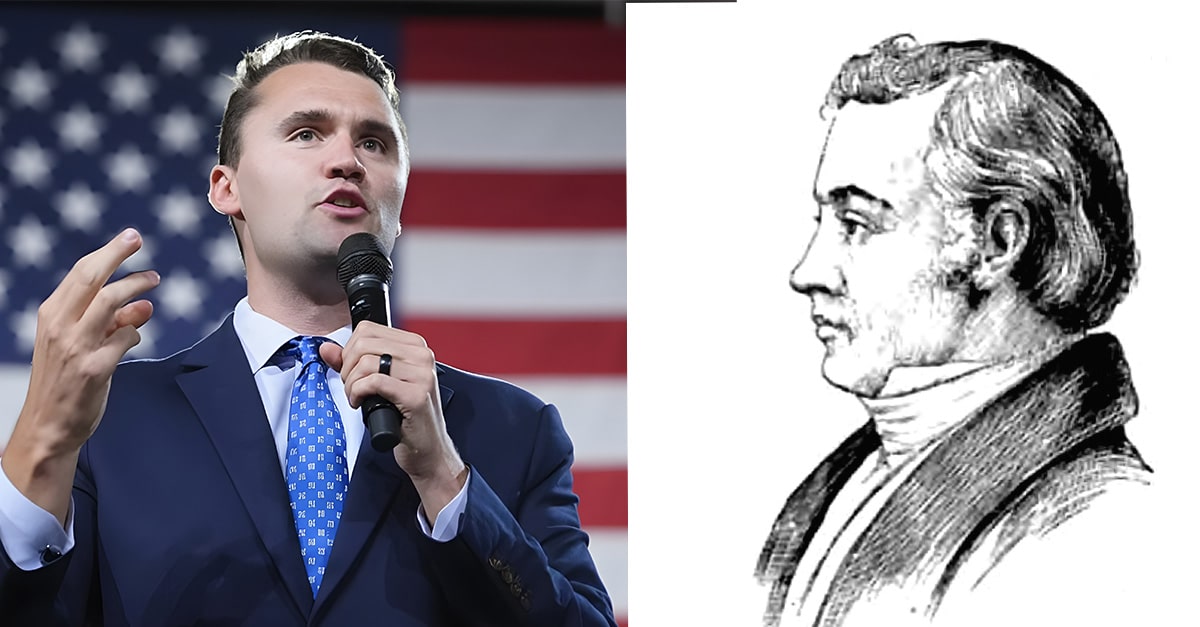
Though they were born nearly two centuries apart, Charlie Kirk and Elijah Lovejoy were targeted and murdered by those who didn’t want to hear that societal evils can only be solved with biblical truth.
Charlie Kirk will be awarded the Presidential Medal of Freedom by President Donald Trump in a White House ceremony later today on what would have been his 32nd birthday — a little over a month after he was gunned down for doing nothing more than holding a microphone and debating on a controversial topic.
Charlie Kirk is truly a martyr for free speech, but he is not the first.
That honor goes to Elijah Parish Lovejoy, a pastor and newspaper publisher who was assassinated in 1837 while trying to protect his printing press from a pro-slavery mob.
Though the two were born in different eras and communicated using very different technology, Kirk and Lovejoy are eerily similar.
Both were murdered in their early 30s, each leaving behind a young wife and two orphaned children. Both eventually came to realize that societal evils can only be truly solved by embracing biblical truth. And both were smeared and threatened for years by those who believed there are some topics or opinions that should never be discussed publicly.
There is one major difference, though. Thanks to video and social media, Charlie’s life and beliefs were so well-documented and viewed that his loss was mourned globally, while Elijah Lovejoy, though once famous in abolitionist circles, is today barely even remembered.
But he should be. For just like Charlie, Lovejoy would live out the command of Jude 1:3 to “earnestly contend for the faith” and help an entire generation come to understand the imperative of countering lies with biblical truth — even when it is socially unpopular and comes at great personal cost.
The Path to Faithfulness
Born on November 9, 1802, in Albion, Maine, Elijah Lovejoy was the eldest of nine children. While his father, Daniel Lovejoy, a Congregationalist minister, and his mother, Elizabeth, encouraged all of their children to read and memorize Scripture, Elijah managed to leave home with, in today’s vernacular, nominal Christian beliefs. He longed for adventure, and after graduating at the top of his college class in 1826 with a degree in classical studies, he headed out west to take a job as a schoolteacher in St. Louis, Missouri.
He then decided he wanted to have an even larger impact and a larger audience. So, just as Kirk did with Turning Point U.S.A., Lovejoy became an entrepreneur and influencer in 1830. As co-owner and editor of a secular newspaper called the St. Louis Times, he wrote about local politics and a variety of social issues, including the growing tensions between pro-slavery and anti-slavery views in Missouri, a slave state surrounded by free states.
At the time, the Second Great Awakening was sweeping the country. Lovejoy, who was described at that point in his life as “destitute of vital piety but not a confirmed infidel,” somehow got caught up in it. He soon converted and went all in on Jesus, selling his interest in the Times and heading back east to attend the Princeton Theological Seminary in New Jersey. In April 1833, he became an ordained Presbyterian minister and traveled back to St. Louis. In short order, he started a new publication: The St. Louis Observer.
His influence immediately took on a different tone and a different weight. Whether preaching from the pulpit or writing on the pages of his weekly Christian newspaper, Lovejoy declared biblical truth. In his very first editorial, he wrote that the Observer “will seek no controversy, and it will decline none, when by doing so it might compromise the purity of that ‘faith once delivered to the saints.’”
In stark contrast to some of today’s Christians, who insist that there’s no point in getting involved in politics or calling out societal sin since Jesus will be back any day now, Lovejoy and others who adopted the Protestant faith during the 1820s and 1830s believed that Christians had an urgent duty to remedy the evils of society in anticipation of the Second Coming of Christ.
It was a doctrinal belief that mirrored that of Charlie Kirk, who once told a faith-based audience, “What do you want to be caught doing upon Jesus’s return? Do not allow eschatology to be an excuse for you not to fight evil. Do not allow the signs of the times to cause you to be paralyzed, static, to not engage in the culture.”
Contending for the Faith
Lovejoy would fill the pages of the Observer with theologically informed editorials in favor of the Sabbath and education reform and, more importantly, against alcohol use, prostitution, political corruption, and other vices. No topic was off limits — and especially not slavery and the nascent push for abolition.
In 1835, Lovejoy wrote to his readers, “It becomes us as a Christian people as those who believe in the future retribution of a righteous Providence to remove from our midst an institution no less the cause of moral corruption to the master than to the slave.”
Such editorializing soon brought some very unwanted attention in the form of pro-slavery mobs and politicians who demanded Lovejoy “pass over in silence everything connected with the subject of slavery.” Future Missouri Democrat senator Thomas Hart Benton even went so far as to insist that the Observer’s anti-slavery content was in no way covered by the First Amendment, and Lovejoy was soon being smeared as an “agitator,” “fanatic,” and “anti-American.”
Nearly 200 years later, especially during the Orwellian era before Elon Musk purchased Twitter, the list of unpopular topics somehow not covered under the Constitution’s Free Speech Clause had only grown longer and now included everything from abortion to vaccines to mail-in ballots. Anyone who mentioned or questioned those things, including Charlie Kirk, would find themselves characterized in the media as “misogynists,” “racists,” “anti-science,” or “election deniers.”
Like Kirk, Lovejoy didn’t cower. In fact, he doubled down. “Asserting his freedom of speech, [Lovejoy] fired off another series of blistering editorials condemning slavery with all its horrors,” wrote author and pastor Robert J. Morgan in his book 100 Bible Verses That Made America. “He compared himself to his namesake, Elijah, who stood before Ahab rebuking his sins, and he refused to be silenced.”
When their “polite” demands to shut up about slavery went unheeded, the pro-slavery crowd turned up the heat. Lovejoy was warned by angry men not to walk anywhere in the city; others threatened to have him publicly whipped.
He wasn’t alone. Across the country, publishers who called for abolition had been violently attacked by more than 100 pro-slavery mobs, many of them paid to make trouble by slave owners and others with an economic interest in slavery; in supposedly genteel Boston, a group of wealthy textile merchants dependent on the cotton trade broke into the offices of The Liberator newspaper, seized its editor, William Lloyd Garrison, dragged him down the street with a rope, and threatened to kill him.
Willing to Die, Refusing to Quit
In August 1837, in an effort to protect his young wife and growing family from the increasing threats, Lovejoy moved his newspaper 30 miles away and across the Mississippi River to Alton, Illinois. He hoped that being in a free state would result in more safety and more support for his speech, but just as Charlie Kirk often encountered resistance to his unpopular stances on abortion, socialism, and radical gender ideology on college campuses in more conservative states, Lovejoy found that his new home was no less hostile to his anti-slavery views.
At a contentious council meeting, city leaders once again implored Lovejoy to tone down all the abolition speak. He refused, explaining,
“Gentlemen, as long as I am an American Citizen, and as long as American blood runs in these veins, I shall hold myself at liberty to speak, to write, and to publish whatever I please on any subject.”
To put a finer point on it, Lovejoy in the very first edition of the new Alton Observer reiterated that “Slavery is an awful evil and a sin.” He then called not just for an immediate end to slavery but for the city’s residents to speedily repent of their role in perpetrating or enabling its evils.
Since they couldn’t get Lovejoy to self-censor, the mob decided it was time to do it for him. They broke into the Observer’s offices and destroyed his printing press, then they did it again. On a third occasion, they intercepted a delivery boat and unceremoniously tossed his newly ordered printing press into the river.
This sustained effort to eliminate Lovejoy’s platform for free speech was akin to the cancel culture era when Charlie Kirk, like so many others with dissenting views on topics deemed too controversial for public debate, was repeatedly banned or restricted from posting to social media.
In both eras, these efforts backfired. Lovejoy himself resolved to never stop speaking truth.
“I have appealed to the Constitution and laws of my country; if they fail to protect me, I appeal to God, and with Him, I cheerfully rest my cause. I can die at my post, but I cannot desert it.”
He ordered another press and this time had it secretly delivered to an alternate location, a large three-story stone warehouse owned by a local businessman. A group of men who supported Lovejoy’s right to publish and speak his mind, but not necessarily abolition, stood post around the printing press in an effort to protect that right.
By nightfall, a pro-slavery mob of 30 men armed with rocks, guns, and torches marched on the site and demanded that Lovejoy hand over his press. He refused, so they tried to set the building on fire. Lovejoy opened the door to try to stop one of the arsonists, only to be immediately shot five times. He stumbled back into the building, and as he lay dead on the floor, the rioters rushed in and again destroyed the printing press.
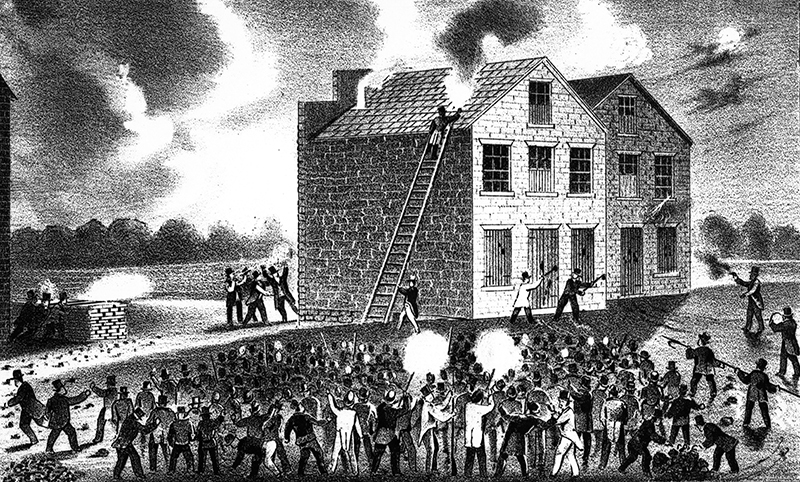
The murder shocked the country, though the mainstream media of the day, which recognized no journalistic legitimacy in religious or abolitionist publications, downplayed the event. The elitist South Carolina Mercury, while prefacing their argument with the obligatory condemnation of violence, suggested that Lovejoy brought it on himself, admitting to having “little sympathy for the man who will persist in his ‘iniquitous doings’ in defiance of the public feelings or public will.”
No one was ever convicted of the crime. Two days later, on what would have been his 35th birthday, Lovejoy was buried privately in a secret location, as his supporters worried that the mob, still openly celebrating, would desecrate his grave.
When Blood Becomes the Seed of Freedom
The pro-slavery mob may have killed the speaker, but they had “no idea” the forces they had unwittingly “unleashed,” to paraphrase the point that Erika Kirk would make in the days after her own husband’s murder.
Elijah Lovejoy’s murder immediately galvanized the abolitionist movement as Americans who had silently agreed with the cause finally got off the fence and put their beliefs into action. Thousands quickly joined or started anti-slavery societies, and new abolitionist papers were established. Debates over slavery and the bounds of free speech intensified, and several now famous figures were inspired to either get into the fight or step up their game.
Owen Lovejoy, Elijah’s brother, decided to leave the pulpit and enter politics, becoming a prominent member of Congress who was responsible for championing efforts to restrict the expansion of slavery and for introducing the bill to end slavery in the District of Columbia.
Harriet Beecher Stowe, whose husband, a pastor, helped Lovejoy smuggle his printing press into Alton and personally witnessed the mob violence, was heavily affected by the murder. She would later write Uncle Tom’s Cabin, the famous novel that helped create a national sense of moral urgency as a result of its vivid portrayal of slavery’s violence and dehumanization and its use of themes of Christian martyrdom and resistance that echoed Lovejoy’s example.
And President Abraham Lincoln, then a little-known legislator in Illinois, condemned the mob’s actions in a speech two months after Lovejoy’s murder, noting that the use of violence as a legitimate response to words and debate would eventually lead to the nation’s ruin. “By such examples [as Lovejoy’s murder], by instances of the perpetrators of such acts going unpunished, the lawless in spirit are encouraged to become lawless in practice… And thus it goes on, step by step, till… the mobocratic spirit spreads like a contagion.”
Likewise, Charlie Kirk’s murder did not silence his movement but amplified it to a deafening level. Today, we are now seeing a new generation willing to get off the sidelines, put their own safety and comfort at risk, and boldly speak biblical truth in the fight to ensure a more righteous, peaceful society.
There’s something profoundly American — and profoundly Christian — about men willing to die for truth. Elijah Lovejoy’s printing press and Charlie Kirk’s microphone were both weapons of light against the darkness. Their blood and bravery remind us that the defense of truth and freedom has always come at a cost.
So today, as Erika Kirk accepts the Presidential Medal of Freedom from President Trump on behalf of her husband, we must do more than just applaud — we must imitate. In this age of deception, may we also “earnestly contend for the faith which was once delivered unto the saints” (Jude 1:3), standing unflinching for truth, no matter the cost.
If you like this article and other content that helps you apply a biblical worldview to today’s politics and culture, consider making a donation here.