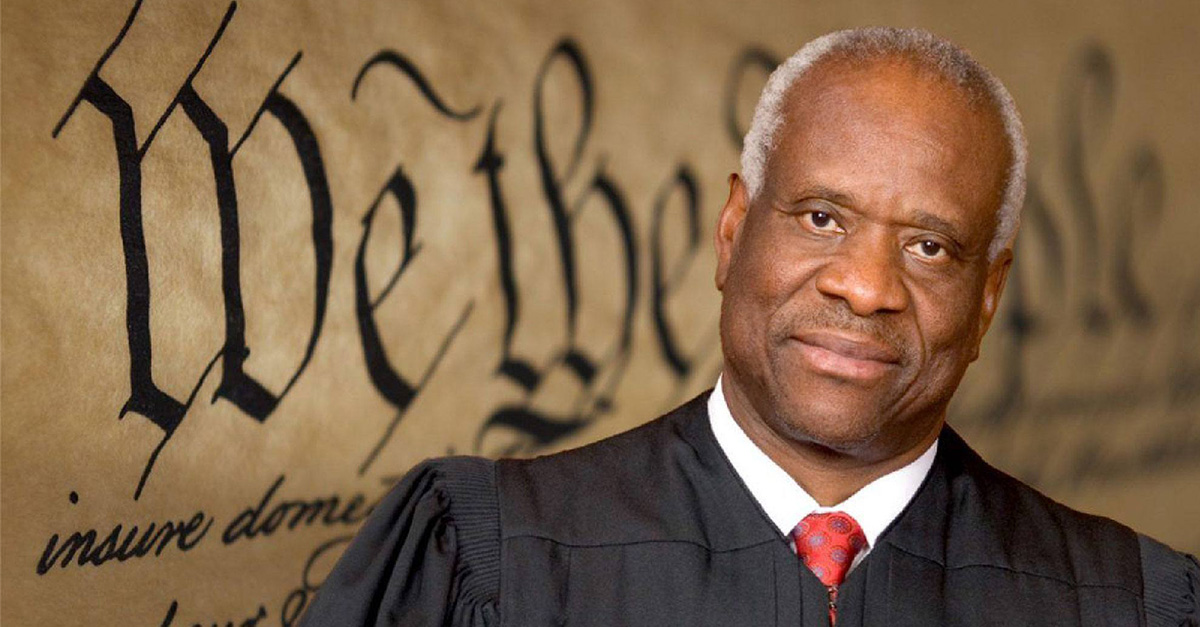
Justice Clarence Thomas has spent more than 34 years doing what Washington rarely rewards: telling the truth about the Constitution when it cost him comfort, consensus, and applause. Now the second-longest-serving justice in Supreme Court history, his legacy is a rebuke to judicial activism and a model of courage for a nation that still needs men willing to stand alone.
This article is a lightly-edited transcript of the “Here’s the Point” podcast by Ryan Helfenbein, executive director of the Standing for Freedom Center.
On May 7, Justice Clarence Thomas became the second-longest-serving justice in U.S. Supreme Court history, surpassed only by Justice William O. Douglas. President George H.W. Bush nominated Thomas to the Court, and he took his seat on October 23, 1991, after one of the most brutal confirmation battles the nation has ever witnessed – hearings chaired by then-Sen. Joe Biden and marked by allegations Thomas forcefully denied. Thomas called the spectacle a “high-tech lynching,” and it failed to stop him.
For more than 34 years, Justice Thomas has produced originalist ruling opinions of remarkable historical depth and intellectual precision. While critics have never stopped attacking him, Justice Thomas has earned the respect of his colleagues and has become revered as one of the greatest conservative justices in American history. At 77, Thomas shows no public sign of slowing down. If he remains on the Court until May 20, 2028, he will become the longest-serving justice in Supreme Court history. He has never stopped working.
And only in recent years has the Supreme Court moved in a more conservative direction. Justice Clarence Thomas is largely responsible for the return to the constitutional text and original meaning — even overturning bad legal precedent, not deferring to old judicial activism, or poor legal precedent, but allowing truth and principle to be his guiding philosophy. Today’s Court has been heavily influenced by Clarence Thomas.
So here are five reasons why Justice Clarence Thomas stands as one of the greatest constitutional originalists in American history.
1. Justice Thomas made a principled journey to becoming a conservative stalwart — one that no liberal on the left expected him to take.
Clarence Thomas did not arrive at constitutional conservatism through a privileged life. He arrived through honest moral, spiritual, and intellectual reckoning.
He entered college as a self-described “black radical,” influenced by Malcolm X and the Black Power movement. He was disillusioned by liberal paternalism, including the affirmative action he experienced at Yale Law School, which he felt stigmatized him more than it elevated him.
Through the writings of thinkers like Thomas Sowell and through the lessons of his grandfather, who often taught him the biblical principle that “if we didn’t work, we didn’t eat,” and through his own careful study of the American Founders, Justice Thomas arrived at a principled conservatism built not on comfort but on conviction. His worldview is shaped by that conviction.
His autobiography, titled My Grandfather’s Son, documents this journey with rare honesty. It is the story of a man who followed the evidence wherever it led — regardless of where it left him socially. He was not on a quest for popularity or groupthink but for truth and principle, even if it left him alone, and the only one holding on to that position.
Every generation needs heroic men like Clarence Thomas.
2. His constitutional originalism is legendary.
Clarence Thomas is widely regarded as the Court’s most consistent and ardent originalist. He does not merely appeal to original meaning; he surveys historical dictionaries, Founding-era writings, and ratifying conventions to reconstruct what constitutional text actually meant when they said what they said at the time they were ratified. He takes great pains to be accurate and to be honest, more than any of his other colleagues.
Thomas has been more willing than any peer to revisit long-settled precedents when they stray from original meaning. In United States v. Lopez (1995), he argued to restore the Commerce Clause to its original scope. In McDonald v. Chicago (2010), he used the long-dormant Privileges, or Immunities, Clause to incorporate the Second Amendment — with sweeping historical analysis showing how gun disarmament was weaponized against black Americans after the Civil War.
His concurrences and dissents read like historical monographs — and they keep becoming majority opinions. That’s because Thomas’s influence has overwhelmed the Court and has inspired a new generation of legal conservatives who follow in his footsteps.
3. His faith is fundamental to his conviction.
Clarence Thomas is a Catholic who returned to the Church after more than two decades away, having once left in frustration over what he saw as the Church leadership’s failure to confront racism and bigotry. He has also credited the Catholic nuns who taught him as a child with shaping his understanding of dignity, discipline, gratitude, and moral courage.
His jurisprudence at its root is shaped by his theological conviction that rights come from God and nature, not from government and not through appointed justices.
This is precisely the understanding embedded in the Declaration of Independence. Thomas has made the connection explicit — linking Christianity, natural law, the Founding, and the Constitution’s original understanding of human equality. His originalism is not merely an interpretive method; there is truth and there is error, there is black and white, there is the right way and a wrong way to interpret the Constitution.
His moral commitment rooted in that conviction, that human beings bear the image of God and deserve the dignity of a limited government, a government that is limited by law, and that justices do not get to willy-nilly reinterpret that law when such rights are no longer in vogue — those are his convictions
4. Clarence Thomas’s courage to stand alone is his superpower.
One of the defining characteristics of Clarence Thomas is his willingness to dissent when no one else will. The word contra mundum — against the world — describes Thomas when he is perhaps at his best.
He has one of the highest solo dissent rates in modern Supreme Court history.
In United States v. Rahimi (2024), Thomas stood alone and applied the strict historical-tradition test that he helped to pioneer — even when the rest of the conservative bloc retreated from it, leaving him as the only dissenting vote.
Among his most notable quotes, he said this: “Government cannot make us equal; it can only recognize, respect, and protect us as equal before the law.”
In a 1998 National Bar Association speech, Thomas warned against reducing people to race and assigning their thoughts by skin color, calling that impulse “nothing short of a denial of our humanity.”
And finally, “A philosophy that is imposed from without instead of arising organically from day-to-day engagement with the law isn’t worth having.”
Make no mistake: Thomas has often said, as a black conservative, what many conservatives would not dare to say, especially if it meant standing alone. That is why his courage to stand alone is his superpower.
5. His legacy will be timeless – not because he invented a new Constitution, but because he forced the Court to take the Constitution’s original meaning seriously again.
Clarence Thomas did not write his dissents for the applause of this generation. He wrote them for the next one and the one before. While Thomas took great pains to discover original meaning and intent, the next generation has often vindicated him.
Robert Bork helped give modern originalism its intellectual firepower, but Clarence Thomas carried that fire onto the Supreme Court with unusual courage. If an originalist revival defines this era of American law, Thomas will be remembered as one of the men who refused to let the Constitution become whatever the loudest generation wanted it to mean.
Free speech, religious liberty, gun rights, private property, and the limits on administrative power — Justice Thomas has built a legacy standing strong on these issues while many colleagues were chasing consensus and judicial precedent to the silence of the Constitution itself.
Thomas Sowell, his closest friend and intellectual mentor, has called Justice Thomas a great man. Thomas said that Sowell was like a “cup of cold water in a desert.”
The Federalist Society has built a generation of constitutionalist lawyers on the jurisprudential foundations Thomas help to lay.
When historians look back at this era of American law, they will say that one man more than any other made the Supreme Court take the Constitution’s original meaning seriously once again.
Proverbs 22:1 says, “A good name is to be chosen rather than great riches, and favor is better than silver or gold.”
Clarence Thomas chose fidelity over fame and conviction over comfort. In a profession that often celebrates compromise over courage and consensus over dissent, Thomas is a masterclass in legal principle and resilience in turbulent times.
America is in desperate need of spiritual revival and civic renewal. We need national heroes and models for excellence. Clarence Thomas is among those few who has achieved greatness in an era of legal confusion and decline. May God raise up more faithful men just like him.
Clarence Thomas will not be remembered as the justice who played it safe but as the one who stood on truth — even while standing alone.
One faithful voice can steady a nation. Your tax-deductible gift helps the Standing for Freedom Center raise up Christians who can read the times, defend the Constitution, and stand for truth when the room goes quiet. Give today.