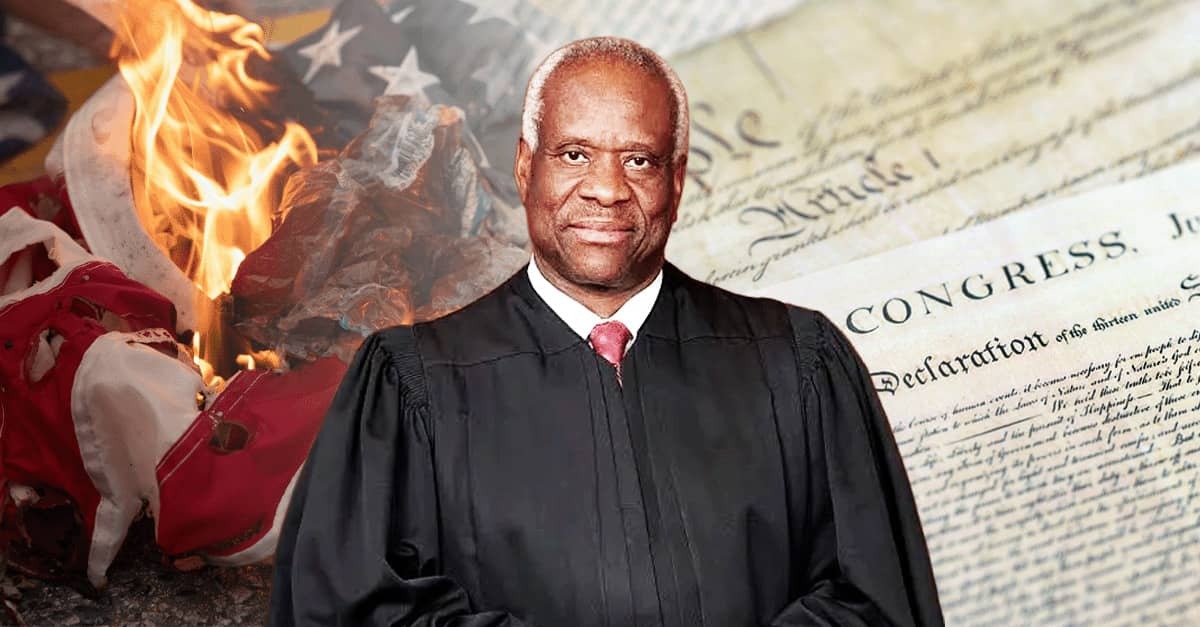
In a landmark address, Justice Clarence Thomas warns that America is drifting from its founding truth — that our rights come from God, not government — and calls citizens to confront the rise of progressivism and reclaim the moral and constitutional principles that sustain a free nation.
In his April 15, 2026, address at the University of Texas at Austin commemorating the 250th anniversary of the Declaration of Independence, Supreme Court Justice Clarence Thomas offered more than a routine patriotic reflection. He laid out a clear philosophical framework for the American constitutional order: the Declaration announces the ends of government, while the Constitution supplies the institutional means to secure them.
Those ends rest on the self-evident proposition that “all men are created equal, that they are endowed by their Creator with certain unalienable Rights,” and that governments are formed “to secure these rights” through the consent of the governed. Naturally, this vision stands in irreconcilable tension with progressivism, which “seeks to replace the basic premises of the Declaration of Independence, and hence our form of government.”
The principled clarity Thomas brings to these questions is striking. His remarks draw deeply from the Christian natural law tradition that informed so much of the founding era. With its pointed critique of progressivism, the speech stands as a timely and essential guide for teaching the basics of American citizenship.
The fact that these ideas now feel unfamiliar to many Americans underscores just how effectively progressivism has buried our national heritage. At its root, progressivism threatens the very foundations of our civic life, moral order, and theological commitments. It must be confronted head-on and overcome if we hope to sustain a viable American republic grounded in decency and truth.
The Ends and Means of Liberty
Thomas’s central distinction cuts to the heart of the matter: “The Constitution is the means of government; it is the Declaration that announces the ends of government.” The Declaration provides the teleological anthropology — rights that precede government and derive from the Creator, not from positive enactment — while the Constitution erects the practical safeguards of separation of powers and federalism.
As Thomas put it, the principles “are a way of life… the basic premises of our Constitution and government that you can learn from the people all around you.” They have been tested in the daily experience of ordinary citizens and in the extraordinary crises of American history.
This framework finds its deepest roots in Protestant political theology, the tradition that recovered biblical natural law, covenantal accountability, and the magistrate’s duty to honor the Creator’s moral order. From the Reformation forward, Protestant thinkers insisted that political authority is fiduciary — held in trust, bound by transcendent standards, and revocable when it violates the covenant between God, rulers, and the people.
Thomas does not invent a new argument here; he restates, with the weight of judicial authority, the political ontology that shaped the colonies and the republic they formed. In Protestant political theology, rights are not conferred by the state but discovered as endowments of the image of God. Government exists to protect those rights, not to redefine them according to shifting historical fashions.
At the core of Thomas’s analysis is a sober realism about human nature. Quoting James Madison, he observed that “the desire for power was… ‘sown in the nature of man,’” making limited government essential. “If men were angels, no government would be necessary.”
This recognition of fallenness is not pessimism but a foundational premise of Protestant political theology: Because human virtue is unreliable without external restraints, power must be dispersed and checked.
Historical episodes such as the slaveholding regime and the Supreme Court’s decision in Plessy v. Ferguson, which affirmed the “separate but equal” doctrine and enabled the Jim Crow era, show how positive law and majoritarian will can be turned against the Declaration’s promise of equality. Far from isolated missteps, these episodes foreshadowed the deliberate and sustained assault that progressivism now levels against the Declaration’s fundamental commitments.
The Horrors of Godless Statism
Progressivism enacts that challenge on a grand scale. “It holds that our rights and our dignities come not from God, but from the government,” Thomas stated. “It requires of the people a subservience and weakness incompatible with a Constitution premised on the transcendent origin of our rights.”
He traced its intellectual origins to President Woodrow Wilson’s blunt dismissal of natural rights as “a lot of nonsense” and to educator John Dewey’s insistence that the Founders’ ideas were merely “historically conditioned” products of their time. In this rival vision, Bismarck-style administrative statism supplants the Creator as the source of dignity; rights become flexible grants dispensed by experts rather than immutable endowments.
The logical outcome is stark incompatibility. Because progressivism is fundamentally opposed to the Declaration’s premises, Thomas concluded, “it is not possible for the two to coexist forever.” Progressivism exchanges self-evident truth for evolutionary relativism, consent of the governed for expert administration, and individual accountability under God for collective dependence on the state.
The last century’s record of eugenics, segregation defended under “evolving standards,” and totalitarian regimes that treated citizens as raw material for the collective will offers grim confirmation: Rejecting the Declaration is not forward movement but a step backward into older forms of absolutism.
Protestant political theology equips us to meet this contest squarely. It rejects both the withdrawal of a private faith and the overreach of a sacralized state. Instead, it calls for active stewardship within a covenantal order in which family, church, and civil government each answer directly to the moral law of God within their proper spheres.
Thomas’s address revives this tradition at the very moment the 250th anniversary invites national self-examination. It reminds us that the Declaration functions as the republic’s sheet anchor, orienting every later institution toward justice rather than raw power.
A Blueprint for Recovering Our National Heritage
The speech’s call to action follows inevitably from its diagnosis. Civic passivity is not realism but a failure of stewardship. “I think if we don’t stand up and take ownership of our country, and take responsibility for it, we are slowly letting others control how we think and what we think,” Thomas warned. “If you think it’s losing confidence, then you get up and you participate. You don’t sit on the sidelines.”
The signers who pledged their lives, fortunes, and sacred honor set the standard: “We must find in ourselves that same level of courage… so that we can do for our future what they did for theirs.”
Thomas’s own journey from the segregated South to the Supreme Court gives his words particular force; his life embodies the ideal he defends and makes the summons to ownership both personal and urgently national.
Protestant political theology supplies the intellectual and moral architecture to answer the Declaration’s demands. It calls for rigorous recovery — embedding the Declaration’s anthropology in law and education, exposing historicist relativism as the solvent of republican virtue, and refusing both retreat and easy compromise.
Thomas has given us a formidable brief for the enduring validity of this inheritance. The republic’s first principles remain rationally and theologically defensible precisely because they are grounded in the Creator’s moral order. Protestant political theology, rightly understood, equips us to confront the present crisis.
The intellectual resources are already in place. The question now is whether this generation will take them up — boldly, confessionally, and without apology — before the memory of our Protestant American heritage disappears altogether.
“A republic, if you can keep it,” Benjamin Franklin once warned. The Founders fulfilled their duty to their future. The 250th anniversary places the same responsibility squarely before us.
If you believe America’s future depends on recovering the truth that our rights come from God – not government – now is the time to act. Your support empowers us to defend the Constitution, uphold biblical truth, and equip the next generation to stand firm in a culture that is rapidly losing its foundation. Make a tax-deductible gift today and help preserve the principles that make freedom possible.