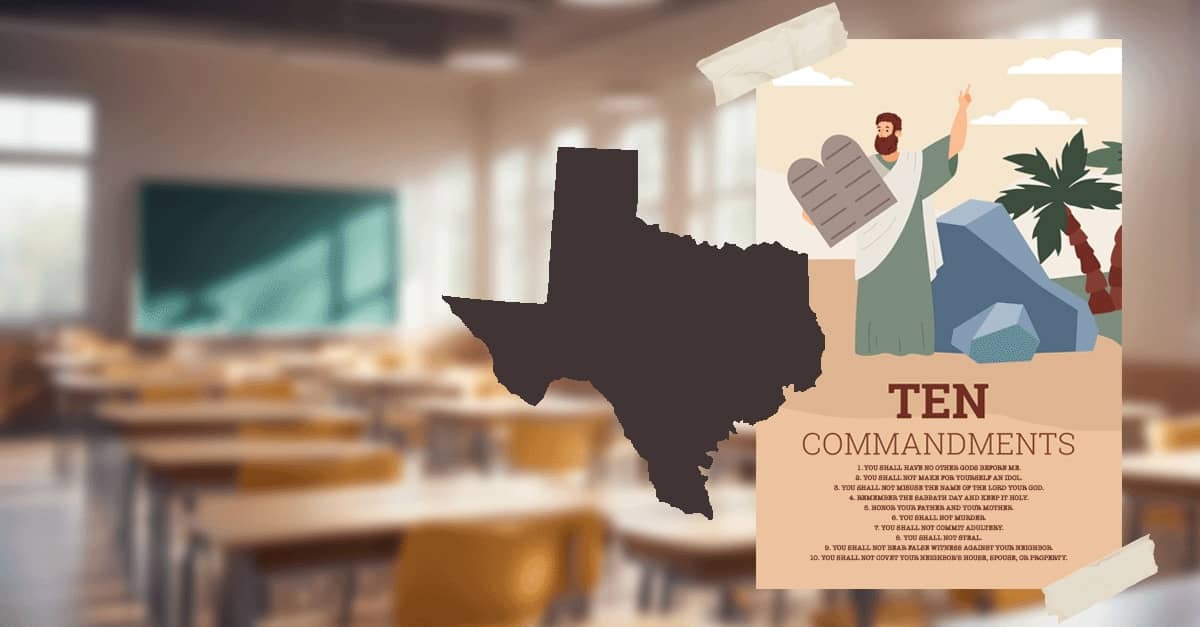
In a narrow 9-8 ruling, the full Fifth Circuit allowed Texas to move forward with its Ten Commandments classroom law, holding that a passive display does not force religious belief or violate the First Amendment under the Supreme Court’s history-and-tradition standard.
[UPDATE] In a 9-8 decision, the full U.S. Court of Appeals for the Fifth Circuit has ruled that Texas can move forward with a law ordering public schools to display the Ten Commandments in all classrooms, reversing a lower court decision that had blocked the measure.
The appellate court’s opinion in Rabbi Nathan v. Alamo Heights Independent School District was handed down on April 21 and reverses an earlier court ruling that blocked the state’s 2025 law. The legislation, known as SB 10, was passed by the Texas House 82-46 and the Texas Senate 20-11.
The appellate court allows Texas schools to display the Ten Commandments while legal challenges continue. In its decision, the court said the law does not violate constitutional protections of religion, citing recent shifts in how courts interpret the First Amendment.
The majority opinion, written by Judge Stuart K. Duncan, said the law does not amount to government establishment of religion or coercion of students, writing,
“S.B. 10 looks nothing like a historical religious establishment. S.B. 10 requires no religious exercise or observance. Students are neither catechized on the Commandments nor taught to adopt them. Nor are teachers commanded to proselytize students who ask about the displays or contradict students who disagree with them. It puts a poster on a classroom wall.
Yes, Plaintiffs have sincere religious disagreements with its content. But that does not transform the poster into a summons to prayer. Because the Texas law has none of the elements of a founding-era establishment of religion, the district court erred in ruling that the law violates the Establishment Clause.”
The court noted that thanks to recent Supreme Court precedent, modern legal analysis no longer relies on the decades-old “Lemon test,” a framework used to test whether a law involving church-state entanglement violated the Establishment Clause. Instead, it said courts must now look to historical practices to determine whether a law resembles the type of religious establishment the Constitution was meant to prohibit.
The Fifth Circuit considered the Texas case alongside a challenge to a similar Louisiana law but dismissed that case as premature, noting that questions remain about how the displays would be implemented.
In a concurring opinion in the Louisiana case, Judge James Ho wrote that a passive display of the Ten Commandments is not coercive and is “fully consistent with the Constitution.”
Recent Supreme Court decisions have moved away from the Lemon test and emphasized historical context when evaluating religious displays. In American Legion v. American Humanist Association, the court said the Ten Commandments carry historical meaning tied to the development of law. Later rulings, including Kennedy v. Bremerton School District, reinforced that approach.
Kelly Shackelford, president, CEO, and chief counsel for First Liberty Institute, which argued the case of Kennedy v. Bremerton, celebrated the ruling, stating,
“As the Fifth Circuit correctly concluded, posting the Ten Commandments in schools clearly meets the Kennedy ‘history and tradition’ test.
The Ten Commandments have been a part of our nation’s history and tradition; banning them from schools because they are religious is not justified by the Constitution and would undermine a comprehensive education for America’s students. We applaud the Fifth Circuit for upholding the Constitution.”
Mat Staver, founder and chairman of Liberty Counsel, which specializes in religious liberty cases, also praised the ruling, saying,
“The Fifth Circuit has rightly ruled that the Ten Commandments can be displayed in public schools. Passive Ten Commandments displays do not compel religious exercise, so there is no Establishment Clause violation. The Decalogue is a universally recognized symbol of law and has indelibly shaped the Western Legal Tradition and American government. There are more than 50 displays of the Ten Commandments inside and outside the United States Supreme Court. The Ten Commandments are ubiquitous and their central role in law and government pre-date the U.S. Constitution and these displays honor its historical significance to our way of life.”
The legal challenge will continue in the courts as it still must be heard on its merits, but many predict that the case will eventually be taken up by the U.S. Supreme Court.
ORIGINAL STORY
New law puts the Ten Commandments in all Texas public school classrooms
{Published on June 30, 2025} Public schools across Texas will soon be required to display the Ten Commandments in every classroom under a new law signed by Gov. Greg Abbott, R. The move has ignited praise from conservative religious leaders and legal challenges from secular faith leaders and civil rights advocates.
Senate Bill 10 mandates that all public schools post a specific version of the Ten Commandments in a 16-by-20-inch framed display or poster beginning on September 1, 2025. The measure makes Texas the largest state to enact such a requirement.
“Texas is where the American dream lives,” Abbott said in a statement after signing the bill on June 21. “Today, I signed critical legislation passed in the 89th Regular Legislative Session that protects the safety of Texans and safeguards the individual freedoms that our great state was founded on. Working with the Texas Legislature, we will keep Texas the best place to live, work, and raise a family.”
Alongside S.B. 10, Abbott signed Senate Bills 11 and 965, which authorize school districts to designate a voluntary daily period during school hours for students and staff to pray or read religious texts.
Supporters of the legislation, including national conservative organizations and religious freedom advocacy groups, argue that the new laws reflect recent U.S. Supreme Court rulings on public expressions of faith. They point to the 2022 decision in Kennedy v. Bremerton School District, in which the High Court upheld a Washington state football coach’s right to pray publicly on the field after games.
This is a Texas-sized blessing that the Ten Commandments will now be displayed for students to see, much like the Ten Commandments Monument at the Texas Capitol and in the U.S. Supreme Court,” said Jonathan Saenz, president of Texas Values, a group that championed the bill.
“Governor Abbott fulfilled the law by signing SB 10 today, making it clear that there will be a Ten Commandments displayed in every Texas public school classroom,” he added.
Matt Krause, of First Liberty Institute, also celebrated the legislation as a reflection of America’s founding principles.
“Displaying the Ten Commandments and national motto and allowing students and teachers to express their faith in Texas classrooms is consistent with Supreme Court precedent that recognizes the country’s religious heritage and the best of the nation’s history and traditions,” Krause said. “The Ten Commandments are a symbol of law and moral conduct with both religious and secular significance which provide valuable lessons for students.”
Critics argue that the law violates the Establishment Clause of the First Amendment and could alienate students of different religious backgrounds across the state’s nearly six million public school students.
The American Civil Liberties Union of Texas condemned the law as unconstitutional.
“We all have the right to decide what religious beliefs, if any, to hold and practice,” the group wrote in a statement. “Government officials have no business intruding on these deeply personal religious matters. S.B. 10 will subject students to state-sponsored displays of the Ten Commandments for nearly every hour of their public education. It is religiously coercive and interferes with families’ right to direct children’s religious education.”
Other states have struggled to implement similar laws. Earlier this month, a panel for the Fifth Circuit U.S. Court of Appeals struck down Louisiana’s law requiring the Ten Commandments to be posted in every public school and university classroom, ruling that it is “plainly unconstitutional.”
This unanimous decision upheld a lower court’s November 2024 injunction, finding the law violated the First Amendment’s Establishment Clause. The judges cited the 1980 Supreme Court precedent Stone v. Graham, which invalidated a similar Kentucky law due to its lack of secular purpose. Louisiana’s attorney general has signaled plans to appeal to the full Fifth Circuit and then, if necessary, the U.S. Supreme Court.
Abbott, a former Texas attorney general is no stranger to the debate. In 2005, he successfully defended the constitutionality of the Ten Commandments monument on the Texas Capitol grounds in the Supreme Court case Van Orden v. Perry.
He expects to defend this law successfully as well, writing on X: “Faith and freedom are the foundation of our nation. If anyone sues, we’ll win that battle.”
With SB 10 set to take effect in the fall, school districts are now preparing for implementation and potential legal challenges. Religious liberty organizations on both sides of the debate are watching closely, as the law could set a precedent for similar measures nationwide.

“Liberty cannot be established without morality, nor morality without faith,” Alexis de Tocqueville wrote in his book Democracy in America, a book that not only highlighted the greatness of America but rightly determined that this greatness was the direct result of its Christian faith.
Public schools today often promote secular ideologies that claim to be moral while rejecting the biblical foundation that defines true right and wrong. For instance, schools have endorsed the idea that exposing children to explicit content, such as drag shows or graphic sexual materials, is “healthy” or “empowering.” They advance abortion as a compassionate choice for teens and push racialized grading standards that suggest minority students should be passed along without meeting basic academic benchmarks.
These aren’t examples of moral progress but of moral collapse. By removing objective truth, schools have replaced God’s law with subjective preferences that often harm the very students they claim to protect.
Texas’ decision to post the Ten Commandments in classrooms stands in direct contrast to these harmful trends. Scripture provides a timeless moral compass. God’s law commands respect for life, sexual purity, and truth.
As Deuteronomy 6 instructs, we are to teach these truths diligently to our children. Unlike the shifting values of secular humanism, God’s Word provides clarity, conviction, and hope. In reintroducing the Ten Commandments, Texas is not pushing religion — it is restoring moral sanity and reminding young hearts that there is a higher standard by which all truth and justice are measured.
America’s future depends on whether truth is still allowed in the public square. If you believe students deserve more than moral confusion and cultural drift, help the Standing for Freedom Center defend biblical truth, religious liberty, and the principles that made this nation strong. Make your tax-deductible gift today.