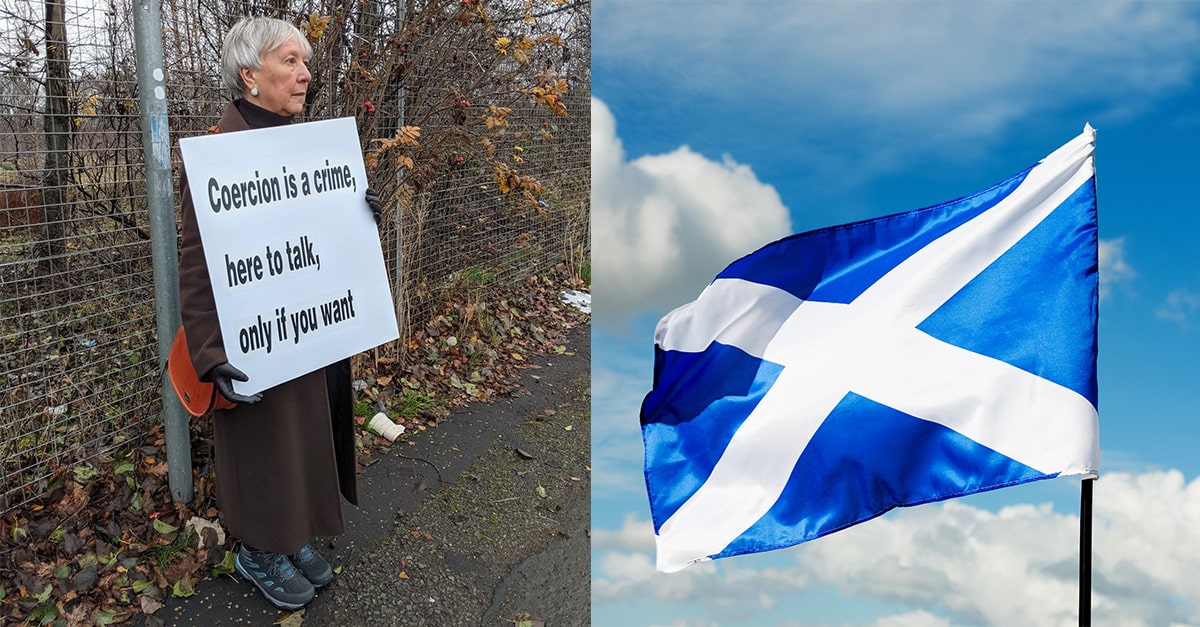
As part of the growing U.K. effort to suppress dissenting speech and criminalize pro-life beliefs, Rose Docherty was arrested earlier this year under Scotland’s controversial new buffer zone law for holding a sign offering friendly conversation to anyone who wanted to talk.
[UPDATE] In a win for free speech and the pro-life movement, the criminal case against a 75-year-old Scottish grandmother for holding a sign in a censored area has been dropped.
Rose Docherty, a native of Glasgow and a pro-lifer, was the first person arrested under Scotland’s newly enacted buffer zone law. She was detained on February 19, 2025, outside Glasgow’s Queen Elizabeth University Hospital for standing quietly with a sign that read: “Coercion is a crime, here to talk, only if you want.” The government characterized her actions as a “silent vigil” and an “anti-abortion protest,” though her sign said nothing about the topic.
The law, which went into effect last year, created 200-meter “Safe Access Zones” around abortion facilities that supporters say is intended to prevent the harassment of patients. Critics have argued, however, that it also restricts peaceful expression, even when no intimidation occurs.
Docherty’s actions involved no confrontation. She only provided an offer to speak with those who wanted to engage. Nonetheless, police arrested her and issued a warning demanding that she admit wrongdoing and agree not to repeat her actions.
Believing she had done nothing unlawful, Docherty refused to accept the warning. She challenged the accusations, maintaining that her presence and message were compassionate, not coercive.
On August 14, 2025, the Crown Office and Procurator Fiscal Service (COPFS) formally withdrew the warning and confirmed that the case would be discontinued. Police even agreed to return the sign that had been confiscated during her arrest.
“After careful consideration of the facts and circumstances of the case, including the available admissible evidence, it was decided that there should be no further action taken at this time,” a spokesperson said, before adding the disclaimer that “The Crown reserves the right to take proceedings in relation to this incident in the future.”
Docherty’s arrest drew international attention, sparking debate about the reach of buffer zone legislation. It also prompted concern from political leaders abroad, who warned that prosecuting peaceful individuals under such laws risked eroding public trust in the justice system.
The U.S. State Department, which has called out the U.K. and other European countries for censoring speech, stated in an X post, “Freedom of expression needs to be protected. We call on governments, whether in Scotland or around the world, to respect freedom of expression for all.”
Docherty celebrated the win in a written statement,
“This is a victory not just for me, but for everyone in Scotland who believes we should be free to hold a peaceful conversation. I stood with love and compassion, ready to listen to anyone who wanted to talk. Criminalising kindness has no place in a free society.”
Lorcan Price, an Irish barrister and legal counsel for Alliance Defending Freedom International, which represented Docherty, said he was pleased with the outcome but also warned about the growing trend towards silencing dissent in the U.K.
“No one should fear arrest for offering a consensual conversation. Rose’s case is a stark example of how ‘buffer zone’ laws can be weaponised to silence peaceful expression,” he wrote. “We are relieved that common sense has prevailed, but the fact that Rose was arrested and threatened with prosecution shows the urgent need to protect fundamental freedoms in Scotland.”
The U.S. State Department also weighed in on the decision to drop the case, telling the U.K.’s Telegraph,
“We applaud Scotland’s sensible decision to refrain from further legal action against Rose Docherty. The United States stands with all those fighting for free speech and religious liberty.”
The Safe Access Zones Act was passed last year and went into effect in September. It mirrors the Public Spaces Protection Order in England and Wales, which has led to the arrests of several people for praying silently outside of abortion clinics or holding up Bible verses.
ORIGINAL STORY
{Published on February 21, 2025} A 74-year-old woman was arrested on Wednesday in Glasgow, Scotland, for allegedly breaching an exclusion zone around an abortion clinic.
This marks the first enforcement of Scotland’s recently enacted Abortion Services (Safe Access Zones) Act 2024, which prohibits anti-abortion protests within 200 meters of medical facilities providing abortion services.
Rose Docherty, a grandmother and retiree, stood in silence on a sidewalk with a sign that read, “Coercion is a crime, here to talk, only if you want.”
A video captured her peaceful presence before her arrest.
The incident occurred near the Queen Elizabeth University Hospital on Hardgate Road, where police responded to reports of an anti-abortion demonstration. The elderly woman was then arrested for violating the exclusion zone, placed in handcuffs, and taken to a police station. She will now be reported to prosecutors.
One of the police officers who approached her explained, “Examples of what would be classed as breaching the Act, you know, approaching someone, trying to persuade them not to access abortion services, surrounding people as they go in or out of the clinic or the hospital, handing out leaflets, religious preaching, silent vigil. So, standing here saying nothing, you know, it’s a silent vigil.”
Docherty responded, “If anyone wants to come and speak to me, they can, so I’m not doing anything else.”
“Well, you seem to believe you’re not doing anything wrong, but there’s obviously a reason why you’re here and why you’re in this area, and you in particular, I am aware that you have been protesting here against abortion before, so I don’t understand why you’re here in this area again if you’re not protesting the same thing,” the officer said.
Docherty again, “I’m not committing an offense if I don’t move away from the area.”
The officer replied, “I believe you’re committing a silent vigil, so I believe you would be, yes.”
Gilliam Mackay, a Green Party MSP (Member of Scottish Parliament) and a supporter of the abortion buffer zone laws, was reportedly pleased with Docherty’s arrest.
“The protests that have taken place outside Queen Elizabeth have been utterly shameful and I am grateful to Police Scotland for acting so quickly,” said Mackay. “This kind of intimidation has no place in a modern or progressive Scotland. Everybody deserves to have access to health care without harassment.”
In recent years, England has also arrested pro-lifers for praying near abortion clinics in violation of censorship laws. British Army veteran Adam Smith-Connor was convicted in October 2024 for silently praying near an abortion clinic in Bournemouth, England.
Smith-Connor, who had paid for his ex-girlfriend’s abortion at the same clinic over two decades ago, stood quietly with his back to the facility, head slightly bowed, and hands clasped, engaging in silent prayer. Authorities charged him with violating the local buffer zone law, which prohibits acts of approval or disapproval regarding abortion within designated areas around clinics.
The Bournemouth, Christchurch & Poole Council sentenced him to a conditional discharge, requiring him to pay £9,000 (equivalent to $11,370) in prosecution costs. Smith-Connor, who is represented by Alliance Defending Freedom UK, expressed concern over the criminalization of private thoughts, stating, “All I did was pray to God, in the privacy of my own mind—and yet I stand convicted as a criminal.”
Isabel Vaughan-Spruce is another pro-lifer who has been arrested multiple times for silently praying within these zones. In October 2023, she was fined for her silent prayer, even after previous charges had been dropped or resulted in acquittal.
“To fine somebody simply for their thoughts is grossly Orwellian and an insult to the freedoms that Britain is meant to protect,” she has stated.
In October 2023, the U.K. increased its enforcement of Public Spaces Protection Orders (PSPOs), targeting individuals engaging in silent prayer or displaying Bible verses near abortion clinics. These PSPOs establish 150-meter buffer zones around such facilities, prohibiting any form of protest, including silent demonstrations. Despite Home Secretary Suella Braverman’s clarification that “silent prayer, within itself, is not unlawful,” law enforcement actions have persisted.
Vice President J.D. Vance recently called out European leaders during a security conference in Munich about the growing use of censorship to suppress political dissent and religious beliefs. In it, he cited a number of egregious free speech violations, including that of Smith-Connor.
“A little over two years ago, the British government charged Adam Smith-Connor, a 51 year old physiotherapist and an Army veteran, with the heinous crime of standing 50 meters from an abortion clinic and silently praying for three minutes, not obstructing anyone, not interacting with anyone, just silently praying on his own,” he said.
As part of his speech, Vance also noted the absurdity of the new Scottish abortion safe access laws, which even applies to those who “can be seen or heard” praying or discussing their pro-life beliefs inside of private homes located within the buffer zones.

The arrest of Rose Docherty is a tragic example of the increasing hostility toward those who seek to defend the sanctity of life. As Christians, we are called to stand for truth, justice, and the protection of the unborn, even when the quiet presence of a pro-life advocate is considered a criminal act.
Prayer is not a threat. Silent reflection before God is not an act of intimidation. And yet, this grandmother was taken into custody simply for standing near a clinic, a supposed “violation” of Scotland’s newly implemented buffer zone laws.
These laws, designed to prohibit protests, are now being used to criminalize not only speech but even private thoughts and prayers. This has established a dangerous precedent — one that undermines fundamental freedoms of religion, expression, and peaceful assembly.
As Christians, we cannot remain quiet while the right to pray in public is stripped away (1 Peter 3:14). Jesus taught us to love our neighbors and to advocate for the most vulnerable, including the unborn. The presence of a peaceful, praying woman should not be met with handcuffs and prosecution but with respect for her deeply held pro-life convictions.
In a world where moral values are increasingly disregarded, it is more critical than ever for believers to be bold in their witness. We must continue to pray, advocate, and stand for life (Psalm 139:13-16), trusting that God will use even the smallest acts of faithfulness to bring about His justice. Arresting and prosecuting Rose Docherty is an unjust act, and we must raise our voices in support of her and all those who courageously defend the unborn (Proverbs 31:8-9).
If you like this article and other content that helps you apply a biblical worldview to today’s politics and culture, consider making a donation here.