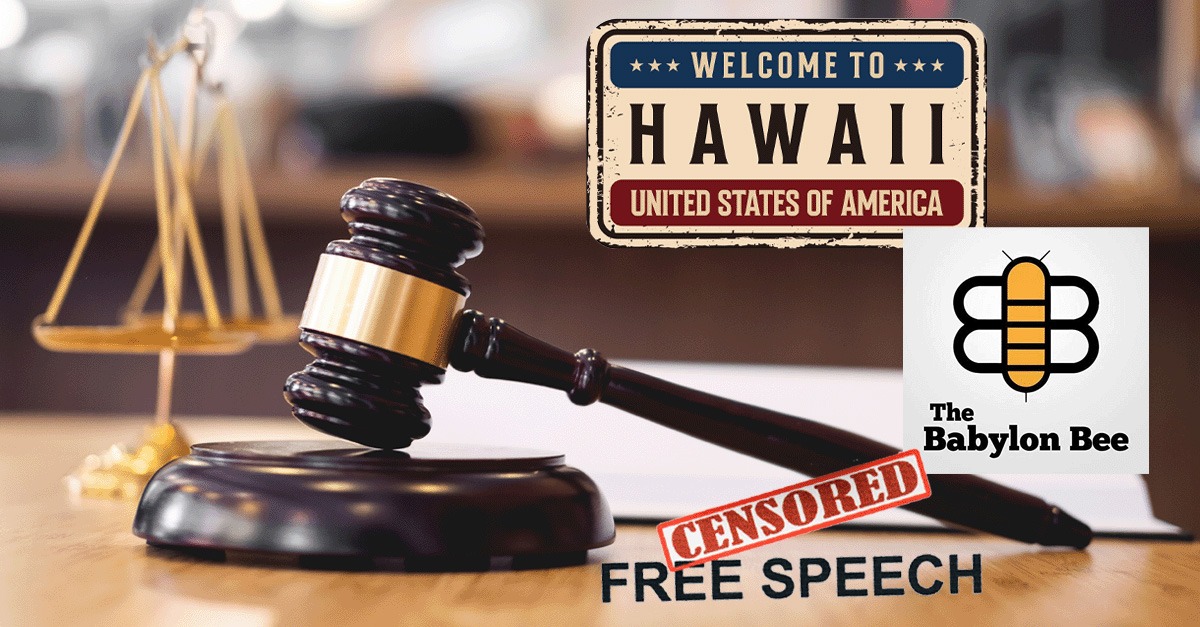
Hawaii tried to make government the referee of political humor. The First Amendment said no — and now the state is paying more than $118,000 for crossing the line.
For years, there has been a progressive effort to criminalize parody and political humor, a push that hit a low point in 2023 when satirist Douglas Mackey was sentenced to seven months in prison for engaging in “conspiracy against rights” over an Internet meme. Fortunately, a unanimous appellate court overturned his conviction, finding that there wasn’t a shred of evidence indicating that Mackey had ever coordinated, solicited, or intimidated anyone in posting his meme, as the prosecution had alleged. The man had simply told a joke.
Despite this, progressive states continue to try to put guardrails on speech, including political satire, but they too are learning that the First Amendment is an especially strong bulwark against government authoritarianism.
The latest to learn the lesson is Hawaii.
The Aloha State recently agreed to pay approximately $118,000 in attorney fees and costs to the satire website The Babylon Bee and political activist Dawn O’Brien after the pair successfully challenged the state’s law banning certain “materially deceptive” election-related content. The law targeted parody and satirical political content deemed harmful to a candidate’s reputation during election season and threatened fines and jail time for creators unless they added disclaimers stating that the material was fictional.
In April, U.S. District Court Judge Shanlyn A.S. Park blocked the law, ruling that it violated both the plaintiffs’ free speech and due process rights under the First and Fourteenth Amendments. She wrote,
“Rather than require actual harm, Act 191 imposes a risk assessment based solely on the value judgments and biases of the enforcement agency—which could conceivably lead to discretionary and targeted enforcement that discriminates based on viewpoint…In this case, the ultimate consequence of indeterminate compliance lines and the risk of discriminatory enforcement is a chilling effect on First Amendment speech.”
Mathew Hoffmann, an attorney with Alliance Defending Freedom (ADF), which represented the plaintiffs, responded to the settlement by saying, “For centuries, humor and satire have served as an important vehicle to deliver truth with a smile, and this kind of speech receives the utmost protection under the Constitution.”
The Babylon Bee has been at the forefront in challenging state efforts to censor comedy. The Christian satire site first won against California when a federal court ruled that the Golden State was in plain violation of the First Amendment when it tried to restrict political commentary and satire. It later filed an amicus brief in an appeal involving New York’s online hate speech law; that law has also been permanently blocked.
As Babylon Bee CEO Seth Dillon stated, “We use comedy to speak about current events in a way others can’t…. The First Amendment protects our right to tell jokes, whether it’s election season or not. We’ll never stop fighting to defend that freedom.”
This ongoing push by government officials to criminalize political memes and online commentary should concern every American, regardless of political affiliation.
The First Amendment was never designed to protect safe or popular speech. It exists to protect controversial, provocative, satirical, and offensive expression, especially when those in power want it silenced. Once government officials gain the power to decide which jokes, memes, or political commentary are acceptable, the door opens to widespread censorship.
And, in fact, that’s exactly what happened. In 2022, under pressure from Biden’s Department of Justice and FBI, Twitter cancelled the Babylon Bee over a satirical post about Richard (Rachel) Levine, the then-deputy secretary of Health and Human Services who started identifying as a woman despite having fathered two children. The ban led Elon Musk to purchase Twitter (now X) and restore free speech.
Governments try to justify speech restrictions by invoking public safety, misinformation, or social order. While those goals may sound reasonable, they can quickly become tools used to silence criticism and discourage dissent. A perfect example of this can be seen in the U.K., which is now arresting and imprisoning thousands of people each year for the wrong jokes, opinions, emotions, and thoughts.
The danger becomes even greater in the digital age. Social media allows ordinary citizens to participate in public debate on a scale never before possible. That freedom has allowed millions of Americans to speak without approval from media organizations or political institutions. Attempts to criminalize online speech only serve to return power to government bureaucrats and corporate gatekeepers who decide what citizens may say.
The solution to speech that people dislike is not censorship. The answer is more speech, debate, and open discussion. Americans do not need government officials policing jokes or interpreting satire on their behalf. A free society assumes citizens can evaluate ideas without state supervision.
These rulings should serve as a warning to public officials nationwide. The Constitution places strict limits on government authority over speech, including speech that is offensive, satirical, or politically inconvenient. Once free expression becomes dependent on the approval of those in power, then that expression is no longer actually free.
When power tries to silence the punchline, the story is bigger than one joke. Your tax-deductible gift helps the Standing for Freedom Center keep liberty’s light burning – exposing censorship, defending the First Amendment, and equipping Christians to speak truth with courage, wisdom, and hope.