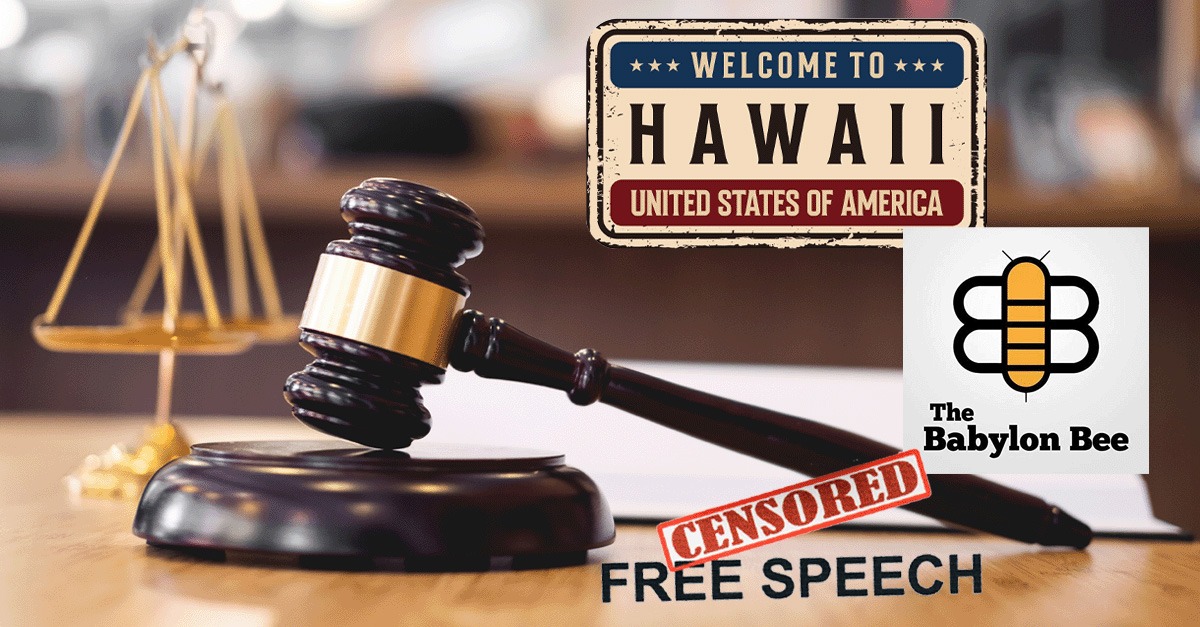
A federal judge struck down Hawaii’s attempt to force satire sites to label their content as “fake,” ruling the law unconstitutional and reaffirming that the First Amendment protects even sharp, political humor from government control.
Update (April 14, 2026): A federal court has blocked enforcement of Hawaii’s Act 191, ruling that forcing satire outlets like The Babylon Bee to label their content as “fake” violates the First Amendment. The decision reinforces longstanding constitutional protections against compelled speech and government overreach in regulating political expression.
Original: Act 191, passed in 2024, sought to criminalize “materially deceptive” political content and required satire and parody to carry a disclaimer stating that it was fake.
The law made no meaningful exception for satire. That is why The Babylon Bee and humorist Dawn O’Brien challenged it, arguing that forced disclaimers drain satire of its force and let government dictate how political humor must be presented.
They argued that the law violated the First Amendment by restricting speech and compelling speakers to say what government wanted said, and that its vague wording invited arbitrary, viewpoint-based enforcement in violation of due process.
Because Act 191 targeted speech based on content, Hawaii had to prove it used the least restrictive way possible to protect elections. It failed to do so, even though alternatives like counterspeech, media literacy, and other less speech-restrictive remedies were available.
Judge Sharilyn A.S. Park wrote,
“State Defendants’ expert agrees that ‘with strengthened media literacy skills and greater political sophistication, people can be more likely to identify political deepfakes and less likely to believe that they are accurate.’ Defendants’ expert’s only reservation with increased literacy as a viable alternative appears to be that developing such skills in the electorate ‘would require a larger investment of resources’ compared to a ban. Such a reason has been rejected by the Supreme Court for it has made clear that ‘[t]he First Amendment does not permit the State to sacrifice speech for efficiency.’”
Park also ruled that existing laws, including those governing defamation and election fraud, already address much of the conduct Act 191 sought to prohibit.
Ultimately, Park found that the law violated not only the First Amendment rights of The Babylon Bee and O’Brien but also their due process rights under the Fourteenth Amendment. She wrote:
“Rather than require actual harm, Act 191 imposes a risk assessment based solely on the value judgments and biases of the enforcement agency—which could conceivably lead to discretionary and targeted enforcement that discriminates based on viewpoint…In this case, the ultimate consequence of indeterminate compliance lines and the risk of discriminatory enforcement is a chilling effect on First Amendment speech.”
Park granted the plaintiffs’ request for summary judgment, meaning that the judge decided the case on its merits without requiring it to go to trial.
Matthew Hoffman, legal counsel with Alliance Defending Freedom (ADF), which represented The Babylon Bee, celebrated the decision. He stated,
“The court is right to put a stop to Hawaii’s war against political memes and satire. The First Amendment doesn’t allow Hawaii to choose what political speech is acceptable and censor speech in the name of ‘misinformation.’ That censorship is both undemocratic and unnecessary.”
The Babylon Bee has frequently been at the center of free speech debates.
In 2022, the outlet was suspended from Twitter after naming former Health and Human Services Deputy Secretary Dr. Rachel Levine as “Man of the Year” in response to USA Today’s decision to name Levine, a male who claims to be a woman, as one of its “Women of the Year.”
Elon Musk contacted The Babylon Bee to confirm the suspension. That incident became part of the broader public debate that preceded Musk’s eventual purchase of Twitter, now X, and his stated commitment to restoring free speech protections on the platform.
Hawaii was not the first state to try this. In California, similar efforts to regulate AI-driven political parody also ran into constitutional trouble, reinforcing the same basic point: government cannot treat satire as a threat simply because it is politically effective.

Laws like Act 191 do more than target deception – they hand government a new tool to police political expression, especially speech that embarrasses powerful people under the banner of protecting the public.
Private platforms can adopt their own policies on AI-generated content. The far more dangerous question is what happens when government forces speakers to use its preferred language before they are allowed to mock, criticize, or parody public figures. That is why satire matters. Good satire tells the truth sideways. It exposes folly, hypocrisy, and political absurdity in a form ordinary argument often cannot. And that is precisely why politicians so often fear it.
AI raises real concerns, and genuine fraud or election deception should be taken seriously, but the answer cannot be to give government the power to decide what political speech is too dangerous to remain free. That path does not stop with satire. It ends in censorship, compelled speech, and the steady shrinking of public debate. Americans do not need warning labels pasted over parody by the state. They need leaders who trust the people enough to let truth compete in the open.
Stand for truth when it’s under pressure. Your support helps defend free speech, expose censorship, and advance a biblical worldview in today’s most critical battles.