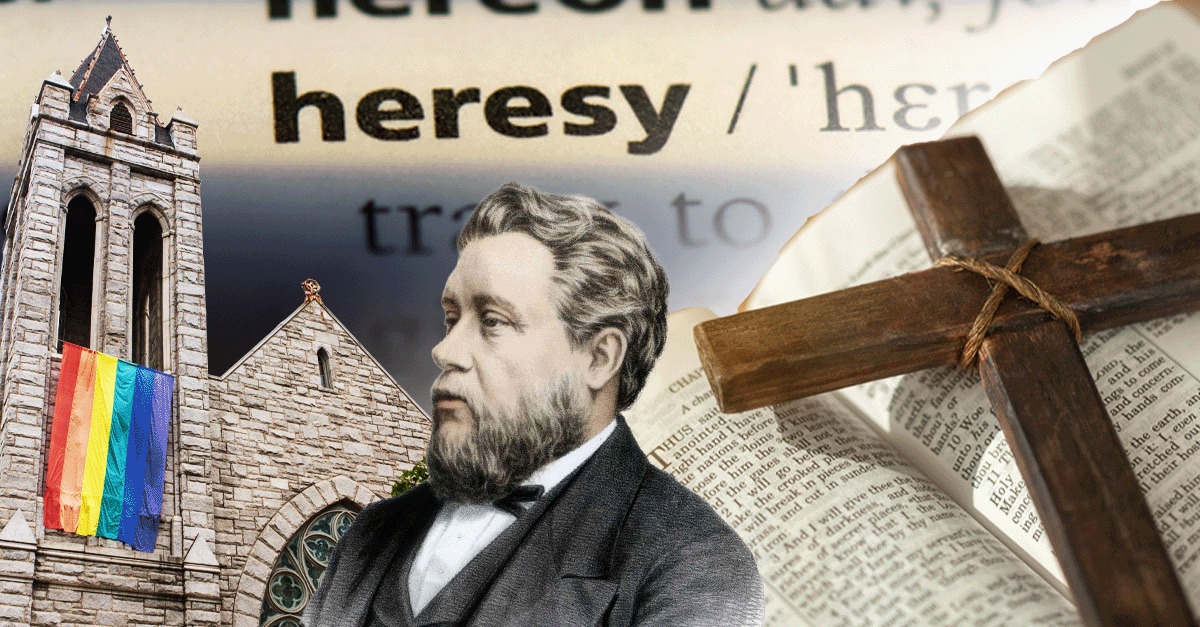
How did mainline Protestant churches come to embrace female pastors, abortion, homosexuality, and the belief that Scriptural doctrine is somehow “fluid”? Look no further than Charles Spurgeon’s Victorian-era battle with the Baptist Union, the original “jellyfish” pastors.
In 2023, Sarah Mullally stated at the Church of England General Synod, “It is my prayer that what has been agreed today will represent a step forward for all of us within the church — including LGBTQI+ people — as we remain committed to walking together…[this is] a moment of hope for the church.”
Last fall, Mullally became the first woman ever installed as the Archbishop of Canterbury in the United Kingdom. To be clear, God does not recognize her legitimacy as a shepherd of His Church, so “installed” is used precisely here. Regardless, it is notable that the highest position of authority in the Church of England is now held by a pro-abortion, LGBTQI-affirming shepherdess.
If you were waiting for a sign of the times, this is it.
Mrs. Mullally is far from the only woman who fancies herself a pastor. As of 2016, women accounted for over 20 percent of “ordained” ministers in the United States alone.
Yet female pastoring is clearly heretical. Paul’s letters to Timothy and the Corinthians are absolute and universal in their teaching, so why the confusion? In many cases it isn’t confusion at all but rebellion; ignorance is to blame for the remainder.
A New Theology has superseded Scripture, but it’s hardly new. It can actually trace its roots back to the great theological debates of late Victorian England, when “enlightened” church leaders began to doubt the doctrinal clarity of God’s Word.
Spurgeon and the Down-Grade Controversy
God’s champion in these debates was Charles Spurgeon, a Baptist pastor out of London, England, who boldly defended the divine inspiration and inerrancy of Scripture against his contemporaries. In an 1887 issue of his magazine, “Sword and Trowel,” he condemned the heresies of his time, writing that the “New Theology can do no good towards God or man,” even if it was preached for a thousand years.
Every century presents the Church with its own unique heresy to combat. Polycarp was burned at the stake in the 1st century for refusing to call Caesar “Lord.” Irenaeus purged the Gnostics in the 2nd century. In the 5th century, Augustine battled Pelagius over the doctrine of original sin. More than 1,000 years later, Jonathan Edwards led the Church through the debates of the Great Awakening.
Ignatius. Tertullian. Benedict. Wycliff. Huss. The list goes on. Christ’s Church is always under assault, but He raises up faithful men in each generation to defend it.
Such was Charles Spurgeon’s lot. The Prince of Preachers started his vocation in a world colored by Charles Darwin’s newly published On the Origin of the Species and the scientific theory of natural selection. This was the time of the great Victorian philosophers and naturalists. A world of rational men, evolved men. That was the idea at least. Presuming the mysteries of nature solved, the grandchildren of the Enlightenment ignited the long 20th century with a new string of heretical teachings.
Was Creation really six literal days? Are women actually forbidden to teach in church? How do we know that Christ is the only way to avoid eternal damnation? Is Scripture Divinely inspired? These questions were asked because Scripture itself, its inerrancy, was under suspicion.
Leading the charge in this new “rational” theology was the Baptist Union of England. Spurgeon, a member of the Union and pastor of England’s largest church, was convinced that he was seeing a theological drift that would lead the Church into a “down-grade.”
Today we would call this a slippery slope.
Spurgeon challenged men like John Clifford, then president of the Union, on these key Biblical issues. Chief among these was Clifford’s low-view of Scripture, one that would have far-reaching theological implications. Clifford’s 1888 book The Inspiration and Authority of the Bible states, “…we seriously imperil the authority and limit the service of Scripture every time we advocate its absolute inerrancy.”
That statement is worth pausing on. Clifford is claiming that the absolute truth of Scripture is a stumbling block to its effectiveness. He doubles down in a sermon entitled “The Supreme Test of Every Religion,” preaching that the appeal of our faith is “not on a book, though that book be the Bible, but on the accumulated experiences of Christian men throughout nineteen centuries.”
How reckless. Clifford’s position (completely disregarding John 1:1) is that Scripture itself is not the ultimate authority on Christ, that mistakes might actually be baked into the text.
Instead, he proposed that our faith rests wholly on a personal relationship with Jesus. Sound familiar? The Baptist Union endorsed a low view of Scripture for entirely pragmatic reasons. Distancing themselves from creedal dogmas and literal Biblical interpretation would (theoretically) allow them to reach more people with the Gospel. It provided ambiguity, just enough room to squirm away from hard Scriptural issues that might offend. “Jelly-fish Christians,” Spurgeon would call them. In hindsight, they look a lot like the original “seeker-sensitive” movement.
Spurgeon responded to the challenge of Scriptural inerrancy by stating:
“Unless we receive Christ’s words, we cannot receive Christ. Unless we receive His apostles’ words, we cannot receive Christ.”
The cost of all this, of course, is sound theology — the substance of the Down-Grade Controversy. Spurgeon understood that even small theological compromises would lead Baptists into all manner of wicked heresy. Like the ship captain who is one degree off his heading, it doesn’t seem notable at first, but over time that slight error will lead the crew hundreds of miles off course.
In an 1887 sermon, Spurgeon writes that in spite of the Baptist Union’s good motivations, “the new views are not the old Truth in better dress, but deadly errors.” A charitable assessment.
Even so, he later writes that “it is never right to do a little wrong,” and that “[even] if an act of sin would increase my usefulness tenfold, I have no right to do it.”
In other words, evil can never be channeled into righteousness. Pursuit of the “common good” cannot be founded on disobedience, no matter how good the intention may be.
Social Justice, Self-Worship, and the “Fluid” Gospel
Charles Spurgeon was right, but he didn’t win his battle. Not yet at least. By the 1920s, the women’s suffrage movement was in full swing, and the Church faced intense pressure to soften Biblical gender roles. In 1922, the Episcopal Church voted to remove the word “obey” from the bride’s marriage vows. This was later codified in their 1928 Book of Common Prayer. Language that implied inequality couldn’t be tolerated, even if it was Scripturally sound.
The Civil Rights era then brought social issues to the doorstep of the Church. In the wake of Brown vs. the Board of Education and the Montgomery bus boycotts, the Church was increasingly pressured to weigh in on social issues. Liberation theology gained traction, reframing Christianity through the lens of “social justice.” It was around this time that female ordinations became institutionalized. Women were intent on breaking the “stained-glass ceiling.” One such trailblazer was Geneva Iradell, who, arguing in defense of female pastors, asked, “Who are we to deny ordination to those God has chosen?”
The proper response to these questions is simple: Would God endorse that which he has expressly forbidden? Certainly not. Yet, more than 50 years later, female pastors abound, abortion is tolerated, and homosexuality is embraced in the Church. The jellyfish pastors of our time are repeating the sins of their fathers.
In service of the “common good,” they embrace woke theology that worships, above all, the self. They view Biblical doctrine, like gender, as somehow “fluid,” able to change in response to individual feelings and needs. They ignore Christ the Word and have created an effigy of Christ the Tolerant, an all-loving God who has matured past His Old Testament fury.
It’s total heresy. Root to stem.
When Scriptural truth became negotiable, any defense of the Christian tradition was de-fanged. We are reading entirely different Bibles, deriving a completely different exegesis from the text. It’s almost difficult to call ourselves brothers and sisters in a common Lord.
The Turning Point of the Down-Grade
And so we return to Mrs. Sarah Mullally. The would-be Archbishop of Canterbury is a product of her time, the logical end of the theological drift Spurgeon spent his life fighting against. She sits in the house of God and wears the cloth of a cleric but is no more a pastor than I am a kangaroo.
We used to know this. In fact, stating such an obvious truth would certainly garner looks of confusion just 150 years ago.
The absurdity of the modern Church has brought us to a turning point in the down-grade. We are (by God’s grace) not at the bottom, but we have fallen far enough to see the danger we are in. The rootless, seeker-sensitive movement is dying. Young men are hungry for a robust, traditional Christian faith, one that is grounded in Truth.
In an age of apostasy, a righteous Church can’t help but offend. The Gospel is, after all, an affront to the spirits of this world. Let it be so, and let it honor our Lord Jesus Christ, the same yesterday, today, and forever.
If you like this article and other content that helps you apply a biblical worldview to today’s politics and culture, consider making a donation here.