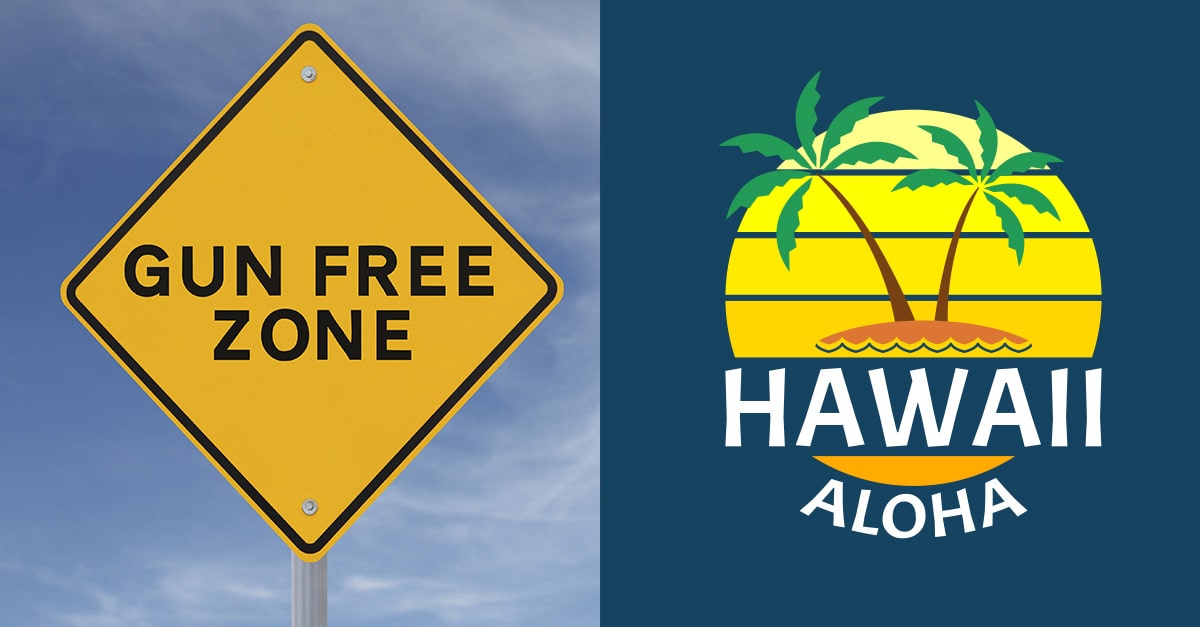
The justices will decide whether a state government can declare all private property to be gun-free zones for concealed carry holders — unless a property owner posts a sign saying that guns are allowed.
In a case that could have far-reaching implications for gun owners nationwide, the U.S. Supreme Court has agreed to hear a challenge to Hawaii’s strict firearms law that bans carrying guns on private property unless the owner specifically allows it.
At issue is whether states can presume private property to be gun-free zones unless owners post signs allowing firearms. This is a reversal of the traditional standard in which citizens have the right to bear arms unless a property owner objects.
Hawaii’s law, signed by Gov. Josh Green, D, in 2023, also restricts firearms from being carried in other “sensitive places” including beaches, parks, bars, and restaurants. While the justices declined to take up that portion of the law, they agreed to review the section dealing with private property, setting up a major Second Amendment battle that could clarify how far states can go in limiting the lawful carry of guns.
The Trump administration has filed a brief in support of the challenge. It argues that Hawaii’s restrictions on firearms violate the Court’s 2022 decision in New York Rifle & Pistol Association v. Bruen that recognized the right of law-abiding Americans to carry handguns in public for self-defense.

“From the earliest days of the republic, individuals have been free to carry firearms on private property unless the property owner directs otherwise,” the administration’s brief reads. “Because most property owners do not post signs either allowing or forbidding guns, Hawaii’s default rule functions as a near-complete ban on public carry. A person carrying a handgun for self-defense commits a crime by entering a mall, a gas station, a convenience store, a supermarket, a restaurant, a coffee shop, or even a parking lot.”
The brief went further, saying, “The structure and operation of Hawaii’s law reveal that the law serves no legitimate purpose and instead seeks only to inhibit the exercise of the right to bear arms.”
The case, which will be argued later this term, is expected to be decided by June 2026. Three Hawaii residents, joined by a Honolulu-based gun rights group, brought the challenge, arguing that the law makes it “impossible as a practical matter to carry a firearm for lawful self-defense in Hawaii.”
A federal judge initially blocked parts of the law, siding with the plaintiffs. The Ninth U.S. Circuit Court of Appeals later reversed much of that decision, prompting an appeal to the nation’s highest court. In his dissent from the appellate ruling, Judge Lawrence VanDyke warned that Hawaii’s approach “effectively nullified the Second Amendment rights of millions of Hawaiians.”
Hawaiian state officials argue that the law is consistent with property rights and limits on where weapons may be carried. Gun rights advocates say that the case marks a defining moment for constitutional freedoms. They warn that allowing Hawaii’s law to stand would open the door for state governments to create widespread gun-free zones across both private and public spaces.
Many conservatives view the dispute as a continuation of the Supreme Court’s 2022 Bruen decision, in which the justices struck down New York’s restrictive concealed-carry permitting system. Writing for the 6-3 majority at the time, Justice Clarence Thomas declared, “In this case, petitioners and respondents agree that ordinary, law-abiding citizens have a similar right to carry handguns publicly for their self-defense. We too agree, and now hold, consistent with Heller and McDonald, that the Second and Fourteenth Amendments protect an individual’s right to carry a handgun for self-defense outside the home.”
Supporters of the challenge also point out the practical implications of Hawaii’s rule, which would make lawful carry virtually impossible in daily life. Because most businesses post no signs either permitting or banning firearms, the default assumption under the law would essentially turn the entire island state into a patchwork of gun-free zones.
Legal scholars expect the Hawaii case to clarify whether the law is a reasonable regulation or open defiance of the Court’s 2022 ruling. If the justices strike down Hawaii’s law, it will reaffirm that the right to bear arms extends onto the private property of others unless a property owner explicitly says otherwise.
The Supreme Court’s decision will determine not only how Hawaii enforces its gun laws but how the rest of the nation defines the boundaries of the Second Amendment in daily life. The ruling could be one of the most consequential in a generation concerning the personal freedoms of Americans.

The fight over Hawaii’s gun law is a question of fundamental freedom. The right to self-defense is deeply rooted in both constitutional and biblical principles, involving the duty to protect one’s life, family, property, and neighbor.
This duty is part of good stewardship. God asks us to care for what He places in our hands. When government assumes that citizens cannot be trusted with liberty, it denies both the worth of the individual and the authority of the One who grants that freedom in the first place.
Personal freedom requires personal responsibility. The same Scripture that upholds peace also affirms the right to defend against evil. Luke 11:21 reminds us, “When a strong man, fully armed, guards his house, his possessions are safe.” That verse does not glorify violence; it affirms that order and protection are moral goods.
Surrendering freedom in the name of security often leads to the loss of both. History repeatedly shows that when people trade liberty for control, it results in neither safety nor peace. Christians are called to live wisely, preserving freedom so that truth can flourish and the Gospel can be proclaimed.
Freedom cannot survive if the right to self-defense is stripped away. The Second Amendment is not a preference but a cornerstone of the liberty that defines America. It affirms that the power to protect life, family, and property belongs first to the citizen, not the state. When government presumes to decide who may exercise that right and where, it undermines every other freedom built upon it.
The Founders understood that disarmed citizens are dependent citizens. Dependent citizens are never truly free. As the Supreme Court weighs Hawaii’s gun control law, Americans should remember that the right to bear arms is inseparable from the right to live free.
If you like this article and other content that helps you apply a biblical worldview to today’s politics and culture, consider making a donation here.