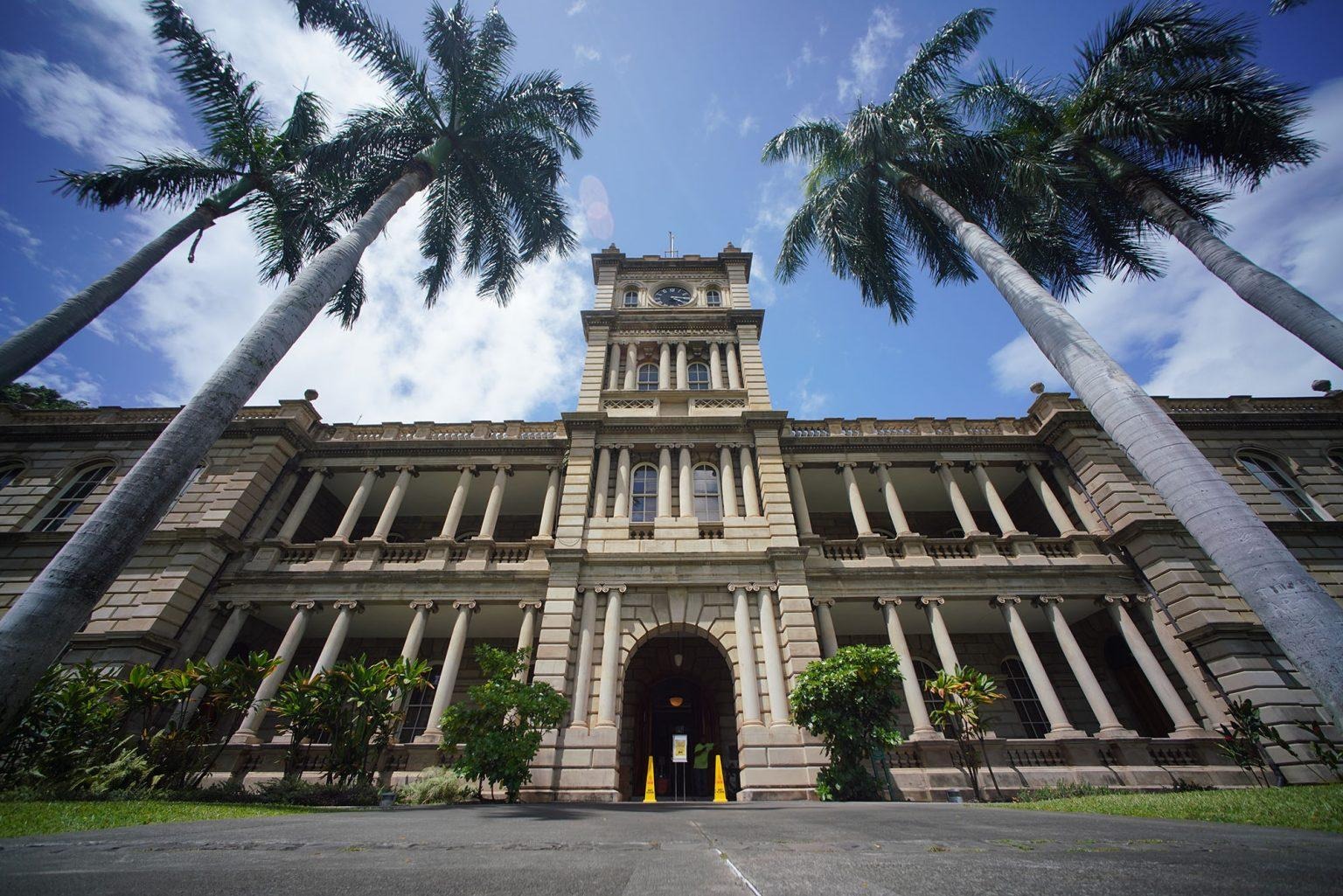
The Hawaii Supreme Court ruled that the state’s constitution does not protect a right to carry firearms for self-defense, rejecting the U.S. Supreme Court’s Second Amendment framework and arguing that Hawaii’s constitutional tradition is guided by the “Spirit of Aloha.”
Update: The U.S. Supreme Court later declined to take Christopher Wilson’s appeal, but Justice Clarence Thomas, joined by Justice Samuel Alito, warned that the Hawaii Supreme Court’s ruling raised “serious questions” and failed to meaningfully address Wilson’s Second Amendment argument under New York State Rifle & Pistol Association v. Bruen. The Supreme Court has also taken up Wolford v. Lopez, another Hawaii gun-rights case involving whether the state may bar concealed-carry permit holders from carrying firearms on private property open to the public unless the owner gives express consent.

Original: Justices with the Hawaii Supreme Court argue that Hawaii must follow the “spirit of Aloha,” not the rulings of the U.S. Supreme Court, when it comes to the Second Amendment rights of individuals.
The Supreme Court of Hawaii has handed down a decision that claims there is no right to carry a firearm for self-defense in the state, while also chastising the U.S. Supreme Court and making the assertion that Hawaii is not required to follow its rulings on the Second Amendment.
The judges made the 5-0 ruling last week in a case involving Christopher Wilson, a man who was arrested in 2017 for carrying a firearm in violation of Section 134-25, a state law that doesn’t allow people to carry a firearm outside the home.
Wilson filed suit to have the charges dismissed, claiming the law violates his Second Amendment right to carry a firearm for self-defense.
A district court initially upheld the charge. However, following the U.S. Supreme Court’s decision in New York State Pistol & Rifle Association v. Bruen that found that there is a Second Amendment right to carry a firearm outside the home for self-defense, a circuit court judge reversed the decision and dismissed the charges against Wilson.
The state appealed to the Supreme Court of Hawaii, which dismissed Wilson’s suit and required him to stand trial. Wilson later asked the U.S. Supreme Court to review the decision, but the Court denied his petition, with Justice Thomas, joined by Justice Alito, writing separately that the Hawaii ruling raised “serious questions.”
The decision by the Supreme Court of Hawaii has garnered national attention for its brazen refusal to follow the Supreme Court’s ruling, as well as its unique reasoning.
While Article 1, Section 17 of the Hawaiian Constitution is nearly identical to the words of the Second Amendment, the state supreme court found that there is actually no right to carry a firearm in the Hawaiian Constitution and argued that the U.S.’s highest court also got it wrong when reviewing the U.S. Constitution.
“We read those words differently than the current United States Supreme Court,” read the unanimous ruling, which was written by Justice Todd Eddins.
The opinion claimed that when the state’s supreme court sees things differently than the Supreme Court, “this court frequently walks another way. Long ago, the Hawaiʻi Supreme Court announced that an ‘opinion of the United States Supreme Court . . . is merely another source of authority, admittedly to be afforded respectful consideration, but which we are free to accept or reject in establishing the outer limits of protection afforded by . . . the Hawaiʻi Constitution.’”
The judges stated that, until the last few decades, there was no understanding that the Second Amendment provided individuals the right to bear arms. They also argued that justices had cherrypicked laws and historical tradition, while ignoring anything that would debunk their reasonings in order to come to its 2022 decision in Bruen, its 2008 decision in District of Columbia v. Heller, and its 2010 decision in McDonald v. City of Chicago, all of which affirm the individual’s right to self-defense under the Constitution.
The Hawaiian Supreme Court also took issue with the test established by the U.S. Supreme Court in Bruen, which requires judges to look to the historical tradition of firearms restrictions when deciding Second Amendment cases.
“Time-traveling to 1791 or 1868 to collar how a state regulates lethal weapons — per the Constitution’s democratic design — is a dangerous way to look at the federal constitution. The Constitution is not a ‘suicide pact,’” the judges wrote. “We believe it is a misplaced view to think that today’s public safety laws must look like laws passed long ago. Smoothbore, muzzle-loaded, and powder-and-ramrod muskets were not exactly useful to colonial era mass murderers.”
The court even attacked the concept of history itself, citing Melissa Murray’s, Children of Men: The Roberts Court’s Jurisprudence of Masculinity to argue that “the current Court ‘frequently relies [on] moments in which women and people of color were expressly excluded from political participation and deliberation.’”
“History is messy. It’s not straightforward or fair. It’s not made by most,” they wrote.
The court reasoned, “As the world turns, it makes no sense for contemporary society to pledge allegiance to the founding era’s culture, realities, laws, and understanding of the Constitution. ‘The thing about the old days, they the old days.’”
The last line quoted in the ruling was by a fictional drug dealer in the gritty HBO crime series “The Wire.”
Oddly enough, the court then spent several pages arguing that restriction of firearms was consistent with the history of the Kingdom of Hawaii before it was part of the U.S., most notably the edicts and laws of King Kamehameha I and Queen Liliʻuokalani.
Then its argument took an even more interesting turn.
“In Hawaiʻi, the Aloha Spirit inspires constitutional interpretation,” Justice Eddins argued, explaining,
“When this court exercises ‘power on behalf of the people and in fulfillment of [our] responsibilities, obligations, and service to the people’ we ‘may contemplate and reside with the life force and give consideration to the “Aloha Spirit.”’ The spirit of Aloha clashes with a federally-mandated lifestyle that lets citizens walk around with deadly weapons during day-to-day activities.”
Anne Lopez, Hawaii’s Attorney General, praised the decision, stating,
“This is a landmark decision that affirms the constitutionality of crucial gun-safety legislation. Gun violence is a serious problem, and commonsense tools like licensing and registration have an important role to play in addressing that problem. More broadly, Justice Eddins’ thoughtful and scholarly opinion for the court provides an important reminder about the crucial role that state courts play in our federal system.”
While Lopez supported the decision, others found the ruling hard to believe.
Jonathan Turley, a professor of constitutional law at George Washington University, addressed the court ruling in his blog recently, writing,
“It has been 65 years since Hawaii became a state, but the Hawaiian Supreme Court appears to be having second thoughts. In an extraordinary ruling, the unanimous Supreme Court rejected the holdings of the United States Supreme Court on the Second Amendment as inapplicable to the 50th state. Hawaii apparently is controlled not by the precedent of the Supreme Court but the ‘spirit of Aloha.’ While Queen Liliʻuokalani would be pleased, the justices on that ‘other’ Supreme Court may view such claims as more secessional than spiritual.”

The Hawaii Supreme Court’s ruling is about more than one state’s gun laws. It raises a larger question: whether constitutional rights mean the same thing across all 50 states, or whether judges can reinterpret those rights according to local preference, political ideology, or cultural sentiment.
The Second Amendment protects the right of Americans to keep and bear arms, and the U.S. Supreme Court has repeatedly affirmed that this includes an individual right to self-defense. Hawaii’s attempt to place the “Spirit of Aloha” above that precedent is not just legally troubling — it is a warning about what happens when courts treat constitutional limits as optional.
If rights can be narrowed whenever judges dislike their consequences, then no right is truly secure.
Every generation must decide whether the principles it inherits are worth preserving.
The Standing for Freedom Center exists to help people engage those challenges with clarity, conviction, and courage. If this work has informed or encouraged you, would you consider helping us continue it?