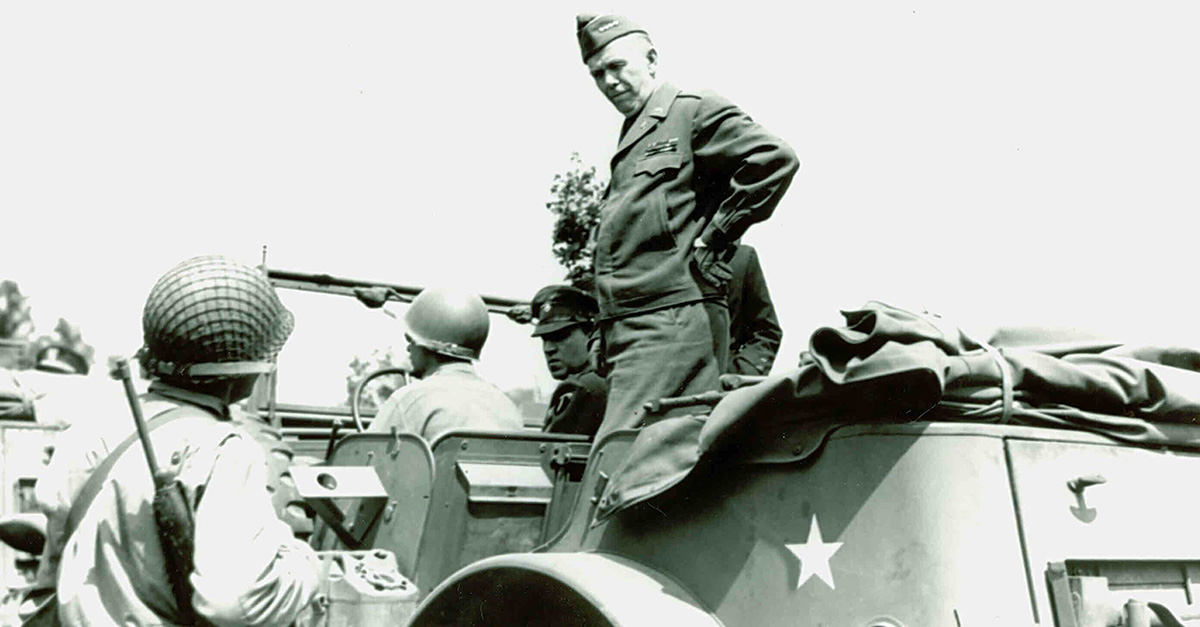
Gen. George C. Marshall broke the Army’s stale traditions by elevating commanders on merit rather than seniority and, in so doing, transformed the U.S. military into the world’s greatest fighting force.
On September 1, 1939, two world-changing decisions were made: One officially started World War II and the other would ultimately end it.
Early that morning, Adolf Hitler sent his Nazi war machine into Poland and finally kicked off the European invasion he’d been threatening for nearly two years, while several hours later and several time zones away, U.S. President Franklin D. Roosevelt quietly announced that he had picked the relatively unknown Gen. George C. Marshall to serve as his new Army Chief of Staff.
Hitler’s decision to start World War II dominated the headlines for weeks to come, but as events conspired to eventually draw the U.S. into the war in Europe and the Pacific, many began to realize that FDR’s personnel decision had been just as consequential.
Few could have predicted it at the time, but Marshall’s knack for strategy, logistics, and diplomacy, his willingness to challenge entrenched Army policy and tradition, and his inspired choices of battlefield commanders would not only transform the U.S. military into the greatest fighting force in the world but — against all odds — enable the U.S. to lead the Allies to win a global war.

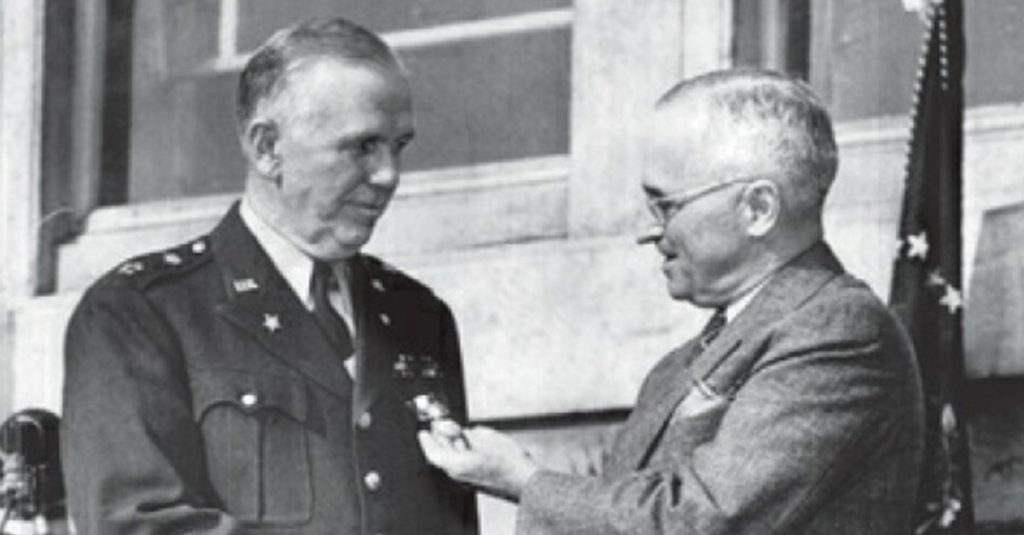
When the war ended in 1945, British Prime Minister Winston Churchill publicly credited Gen. George Marshall as “the true organizer of victory,” while President Harry Truman declared him to be “the man who won the war.”
And yet his story holds a different kind of lesson today, for it highlights why merit should be the only standard by which people are hired, promoted, and advanced.
For most of his career, Marshall, like many others, had been stymied by the Army’s seniority system, which promoted officers based solely on their time in service and their location on a waiting list. Officers who hoped to advance to the next rank, explained Marshall biographer Dr. Forrest C. Pogue, “just had to wait until somebody died or somebody retired.”
Despite having been in the Army for nearly 40 years and earning raves from all who worked with him for his planning and operational genius, integrity, candor, and rapport with his men, Marshall had only made brigadier general three years prior. So when FDR went looking for someone who could excel as his top miliary advisor, he didn’t find Marshall at the top of the list of Army generals; in fact, Marshall wasn’t even in the Top 10 or Top 30.
So needless to say, many at the Pentagon were surprised and angered when the President passed over 33 more senior military leaders and tapped the dignified, unflappable, blue-eyed native of tiny Uniontown, Pennsylvania, for the Army’s top job.
Why? Because like everyone else who’d ever come in contact with Marshall, FDR recognized and appreciated him as an absolute genius at getting things done — and getting them done right.
Marshall’s immediate task was to apply that genius to one primary goal: Make the Army great again.
It would be a momentous undertaking. After 20 years of troop drawdowns and minimalist budgets, the U.S. Army had devolved into a shell of what it had been at the end of World War I. In September 1939, it had just 174,000 men, making it only the 19th largest army in the world, smaller than that of Portugal.
What’s more, an isolationist fervor had taken hold across America, and with the financial effects of the Great Depression still lingering, no one was keen on spending the country’s limited funds on building up the military just so it could get bogged down in another bloody European war.
Marshall wasn’t particularly keen on it either, once characterizing modern conflict as “all horrible, profoundly depressing.”
But he also knew that the only thing worse than going to war was going to war unprepared.
He’d seen it firsthand in France during World War I when he served as chief of operations of the First Division and later as a top assistant to Gen. John J. Pershing, the head of the American Expeditionary Forces. Marshall had been horrified at how undertrained and underequipped U.S. troops had been even as they were thrown into the slugfest along the Western front, and he would long lament the mistakes and massive number of casualties that had resulted from it.
In response, Marshall would spend the next 20 years thinking on the nature and logistical demands of a future war and was surprisingly proactive in taking steps to help prepare the Army for the possibility.
For example, as head of the Army Infantry School at Fort Benning from 1927 to 1932, he took it upon himself to completely overhaul the Army’s training curriculum and methods in anticipation of a more mobile, more mechanized, and more brutal style of warfare. Through the years, he even kept a “little black book” of up-and-coming officers who impressed him with their quick thinking, creativity, and leadership skills.
So by the time he was formally sworn in as Army Chief of Staff, Marshall had a plan and he wasted no time working it.
Among the steps he took was to convince a very skeptical and isolationist Congress to not only give him a sizeable chunk of cash for recruitment and training but also to authorize the first peacetime draft in American history. He pushed to federalize the National Guard. And he worked with his staff to streamline the Army’s structure to make it more efficient and effective.
He also eliminated the Army’s antiquated seniority system and established a new standard for promotion and assignment: “Today’s performance.” In other words, merit. Who was best able to do the job at that moment in a way that would benefit the soldiers, the mission, and the country?
As Marshall himself bluntly put it,
“I do not propose to send our citizen-soldiers into action, if they must go into action, under commanders whose minds are no longer adaptable to the making of split-second decisions in the fast-moving war of today, nor whose bodies are no longer capable of standing up to the demands of field service. They’ll have their chance to prove what they can do. But I doubt that many of them will come through satisfactorily.”
Marshall set up a “Purge Board” of six retired officers to carefully review aging and underperforming active-duty officers and to cut all “dead wood” who didn’t measure up. The committee ultimately ousted more than 1,000 officers, including 500 colonels, some of whom had been long-time friends and colleagues of Marshall.
That move opened room at the top for the kind of younger, vigorous junior officers that Marshall had been observing and keeping notes on in his little black book for the past 15 years. However, nobody got to skate in on their reputation, past performance, the number of medals on their chest, or who they knew.
They would all be forced to prove their worthiness according to the very high standards of Gen. Marshall.
Most of them would get their chance to do just that in the spring, summer, and fall of 1941, when Marshall and his staff put on the “Louisiana Maneuvers,” the largest series of training exercises in the history of the U.S. Army. It would be, one historian noted, “the anvil on which the U.S. Army was shaped.”
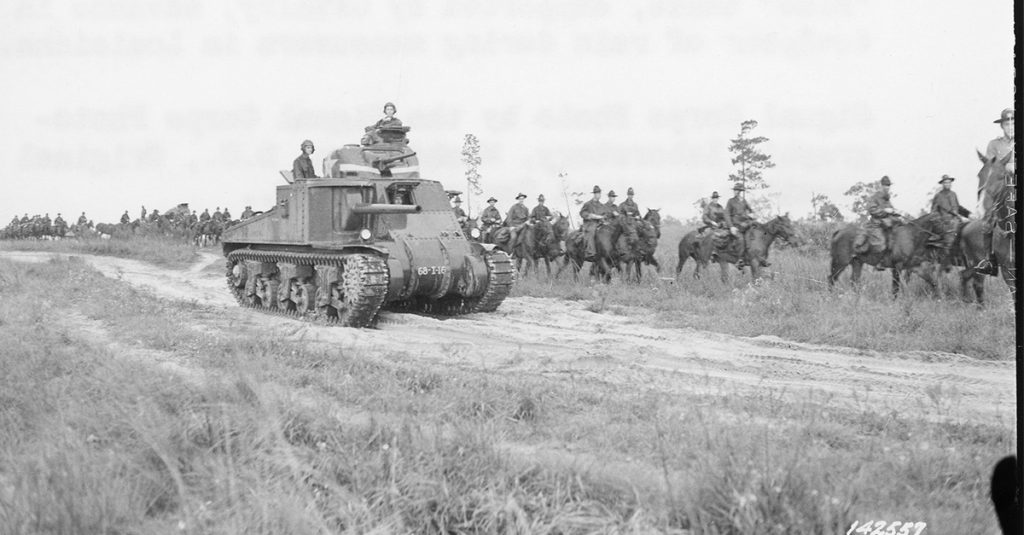
The largest of the three exercises saw nearly 500,000 troops, 50,000 wheeled and tracked vehicles, and 32,000 horses spread out across the swamps, open fields, small towns, and mud of the Deep South to partake in war games that would realistically simulate likely battle scenarios against the Nazi blitzkrieg.
The exercises were designed to stress-test the Army’s communications, structure, logistics, communications, and leadership and help it learn “to fight as a team.” But equally important, they offered a good look at what the cadre of up-and-coming officers could do under pressure. Among those who excelled were then-Col. Dwight Eisenhower, Lt. Col. Omar Bradley, and Lt. Col. Mark Clark, all of whom would later be rewarded with high command positions after the U.S. formally joined the war effort just months later.
The biggest beneficiary, though, was Patton. Then 54 years old and still a colonel, he came under the Purge Board’s review, but his youthful energy and charisma won him a reprieve; in Louisiana, assigned as a tank commander, Patton brilliantly demonstrated his knack for tactical innovation and adaptability that would soon make him a battlefield legend. Marshall personally chose him to lead the Army’s Third Division.
Later in the war, Marshall would apply his mission-focused standard to himself. In 1943, FDR offered his “top soldier” the chance to lead the D-Day invasion of Europe. It would be a dream come true for Marshall, who had long yearned for a field command, and everyone knew he could run the operation as well or better than anyone else. All he had to do was “open his hand,” Pogue noted. But he didn’t. He left it up to the President.
As Marshall would later recount,
“I just repeated again, in as convincing language as I could, that I wanted him [FDR] to feel free to act in whatever way he felt was to the best interests of the country and to his satisfaction, and not to consider my feeling in any way. I would cheerfully go whatever way he wanted me to go.”
In response, Roosevelt gave the assignment to Gen. Eisenhower, later explaining to Marshall, “I didn’t feel that I could sleep at ease if you were out of Washington.”
Eisenhower was more than up to the task, of course. But in hindsight, FDR’s throwaway compliment only further solidified that he’d made the right choice in 1939. Marshall had been the best man for the Army’s top job then — and he still was.
Later, Marshall would go on to serve in a number of other capacities, most notably as U.S. Secretary of State under President Truman, when he implemented the Marshall Plan that rebuilt Europe’s economy and infrastructure. For his efforts, he would become the first and only soldier to be awarded the Nobel Peace Prize.
He passed away on October 16, 1959, and was buried at Arlington National Cemetery. Today, many of “Marshall’s Men,” those extraordinary, handpicked officers who helped win World War II, lay in rest around him.

When George Marshall took over as head of Fort Benning’s Infantry Training School, he invoked a simple goal, which today might be dubbed the Marshall doctrine for how to operate a successful military:
“We must get down to essentials and expunge the bunk.”
He later relied on this philosophy to choose the absolute smartest, most talented officers who could recruit, train, equip, and lead a vast force of citizen-soldiers and prevail in a two-theater war against incredibly ruthless adversaries. In so doing, the U.S. military became the greatest fighting force in the world.
Unfortunately, in recent years, politicians and military leaders decided to get away from the essentials and add in a lot of “bunk.” Such nonsense included diversity, equity and inclusion (DEI), critical race theory (CRT), radical gender ideology, and other woke and Marxist ideologies.
What did that look like in practice? The U.S. Navy hosted drag shows on warships and hired an active-duty drag queen to be the face of its new recruiting campaign. West Point removed its long-time slogan “Duty, Honor, Country” from its mission statement. All the service academies relied on race-conscious admissions and incorporated “critical race theory,” “anti-racism,” and “white privilege” trainings into their curriculum.
Policies were changed so men identifying as women could join up, get access to taxpayer-funded sex change treatments and surgeries, and live and train with female units. Abortion was pushed, and the Biden administration authorized the military to pay for “abortion travel” for servicemembers and their families.
The Pentagon “removed aptitude tests that adversely impacted diversity,” renamed iconic military bases to avoid “offending” anyone, and removed paintings and statues of historic military figures. And Gen. Mark Milley, who refused to take accountability for the disastrous Afghanistan withdrawal and the men and women killed under his watch, went before Congress to rail about his desire to understand all the “white rage” that he insisted was increasingly prevalent in the ranks.
Proponents tried to claim that all this somehow improved “military readiness” and kept America safe from its enemies, but what it really did was breed suspicion and divisiveness, destroy morale, and drive recruiting to its lowest levels since the Vietnam War.
Fortunately, the Trump administration has now reversed those policies. On January 25, newly appointed Secretary of Defense Pete Hegseth released an executive order titled “Restoring America’s Fighting Force.” In it, he declared that the military would now focus solely on one singular mission: “to win the Nation’s wars.”
“To do this, we must have a lethal fighting force that rewards individual initiative, excellence, and hard work based on merit,” Hegseth stated. To ensure this, he ordered the elimination of all DEI offices and any programs, elements, or initiatives that “subvert meritocracy, perpetuate unconstitutional discrimination, and promote radical ideologies related to systemic racism and gender fluidity.”
Moreover, he stated, all decisions related to promotion, command, and special duty assignments must be made “in accordance with merit-based, color-blind policies.”
In other words, it’s again time to “get down to essentials and expunge the bunk” so the United States military can remain the world’s greatest fighting force — just as it has for more than 80 years, thanks to Gen. George C. Marshall.
If you like this article and other content that helps you apply a biblical worldview to today’s politics and culture, consider making a donation here.