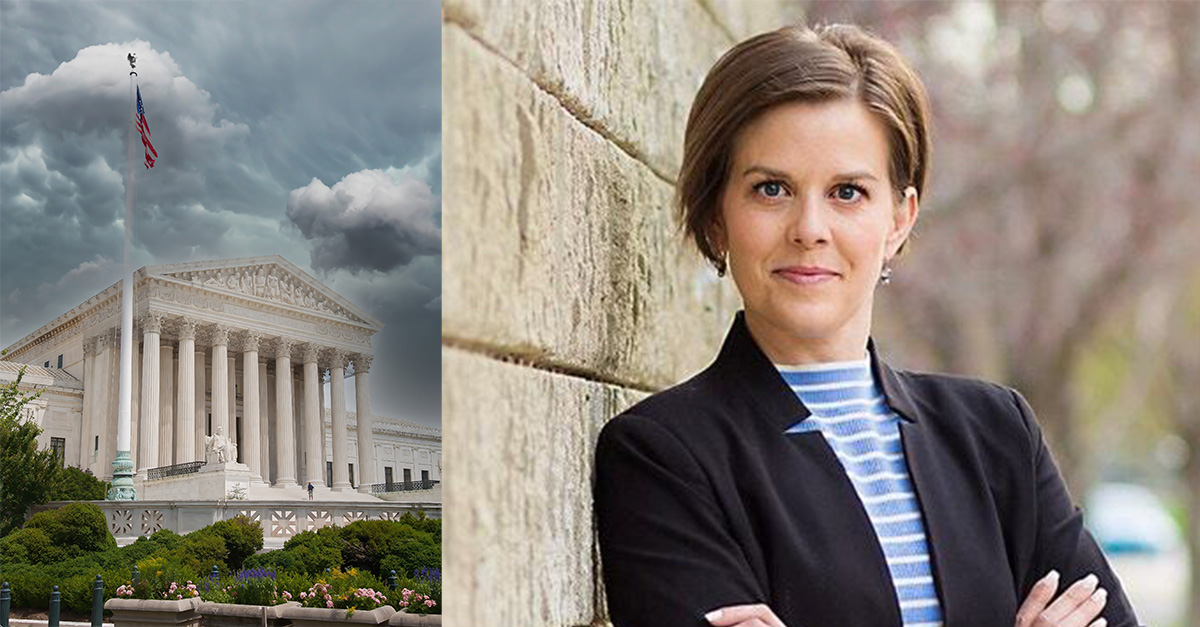
This decision restores not just the rights of Rep. Laura Libby, R, to have her vote count in the state legislature but also the 9,000 citizens she represents.
On May 20, the Supreme Court granted Maine Rep. Laurel Libby’s application for an injunction pending appeal, which means she will again be allowed to vote in the Maine legislature as her case proceeds.
In February, a male athlete identifying as female won the Maine state championship in girls’ pole vaulting. Libby posted on social media that the athlete had previously competed in the male division and placed fifth.
Libby stated that it was unfair for male athletes to compete against females due to their intrinsic athletic advantages.
House Speaker Ryan Fecteau asked Libby to remove the post, but she refused, saying, “I won’t apologize for speaking the truth and defending our women and girls in Maine that are being discriminated against.”
She was then censured, with a resolution passing by a 75-70 party-line vote to remove both her right to vote and right to speak in the Maine House of Representatives.
Libby and some of her constituents filed suit to have her rights restored.
A U.S. District Court judge ruled in favor of Fecteau, claiming the representatives who censured her had legislative immunity, which protects elected officials from lawsuits due to carrying out actions in the scope of their duties.
Libby filed an appeal to the U.S. Court of Appeals for the First Circuit and requested that the legislature be required to count her votes. The First Circuit agreed to hear her case on an expedited basis but denied her appeal to have her voting rights restored as the case proceeds.
Libby then petitioned the Supreme Court, which ruled 7-2 to grant an injunction pending appeal so she can vote and represent her constituents as the case proceeds.
No opinion was written by the majority, but Justice Kentanji Brown Jackson authored a dissenting opinion in which she wrote, “We have long recognized that this injunctive relief is appropriate only when ‘critical and exigent circumstances’ exist necessitating intervention ‘in aid of [our] jurisdictio[n],’ and the applicants’ entitlement to relief is ‘indisputably clear’. In my view, these applicants have not met this high bar.”
Jackson claimed that “the applicants have not asserted that there are any significant legislative votes scheduled in the upcoming weeks; that there are any upcoming votes in which Libby’s participation would impact the outcome; or that they will otherwise suffer any concrete, imminent, and significant harm while the lower court considers this matter.”
However Libby has already been denied the right to vote on several crucial actions, including the state’s biannual budget and a vote to codify the Maine Human Rights Act, which enshrines the right of transgender athletes to compete in sports according to their purported gender identity.
In response to the ruling, Libby said,
“Thankfully the Supreme Court saw the merits and the high stakes with this case, and really what was on the line not just for just me, my constituents in Maine, but really the entire country if this was upheld… No one should ever be silenced for speaking up on behalf of our girls.
Now we have a ruling from the Supreme Court that says no one can be silenced for speaking the truth even if it’s an unpopular truth. So I hope we will be seeing more folks speaking up on behalf of women and girls and their rights.”
Fecteau said that he would follow the Supreme Court’s decision and that Libby’s voting rights have been restored.
On Thursday, Libby shared a video of herself back in the legislature, where she voted for the first time in three months.
The First Circuit will hear oral arguments in her case on June 5.

This was a blatant attack on both representative democracy and the First Amendment. Thankfully, the Supreme Court ruled justly in rectifying an egregious wrong that would have set a debilitating precedent for the rest of the country.
In this case, the majority party, with only five more votes than the minority party, was able to remove an elected official’s right to speak and vote and, by extension, the 9,000 constituents she represents — all because it did not like something she said on social media.
That is anathema to a free representative republic.
To Justice Kentanji Brown Jackson’s dissent, which was largely based on procedural questions: It is not for a Supreme Court justice to decide which votes are important to a district and which are not.
Libby was punished for having a dissenting viewpoint and thus she and 9,000 people she represents were stripped of their constitutional right to vote based on that viewpoint. That is a violation of free speech rights, as well as viewpoint discrimination.
While the Supreme Court was not ruling on the merits of the case, not a single day should have passed without this obvious wrong being righted.
To have ruled any other way would be to set a precedent that majority parties may remove the right of minority parties to vote. As the Boston Globe noted: Imagine the reaction if the U.S. House of Representatives had chosen to not only censure Rep. Al Green for his disruptions of the State of the Union but to remove his right to vote?
That would be treated as a coup — as it should be.
In the United States, free speech is a God-given right. Libby spoke on the issue of males competing in women’s sports, a topic of much debate and an issue important to Libby and those she represents. Her state is currently violating both Title IX and President Donald Trump’s executive order banning males from competing in women’s sports. This defiance has led to federal investigations and will lead to the loss of funding for the people of Maine.
Libby claims she told Fecteau in a meeting before her censure, “Speaker, you’re going to go down in history as the man who silenced a woman for speaking up for girls.”
Now that the Supreme Court has weighed, Fecteau and others running the Maine House should finally take Libby’s statement under serious advisement. If they did, they might spend less time silencing women and more time listening to them and protecting their rights.
If you like this article and other content that helps you apply a biblical worldview to today’s politics and culture, consider making a donation here.