The Senate has repeatedly blocked efforts to advance the SAVE America Act, even as President Trump moves forward with executive action on citizenship verification and mail-ballot security. The question now is whether Congress can deliver lasting election reform.
Update – June 9, 2026: The Senate initially voted 51–48 on March 17 to begin considering the House-passed legislation. But subsequent efforts to advance the measure failed. On June 4, senators rejected an amendment tied to the SAVE America Act by a 48–50 vote. On June 5, a related proposal requiring citizenship verification and photo identification failed by a 50–49 vote.
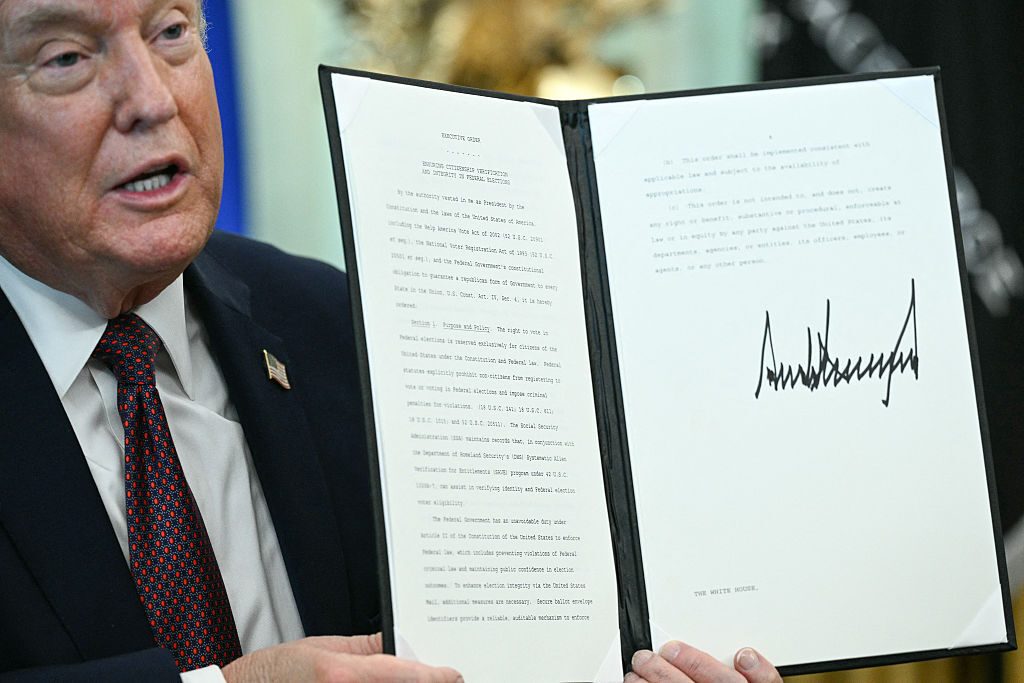
President Donald Trump has continued to press for action. On March 31, he signed an executive order directing the federal government to develop state citizenship lists from federal records and initiate rulemaking related to mail-in and absentee ballot procedures through the U.S. Postal Service.
The congressional fight is not over. But the path is increasingly clear: Executive action may advance portions of the administration’s agenda, while lasting nationwide reform will still require Congress to act.
Original: A snare has been set in Washington, D.C., and too many of our elected officials have walked straight into it.
This is not new. Proverbs 29:25 names it plainly: “The fear of man lays a snare.”
It has toppled kings, corrupted judges, and silenced prophets. Now it has paralyzed the United States Senate. A bill requiring citizens to prove they are citizens before voting cannot clear the necessary threshold to become the law of the land.
Explaining that failure does not require complex policy analysis. It requires an honest reckoning with cowardice.
Scripture has always been unflinching about the responsibility of rulers. “Give justice to the weak and the fatherless,” Psalm 82:3–4 commands. “Maintain the right of the afflicted and the destitute. Rescue the weak and the needy.”
Romans 13 establishes governing authorities as God’s servants, appointed for the good of those they govern. When rulers abandon that charge, they do not merely fail politically, they fail before God.
On March 17, the Senate voted 51–48 to begin considering the House-passed SAVE America Act. The legislation requires documentary proof of U.S. citizenship to register for federal elections and photo identification to cast a ballot. The House passed the measure on Feb. 11, 2026, by a vote of 218–213. As explained in the update above, subsequent efforts to advance the bill have repeatedly failed in the Senate.
Pew Research Center found in August 2025 that 83 percent of U.S. adults support photo ID requirements for voting, including 95 percent of conservatives and 71 percent of liberals. Gallup put the number at 84 percent. A Harvard CAPS/Harris poll found that 81 percent of Americans support voter ID and 75 percent support proof-of-citizenship requirements specifically.
In other words, there is no divided nation on this issue, only a divided government.
And yet, the bill has repeatedly stalled in the Senate. The votes and the will have not been there. The question is no longer hypothetical: Will elected officials allow political fear, procedural caution, or competing interests to keep them from acting?
That gap between what the people want and what their representatives will do is not a procedural inconvenience, it’s a breach of covenant. And the Church must name it as such.
What Is Actually At Stake
The SAVE America Act is not just an election bill. Republican leaders across multiple states have voiced support for stronger voter verification measures aligned with the SAVE America Act.
Existing voter registration systems rely in many cases on self-attestation of citizenship rather than documentary proof. That makes it a system built on assumption, not integrity. It’s the electoral equivalent of leaving the front door wide open and trusting that no one will walk in uninvited and steal what’s most valuable.
The concern doesn’t stop at registration. It extends to how ballots are cast and counted, particularly in the growing reliance on mail-in voting.
President Trump has pushed for a version of the bill that goes further still. Sen. Eric Schmitt, R-Mo., has introduced an amendment incorporating the president’s additional priorities: A ban on mail-in ballots except for illness, disability, military duty, or travel; a ban on men who identify as women competing in women’s sports; and a ban on sex change operations for minors. Those additions were part of Sen. Schmitt’s proposed substitute amendment, not the original House-passed bill.
These additions reflect a broader effort to address what many see as institutional instability. They are a direct repudiation of the ideological disorder that has destabilized institutions from youth sports to military readiness. Their inclusion signals that this legislation is a comprehensive statement about who we are as a nation and what we will and will not tolerate.
The left has responded predictably, hysterically waving the bloody shirt of Jim Crow. You know the playbook. Any accountability measure gets branded as voter suppression.
That comparison collapses under scrutiny. Jim Crow was a systematic, government-enforced regime of racial terror designed to strip black Americans of their constitutional rights through violence, intimidation, and legal chicanery. Asking every American to equally prove their citizenship when they register to vote and to show a driver’s license when they show up to vote is not that. Not even close.
The state attorneys general supporting the SAVE America Act put it well: “It is an insult to suggest that minorities, women, or members of the working class are not smart enough to obtain and provide simple proofs of citizenship.”
When every accountability measure gets labeled as Jim Crow, the label loses its meaning and the people who deploy it lose their credibility.
The Cowardice on the Right
The sharper indictment does not fall on the left, however. That is expected. The more serious failure lies within Republican ranks.
Senate Majority Leader John Thune, R-S.D., has said plainly that Republicans do not have the votes for either a talking filibuster, which would require Democrats to hold the floor continuously to block the bill, or the nuclear option, which would change Senate rules to lower the approval threshold to a simple majority.
The resistance takes two forms. The first is the institutionalist camp: senators like Mitch McConnell, R-Ky., who oppose changing filibuster rules on principle regardless of the issue and who voted to begin debate only as a courtesy to leadership.
The second is the political survival camp: senators quietly calculating what this vote costs them at home. Sen. Lisa Murkowski, R-Alaska, voted against advancing the bill outright. Sen. Thom Tillis, R-N.C., did not vote at all. Some rural-state Republicans have balked at the mail-in voting restrictions, with Sen. Shelley Moore Capito, R-W.Va., calling the proposed ban “problematic.” Constituent service politics is a legitimate concern, but it is not a substitute for conviction nor is it an excuse for cowardice.
“The fear of man lays a snare,” Proverbs 29:25 warns, “but whoever trusts in the Lord is safe.”
These senators are caught in exactly that snare. Elected office is not personal property. It is a stewardship, temporary and accountable, answerable to a higher authority than the next election cycle. When rulers subordinate the public good to their own political survival, they have forgotten, or perhaps never believed, that their authority is derivative, not original. It is granted by the people, for the people, under God.
The Point
Election integrity is not merely a partisan concern. It is a question of stewardship.
Scripture teaches that rulers are accountable to God for how they exercise authority. It also teaches that dishonest scales are an abomination to the Lord. A representative government cannot flourish without laws that are clear, consistently applied, and worthy of public trust.
Christians should seek both integrity and wisdom. Only eligible citizens should vote in federal elections. At the same time, reforms should be administered carefully so that lawful voters are not unjustly burdened or denied their voice.
President Trump has continued pressing the issue through executive action. Congress still bears responsibility for any lasting nationwide reform.
The Church should not confuse silence with neutrality. Christians can speak with conviction, pray for those in authority, and call public officials to pursue truth, justice, and the common good.
A free nation depends on citizens who are willing to seek truth, defend integrity, and hold leaders accountable. Your gift helps the Standing for Freedom Center produce timely, biblically-grounded content that equips Christians to engage the defining issues of our day with clarity, courage, and grace. Stand with us today.