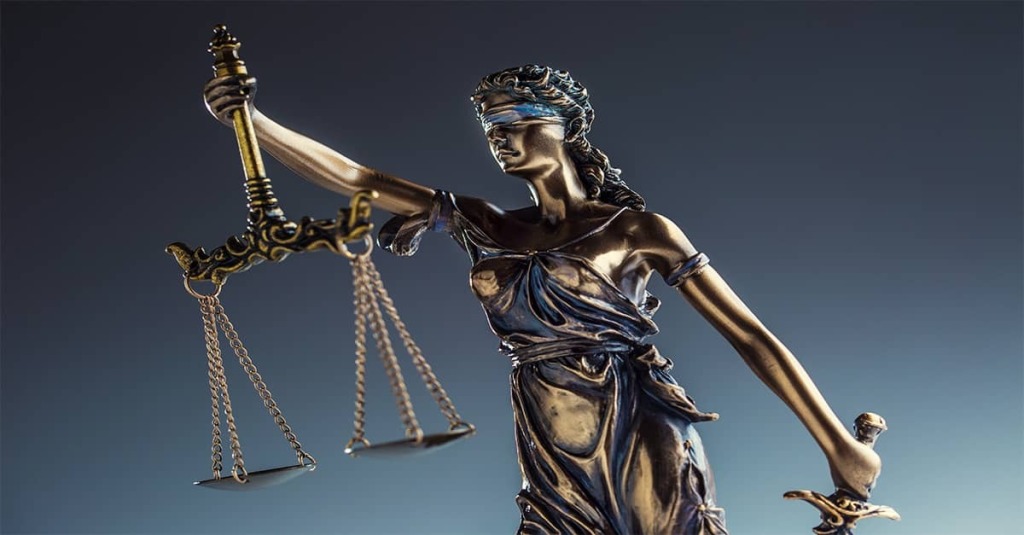
When activist judges follow ideology over the law, when they put emotion before reason, and when they’re partial to the wicked over the innocent, there is no justice — only distrust, disorder, and the risk of self-appointed vigilantes.
Aristotle is quoted as saying, “Justice is the bond of men in states, and the administration of justice, which is the determination of what is just, is the principle of order in political society.”
So, what happens when that bond is torn asunder by partiality and misplaced compassion?
The United States may soon find out.
Seemingly every day, Americans read the news of a gross miscarriage of justice, leaving them feeling helpless, frustrated, and angry. A serial criminal turned loose on the streets commits murder, an illegal immigrant who should have been deported commits a heinous offense, someone who can’t even identify road signs is given a CDL and causes a fatal crash.
And routinely, soft-on-crime district attorneys and judges let criminals walk free or with nothing but a paltry excuse for justice, all in the name of racial equity or restorative justice.
Take, for example, just two recent cases.
A Heinous Crime and a Callous Criminal
In Louisville, Kentucky, a judge is being accused of racial prejudice in granting a light sentence to a truly unremorseful defendant.
In 2023, Christopher Thompson, now 24, wore a ski mask while armed with a gun, forced his way into a woman’s car, and ordered her to drive him to a school parking lot where at gunpoint he forced her to perform sexual acts. He then forced her to drive to an ATM where he robbed her, then required her to drive back to the school and sexually assaulted her again.
Thompson was offered a plea deal of 18 years by the prosecution so as to spare the victim from testifying in court, but he declined the deal. After a trial, the jury found Thompson guilty and recommended a 65-year prison sentence.
Thompson has a long list of prior offenses, among them theft, robbery, felony gun charges, and resisting arrest. When he attacked his latest victim, he was on probation and in a diversion program.
In court, Thompson was belligerent and repeatedly threatened and denigrated the victim and Judge Tracy Davis, profanely threatening to assault them both.
He repeatedly interrupted the judge, who was trying to coach him into showing remorse. He made it very clear that he “did not care” and had “no sympathy” for the victim. “Boohoo,” Thompson said mockingly.
Despite this, Judge Davis decided to sentence Thompson to just 30 years in prison, claiming, “Unfortunately, he fell through the cracks and ended up before this court as an 18 or 19-year-old. This court does not believe that Mr. Thompson, if given the resources that he can get while incarcerated, is beyond being rehabilitated.”
Davis is now being accused of racial bias after she characterized Thompson as “a 20-year-old African-American male that has been…you know, experienced this society.”
Thompson’s trial lawyer, Clay Kennedy, said that in his 13 years of practicing law, he had never seen a judge ignore a jury’s sentencing recommendation.
“Doesn’t Feel Like Justice”
In San Francisco, Mary Lau, 80, will soon receive her sentence from Judge Bruce Chan. In 2024, Lau drove her SUV the wrong way down a one-way street, hitting speeds of about 70 miles per hour, and plowed her vehicle into a family of four sitting at a bus stop, killing Diego Cardoso de Oliveira, 40, his wife Matilde Ramos Pinto, 38, and their one-year-old son, Joaquin, and 3-month-old son, Caue Ramos Pinto de Oliveira.
Lau first pled not guilty to four charges of vehicular manslaughter before changing her plea to no contest.
Reports say that Judge Chan is likely to let Lau off without jail time or even home detention or community service.
Instead, he is expected to give her just three years’ probation, after which she will be eligible to drive again.
Chan has cited Lau’s age as the reasoning behind such a sentence, claiming that the prison system would kill her. He also claimed that Lau’s own sense of guilt was sufficient punishment, insisting that she is “going to spend the rest of her days living with the knowledge of the harm she has caused to others.”
However, just how remorseful Lau is has been the subject of intense scrutiny.
The families of the victims filed a civil suit in May accusing Lau of moving her assets to avoid having to pay restitution in a civil lawsuit and are seeking an injunction to stop her from moving any further assets. Lau’s attorneys claim the timing of her asset rearranging was merely coincidence.
The victims’ families believe that justice won’t be done.
Denise Oliveira, Diego’s sister, stated, “It feels like we have no rights. I feel deeply disrespected by this process. It doesn’t feel like this is justice.”
Unmerciful Mercy
That isn’t justice.
Of course, there is a place for mercy in the justice system, but it should be reliant on the remorse shown by the defendant, the nature of the crime, and the defendant’s prior record.
Otherwise, as C.S. Lewis, the famed author and philosopher, put it, “Mercy, detached from Justice, grows unmerciful.”
Lewis criticized the idea that criminal behavior was like a disease rather than a sin, and he argued that simply pardoning crimes without acknowledgement of their evil and dealing with it would be to take mercy and make it wicked.
Where is the concern for Thompson’s victim? She will never recover from this and now she knows that one day Thompson will be out of prison and he may try to pay off on his claim to hurt her again.
Where is the concern for other women who may be similarly tortured by Thompson in the future or by another pervert who sees this light sentencing and feels emboldened to also attack?
And that is where this misplaced mercy, this toxic empathy, as it is now popularly known, has led us: to think more about the criminal and less about the victim.
It is this type of unmerciful mercy that has resulted in scores of new victims like Iryna Zarutska, who was barbarically murdered on a Charlotte train by a serial violent criminal.
It is this unmerciful mercy that has shuttered mental institutions, where men like Zarutska’s killer should have been locked up.
And it is this unmerciful mercy that leaves victims’ families, like Denise Oliveira, feeling powerless and wronged. And that feeling can create a dangerous situation.
Supreme Court Justice Louis Brandeis noted the dangers of the government shirking its responsibility to the law in Olmstead v. United States, a 1924 case in which the Supreme Court ruled 5-4 that evidence collected by illegal wiretapping was permissible in a case against bootleggers. In his dissent, Justice Brandeis warned,
“In a government of laws, existence of the government will be imperiled if it fails to observe the law scrupulously. Our Government is the potent, the omnipresent teacher. For good or for ill, it teaches the whole people by its example. Crime is contagious. If the Government becomes a lawbreaker, it breeds contempt for law; it invites every man to become a law unto himself; it invites anarchy.”
The Bible teaches that government’s main role is to punish evil and to protect the innocent — in other words, to deliver justice. (Romans 13, 1 Peter 2 and 3, Proverbs 18:5, Proverbs 21:15, Proverbs 24:24-25, Isaiah 61:8)
If Government Won’t, Someone Else Might
So, what happens when government fails to do its chief duty?
What happens when citizens know that violent criminals will be released back on the streets? What happens when they know that we’re supposed to be equal under the law but some are more equal than others depending on their political affiliation, skin color, tax bracket, or name?
Well, you’ll eventually get vigilantism.
America, like most civilizations, craves justice. One need only look at the meteoric popularity of superheroes in the U.S. since their introduction in the 1930s. Fiction figures like Batman, who is technically a vigilante, are hailed as heroes.
Why? Because Batman does what the justice system can’t or won’t: protect the innocent and punish the guilty. Gotham City’s gross corruption necessitates the existence of a defender who is outside the law. We celebrate such fictional vigilantes because they are righteous men and women imposing a good standard of justice.
But in the real world, not all who would take on the mantle of vigilante are morally righteous or even sane. Most notably, in recent years, we have seen the left descend into this type of vigilantism that seeks justice not under the law but according to their own personal morality.
The examples are numerous, but they include pro-abortion groups like Jane’s Revenge that firebombed pro-life pregnancy centers and those individuals who tried to assassinate President Trump and Supreme Court Justice Brett Kavanaugh and who actually did assassinate Charlie Kirk. In their minds, such horrors are right, but their belief does not magically transform terrorism and cold-blooded murder into a justified crusade.
But vigilantism is wrong even if done under the auspices of enforcing the law. It might avenge a crime, but it invites only societal destruction and chaos.
It’s why the Bible warns explicitly against individuals taking the law into their own hands or exacting their own revenge. God established civil government as his tool for punishing wrongdoers, and the Founders built on that principle by ensuring that accused criminals have the right to due process and jury trials. True justice requires judges and juries to apply reason, evidence, fairness, and sober-mindedness, all while acting in accordance with God’s moral law.
Vigilantism is wrong, and we must discourage it in all circumstances. But equally wrong are judges who rely on their own personal beliefs over the law and who judge with emotion rather than righteousness. As Proverbs 18:5 warns,
“It is not good to be partial to the wicked and so deprive the innocent of justice.”
Our nation must have law and order, equal justice, and the societal trust that when someone commits a heinous crime they will be held accountable for it.
Otherwise, we may find ourselves a nation of people who are each a law unto themselves — and that will be a nation that no one will want to live in.
If you like this article and other content that helps you apply a biblical worldview to today’s politics and culture, consider making a donation here.