The 2023 law can finally go into effect even though the majority of the state’s Supreme Court justices believed the law was unconstitutional.
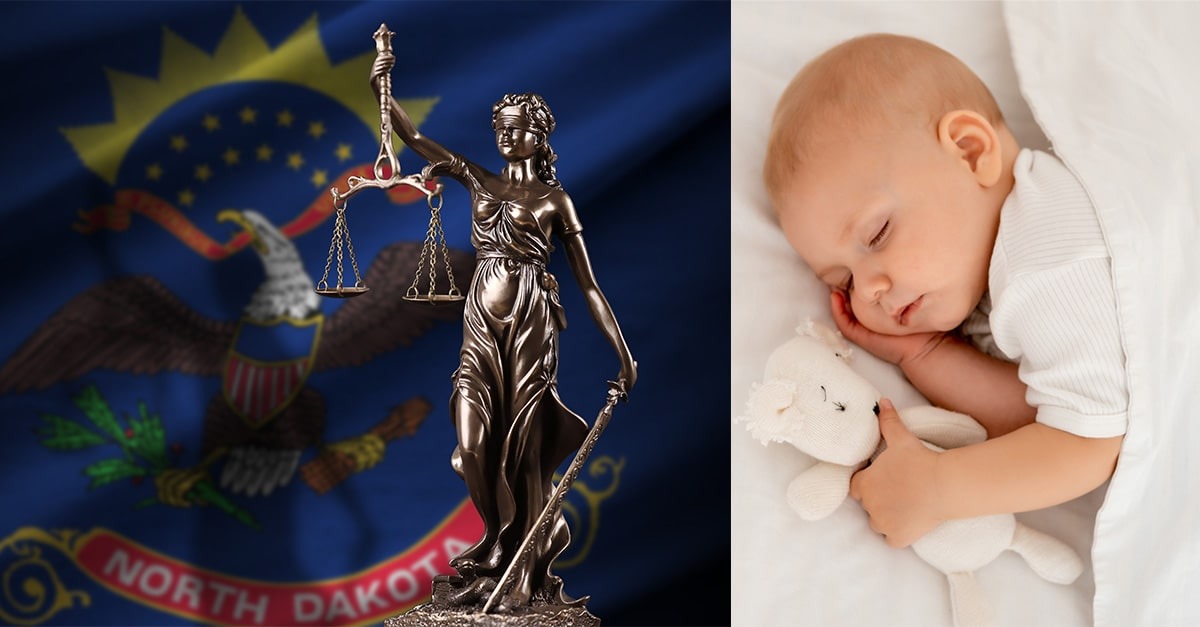
The North Dakota Supreme Court has reinstated the state’s near-total abortion ban, overturning a lower court ruling that blocked the law on constitutional grounds.
In April 2023, then-North Dakota Gov. Doug Burgum signed a law passed by the state’s lawmakers prohibiting most abortions. That law, SB 2150, was enacted in 2023 following the U.S. Supreme Court’s Dobbs decision that returned abortion regulation to individual states.
The North Dakota legislation outlawed abortions except in cases of rape or incest before six weeks of pregnancy, or when an abortion is “deemed necessary” to protect the life or health of the mother. Medical professionals performing an elective abortion under the statute can be charged with a Class C felony, punishable by up to five years in prison and fines of up to $10,000.
The Red River Women’s Clinic in Fargo challenged the measure that summer, and in September 2024 Burleigh County District Judge Bruce Romanick struck it down as unconstitutional.
In a 3-2 decision, the state’s highest court agreed with the 2024 district judge’s ruling that SB 2150 is unconstitutional. However, because North Dakota requires at least four justices to strike down a law as unconstitutional, the lower court’s ruling was reversed, and the statute is now back in effect.
The ruling is a win for the pro-life movement, but only because the ruling needed the support of one more justice.
According to the majority opinion, the “vague” and “unconstitutional” medical-exception language could not be separated from the rest of the statute, rendering the entire law “invalid in its entirety.”
The justices also wrote that the state constitution “guarantees the right to an abortion” under its protections for “enjoying and defending life and liberty” and “pursuing and obtaining safety and happiness,” even though abortion is not mentioned in the founding document.
In dissent, Justice Jerod Tufte, joined by Chief Justice Jon Jensen, argued that the Constitution does not broadly protect abortion rights. He wrote that North Dakota’s constitutional provisions guard natural and inalienable rights only as they were understood when the state was founded in 1889.
The “fundamental right” of abortion “was apparently overlooked by every person alive when [the Constitution] was adopted and by almost everyone else in the time since,” Tufte wrote. “The fact that it took more than a century for [the Constitution] to be asserted against any of the statutes criminalizing abortion refutes any notion that the language ‘defending life and liberty’ or ‘pursuing and obtaining safety’ plainly limits state regulation of abortion.”
He further argued that the vagueness challenge rested on “lawyer-crafted hypotheticals” rather than real medical situations and that disagreement among medical experts on imagined scenarios was insufficient to invalidate the law.
Despite the technical nature of the victory and its very narrow margin of the ruling, pro-life leaders celebrated the outcome.
Republican state Sen. Janne Myrdal, who introduced the legislation, reportedly stated that she is “thrilled and grateful that two justices that are highly respected saw the truth of the matter, that this is fully constitutional for the mother and for the unborn child and thereafter for that sake.”
Mat Staver, founder and chairman of Liberty Counsel, also praised the ruling, saying, “Restoring North Dakota’s duly enacted abortion ban is a victory for life. North Dakota’s pro-life law protects innocent unborn lives and there is nothing unconstitutional about that. Abortion harms women physically and emotionally, and there is no right to cruelly kill defenseless children in the womb.”
“This is a victory for life and the people of North Dakota,” said Bridget Turbide, executive director of North Dakota Right to Life. “Our legislature passed this law to safeguard both mothers and their unborn children. Today’s decision ensures that the will of the people is respected.”
Family Research Council’s Joy Stockbauer warned pro-life supporters of the need to remain involved, noting that North Dakota’s judges are elected officials. “Given that the majority of judges in North Dakota are elected rather than appointed, this case should remind pro-lifers of the significance of participating in local elections. There are no unimportant elections when the lives of unborn children and the well-being of their mothers are on the line,” she stated.
By contrast, Meetra Mehdizadeh, senior attorney at the Center for Reproductive Rights, criticized the outcome in a statement, saying, “As a majority of the Court found, this cruel and confusing ban is incomprehensible to physicians. The ban forces doctors to choose between providing care and going to prison. Abortion is health care, and North Dakotans deserve to be able to access this care without delay caused by confusion about what the law allows.”
Nationally, North Dakota is now one of 13 states with a near-total abortion ban. The other 12 are Alabama, Arkansas, Idaho, Indiana, Kentucky, Louisiana, Mississippi, Oklahoma, South Dakota, Tennessee, Texas, and West Virginia.
An additional six states limit abortion between 6 and 12 weeks, while four more states limit abortion between 18 and 22 weeks. A total of 18 states allow some form of late-term abortion, with 9 states and Washington, D.C., providing no gestational limits at all on abortion.

The North Dakota decision is a wake-up call for every Christian who wonders whether their vote really matters. The pro-life law in this case survived by a single vote on the state’s highest court. One more justice on the other side would have struck it down completely.
Because North Dakotans elected these justices, the difference between protecting life and losing that protection came down to who showed up on Election Day. This is exactly why Christians cannot afford to be sit out of the electoral process simply because they don’t like politics.
The truth is that the two dissenting judges got this ruling right. There is no right to abortion in the North Dakota Constitution. In 1889, the year North Dakota became an official part of the union, abortion was completely illegal in every single state and territory in the United States, the only exception being to save the life of the mother. To claim otherwise is simply wishful thinking or judicial activism.
At the same time, pro-lifers should celebrate this win. The outcome of this court case points us back to truths God has made clear from the beginning. Life in the womb is not a political talking point. It is precious to God. He forms every child with purpose, knows them before they draw a breath, and calls them His own. When a court upholds laws that defend unborn children, it reflects the value God places on every human life He creates.
We live in a culture that works hard to blur that reality. Christians cannot stay silent and call it “someone else’s issue.” God asks us to speak up for those who cannot speak for themselves and to care about those who have no one in their corner. Staying quiet in moments like this helps no one, least of all the women and children who need support and truth.
This ruling also reminds us that freedom is not the right to do whatever we want, but the ability to choose what is good. Communities that protect vulnerable children and support mothers reflect Christ-like values. A society that refuses to defend the innocent cannot claim to be pursuing justice.
For the Church, this is a moment to step forward, not backward. Christians must be involved in the electoral process by doing their research so they fully understand the positions and beliefs of candidates and the issues that are being decided on the ballot and then voting according to their pro-life values.
It’s a misnomer to think that faith and citizenship is an either/or proposition. Christians can show through both compassion and conviction that choosing life is not just a political or legal position but an act of faithfulness to the God who gives life in the first place and has final dominion over when it ends.
If you like this article and other content that helps you apply a biblical worldview to today’s politics and culture, consider making a donation here.