The Lone Star State is the seventh state to ban men from female-segregated facilities operated by the government, including prisons and women’s shelters — joining Arkansas, Florida, Montana, South Dakota, Utah, and Wyoming.
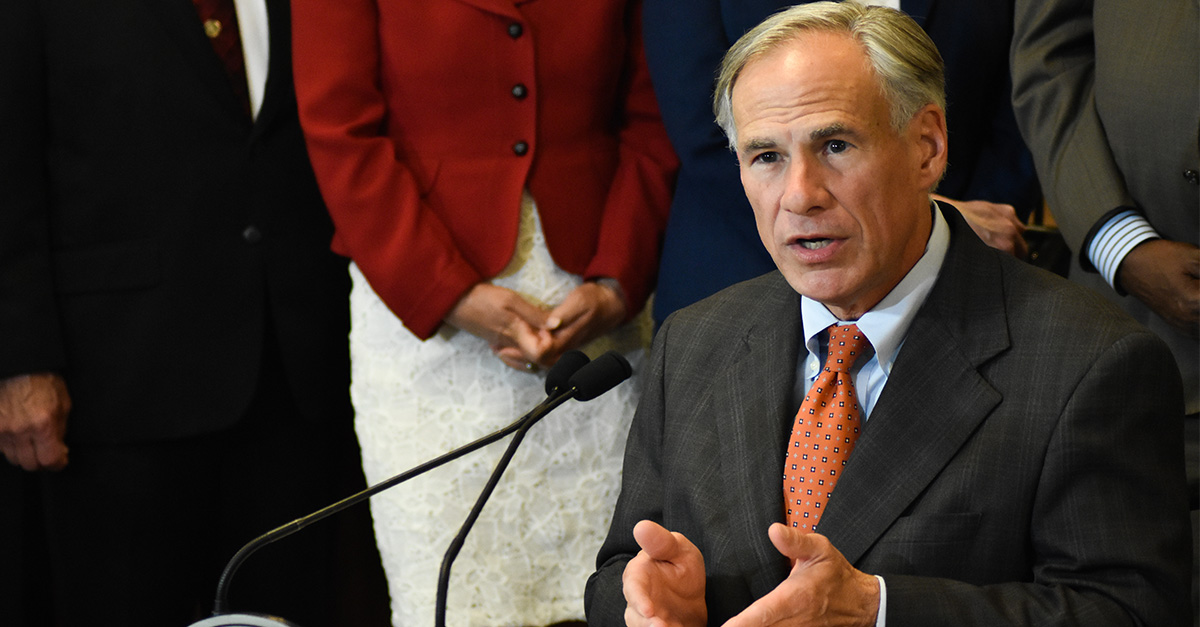
Texas Gov. Greg Abbott, R, has signed into law a measure that restricts access to women’s facilities based on biological sex, making Texas the latest state to adopt the policy in the ongoing battle about gender identity, privacy, and safety.
The legislation, known as Senate Bill 8 or the Texas Women’s Privacy Act, was approved last month in the Republican-controlled legislature with votes largely along party lines. The Senate passed it 19-11, while the House approved it 86-45. Two Democrats joined Republicans in backing the measure.
The law, set to take effect on December 4, requires “each multiple-occupancy private space in a building,” including restrooms and locker rooms in government-owned facilities, to be designated for use by one sex only. It also mandates the Texas Department of Criminal Justice to house inmates in correctional facilities “according to the inmate’s sex.”
The bill defines sex as “an individual’s biological sex, either male or female.” Family violence shelters specifically designed for women are also covered, with provisions barring male entry except for boys under 18 who are the children of female victims.
Violators face fines of up to $25,000 for a first offense and $125,000 for subsequent violations.
Supporters of the measure framed it as a safeguard for women and girls.
“Women and girls should not be forced to sacrifice their privacy and safety in the name of promoting gender ideology,” said Sara Beth Nolan, an attorney with Alliance Defending Freedom (ADF). “Allowing men to invade girls’ most intimate spaces — including locker rooms, sleeping areas, or restrooms — compromises their dignity.”
Democratic lawmakers in Texas opposed SB 8, calling it discriminatory and harmful to people who identify as transgender. LGBTQ advocates argue that the law targets transgender individuals and exposes them to increased risks of violence.
“It’s going to require extreme invasions into the privacy of Texans who don’t look like culturally accepted gender stereotypes,” said Johnathan Gooch, communications director for Equality Texas, a statewide LGBTQIA+ organization.
The implementation of the new Texas law will be closely watched by courts, schools, shelters, and prisons across the state. Enforcement mechanisms, such as fines against violators, are expected to be clarified through regulations issued by state agencies.
Abbott has positioned Texas as a national leader on several gender and family issues. The governor previously signed legislation in 2021 banning biological male athletes from women’s sports and in 2022 ordered an investigation into the use of drugs and surgeries on gender-confused children in Texas.
Texas is now the seventh state to enact restrictions on transgender-identifying individuals in government-owned facilities, joining Arkansas, Florida, Montana, South Dakota, Utah, and Wyoming.
Alabama, Idaho, Louisiana, Mississippi, North Dakota, Ohio, Oklahoma, and Wyoming have measures that apply to K-12 schools and some public facilities. Five others — Iowa, Kentucky, South Carolina, Tennessee, and Virginia — limit restrictions only to K-12 schools.
The spread of these laws reflects a growing state-level movement to regulate access to sex-segregated spaces in response to the expansion of policies that affirm gender identity.
The issue has been at the center of several major controversies. In 2022, female swimmers at the University of Pennsylvania filed a lawsuit against the school, objecting to sharing locker room facilities with transgender athlete William “Lia” Thomas.
In Virginia, Loudoun County schools became a flashpoint in 2021 after reports of sexual assaults involving a male student who identified as “gender-fluid.” One assault took place in a high school bathroom, while the district was considering a policy to allow transgender students access to facilities matching their preferred gender identity.

Abbott’s signing of the Women’s Privacy Act reflects God’s design for men and women. Scripture affirms that God created humans “male and female” (Genesis 1:27). Laws recognizing and protecting these distinctions help preserve the safety and dignity of women and girls who deserve privacy in intimate spaces.
The shame here is that a state like Texas even has to pass a law declaring this fact — and the greater shame is that more states continue to allow men into women’s spaces, including prisons.
As believers, we cannot shrink back in silence while the world insists that gender is whatever someone says it is. To stay quiet is to surrender ground that belongs to God. Protecting women’s privacy and safety in locker rooms, shelters, and prisons is not just common sense. It is obedience to God’s order and a defense of the vulnerable who would suffer most from policies that deny biological reality.
The church must lead with courage and conviction, declaring that God’s design for humans is good, even when culture rejects it. This is not about hate or exclusion, but about love for truth and people. Standing firm on the biblical view of gender requires both conviction and compassion to bring lasting hope to a confused generation.
This moment is also a call to action. Parents must disciple their children in the truth of God’s Word so cultural lies do not sway them. Pastors must preach clearly about God’s design for humanity, even when it is unpopular. Every believer must be willing to speak up in love, pointing people back to the Creator who alone defines identity. Laws like the Texas Women’s Privacy Act may provide protection, but only the Church proclaiming God’s truth can bring the transformation our culture desperately needs.
In a time when the foundations of truth are under attack, Christians must hold fast to God’s Word and live it out with boldness. To compromise on what God has made clear is to deny His authority. To stand firm is to shine light in the darkness, showing a broken world that God’s way is best.
If you like this article and other content that helps you apply a biblical worldview to today’s politics and culture, consider making a donation here.