Each year, seniors at Grand Island High School get to decorate their designated parking spaces in a way that reflects their interests — except Sabrina Steffans, who was initially turned down because she wanted to express her Christian faith.
A New York public high school that refused to let a student decorate her paid senior parking spot with Bible verses and Christian imagery has reversed course after the student threatened legal action.
Senior Sabrina Steffans, a student at Grand Island High School near Buffalo, initially submitted three design proposals for the tradition that allows seniors to personalize their parking spaces if they pay $50.
The tradition is intended to “encourage students to express themselves through positive artwork, to beautify the campus, to build school spirit, and to create a new and exciting tradition to support Senior Class activities and events.”
The first two of her designs incorporated overtly Christian themes, but both were rejected by school officials. They did approve a third design, which included no explicit religious references.
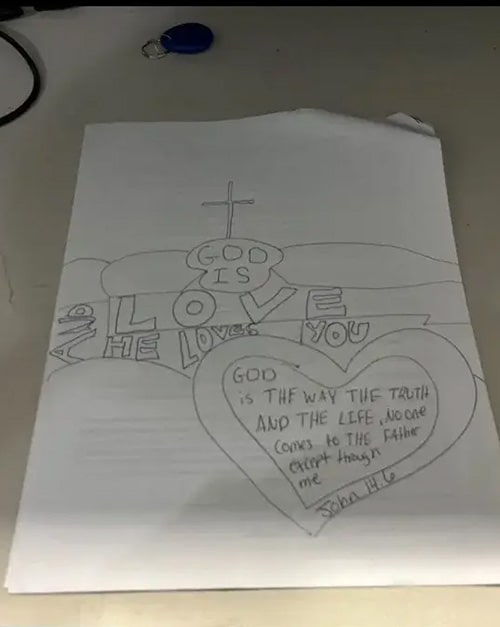
Steffans’ first design featured a cross, a heart, messages about God’s love, and the verse John 14:6, where Jesus says, “I am the way and the truth and the life. No one comes to the Father except through me.”
School administrators reportedly told her, “If we had to approve your cross, we’d have to approve a satanic symbol, and I wouldn’t want to attend a school like that,” and suggested she disguise the cross as the letter “T.”
Her second submission quoted Matthew 5:16 — “Let your light shine” — and incorporated Jeremiah 29:11. Like the first design, it cited chapter and verse alongside a cross, but this time she shaped it as a “T”, as requested. It was also denied. Her third design, which removed Bible verse references but retained the phrases “Let your light shine” and “He is King,” was approved.
After the rejection of her religious designs, Steffans sought legal advice from the First Liberty Institute, a national religious liberty law firm. Attorneys sent a letter to the school district, arguing that her First Amendment rights were being violated.
The school district later released a statement reversing its decision and approving Steffans’s original design. Superintendent Brian Graham said the district remains “committed to fostering an inclusive school environment that respects the rights and dignity of all students.”
He added that, “after careful consultation with legal counsel, the Board of Education and District leadership … have decided that the student in question will be permitted to proceed with her original senior parking space design.”
Graham emphasized that the move was a response to both constitutional considerations and the desire to avoid “prolonged, expensive, and divisive litigation that would ultimately distract from our shared mission — supporting student success.” He also said the district intends to review the senior parking program in the months ahead to determine whether policy adjustments are warranted.
First Liberty Institute praised the outcome. “We are pleased that the school district changed course and will allow Sabrina to truly express her deeply held beliefs in her design,” said Keisha Russell, senior counsel for First Liberty. “The First Amendment protects students’ private expressions of faith in public schools.”
Steffans, who leads her school’s Bible club, told reporters she found the initial rejection disheartening. But the legal victory left her feeling empowered.
“Just because you’re young doesn’t mean you don’t have power to bring change into your schools and into your life,” she said.
Steffans also described the moment she heard the school had changed its mind: “I was shocked that they even picked the very first one of all of them, so I was just really ecstatic to hear it. … I was just so excited to paint and everything.”
Sabrina noted in a separate interview with CBN News that the controversy was not the first time she had encountered resistance to her faith at school. She also said that school leaders took a long time to approve a student-led Bible club and rejected her group’s ads and posters at the school because of their religious message.
This case is the latest in the ongoing national debates over religious expression in public schools and how to achieve the balance between encouraging student expression and maintaining neutrality in school-sponsored programs.
Advocates for religious liberty argue that protected private expression, such as a student’s personal parking design, should not be suppressed simply because it conveys a religious message.
With her original design now approved, Steffans’ next steps are to paint her senior spot and complete her final year at Grand Island High School, honoring both her faith and her rights.

Sabrina’s story is more than a local dispute over a decorated parking space. It is a reminder of the responsibility Christians have to stand firm when their faith is challenged.
The school’s initial rejection of Sabrina’s design reflected the inclination to automatically exclude expressions of faith from the public square. Her courage in speaking up and seeking legal help demonstrates that even young believers can make a difference when they refuse to compromise biblical convictions.
Scripture calls Christians to let their light shine before others so that they may see good works and glorify God (Matthew 5:16). Sabrina sought to live out that verse in a literal and visible way. Although she faced resistance, she ultimately prevailed because she relied on her constitutional rights and on her faith.
Her example should encourage other believers not to shrink back when they encounter opposition at school, in the workplace, or in their communities.
Standing for religious freedom is not only about defending our own rights but also about ensuring future generations can live and speak the truth without fear. If Christians remain silent when their faith is pushed aside, it sends the message that biblical truth has no place in public life. When believers stand with humility and courage, like Sabrina did, they testify that God’s Word is unchanging and relevant in every sphere of life.
This case also highlights the need for prayer for students who face pressure to compromise, for school leaders to uphold fairness, and for our nation to honor the freedoms upon which it was founded. Religious liberty is a Gospel issue because it protects the freedom to proclaim Christ.
Sabrina’s situation affirms that even in a parking space, God can use boldness to inspire others. Every believer is called to be salt and light in the world. Sometimes that begins with taking a small stand that points to a greater truth.
If you like this article and other content that helps you apply a biblical worldview to today’s politics and culture, consider making a donation here.