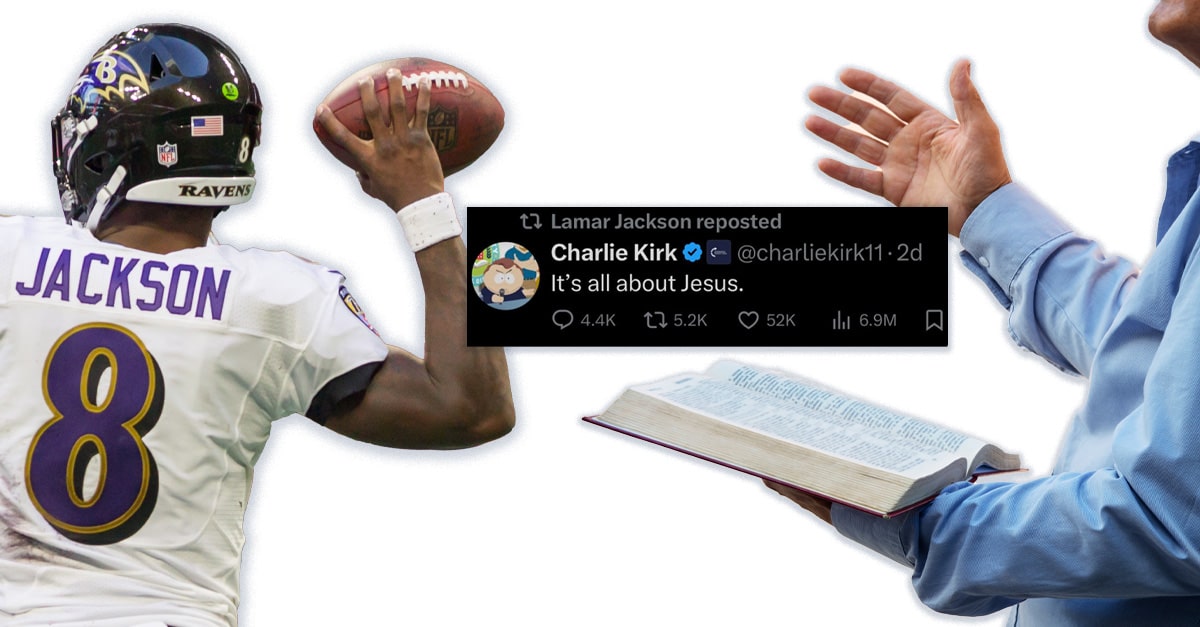
The outrage that ensued over a simple retweet declaring that “It’s all about Jesus” exposes a culture increasingly hostile to biblical truth and a generation of pastors who helped cultivate it by being too timid to thunder God’s Word from the pulpit.
When Baltimore Ravens quarterback Lamar Jackson retweeted a simple message from Charlie Kirk that read “It’s all about Jesus,” the response was swift and surprisingly hostile. Perhaps the backlash stemmed from the messenger — a conservative influencer — rather than the message itself. But that possibility reveals something even more troubling about our cultural moment: We’ve reached a place where even the most basic Christian confession becomes divisive based on who delivers it.
“It’s all about Jesus” should be a universal truth that transcends political personalities and partisan divides. Just decades ago, the statement “It’s all about Jesus” would have garnered universal celebration, but not anymore.
The outrage over Jackson’s retweet highlights our significant departure from a culture that valued biblical truth independent of its messenger.
Early America certainly had its political and ideological divides — Federalists versus Democratic-Republicans, urban versus rural interests, and regional tensions that would eventually lead to civil war. But there was something that bound the culture together despite these differences: a shared reverence for Jesus Christ and biblical truth. That common foundation allowed Americans to find unity even amid disagreement, because they recognized a higher authority than their own political preferences.
This unity through Christ was the fruit of bold biblical preaching. There was a time when pulpits burned with biblical fire, when preachers thundered truth without apology, and when the Word of God shaped not just individual hearts but entire communities, as well as the nation itself.
When America’s Pulpits Shook the World
On July 8, 1741, in Enfield, Connecticut, a soft-spoken pastor named Jonathan Edwards stepped into a pulpit and delivered a sermon that would echo through American history. “Sinners in the Hands of an Angry God” was no motivational talk or therapeutic session. Edwards opened Deuteronomy 32:35 and declared the unvarnished truth about human sinfulness and divine judgment.
The response was immediate and overwhelming. People cried out in conviction, some fell from their pews, and many were converted on the spot. That single sermon became a catalyst for the Great Awakening, a spiritual revival that swept across the American colonies and fundamentally shaped the character of the emerging nation.
Edwards didn’t preach to make people feel better about themselves. He preached to make them desperately aware of their need for Christ. He declared, “The God that holds you over the pit of hell, much as one holds a spider, or some loathsome insect over the fire, abhors you, and is dreadfully provoked.” These weren’t words designed to boost self-esteem — they were words designed to break hard hearts and drive sinners to the cross.
The Great Awakening didn’t just fill churches, it transformed society. It created the moral foundation that shaped the character of the emerging republic. The spiritual fire that Edwards ignited spread across the colonies, creating a people with shared biblical convictions about human nature, moral responsibility, and divine authority.
When French observer Alexis de Tocqueville visited America nearly a century later, he marveled at what that Great Awakening had produced. He saw a nation where religion provided the moral backbone of democracy, famously noting that “liberty cannot be established without morality, nor morality without faith.” Tocqueville observed that preachers like Edwards laid the moral foundation for America’s unique experiment in self-government, which led to its success.
That success was the fruit of bold, biblical preaching — not just individual conversions but cultural transformation that lasted for generations.
The Decline of Prophetic Preaching
Contrast those thundering voices with much of what passes for preaching today. Too many pulpits have traded the sword of the Spirit for motivational speaking. Instead of opening the Word of God with trembling and proclaiming, “Thus saith the Lord,” many pastors offer therapeutic advice, life-coaching tips, and carefully tested focus-group messages designed to offend no one.
The result? A generation of Christians that lacks an understanding of Scripture’s ability to convict, convert, and transform. We’ve produced churchgoers who are more familiar with pop psychology than biblical theology, more concerned with personal fulfillment than personal holiness.
When Paul wrote to Timothy, he didn’t encourage him to make people feel good about themselves. He commanded, “Preach the word; be ready in season and out of season; reprove, rebuke, and exhort, with complete patience and teaching” (2 Timothy 4:2).
The apostle knew that faithful preaching would sometimes be unwelcome, also writing in 2 Timothy 4:3: “For the time is coming when people will not endure sound teaching, but having itching ears they will accumulate for themselves teachers to suit their own passions.”
The Cost of Silence — and the Call to Courage
When pulpits go silent on what Scripture plainly teaches, the consequences are devastating. Churches become indistinguishable from the culture around them. Christian young people graduate from church with no biblical worldview to guide them through college and career. Families crumble because no one taught them God’s design for marriage and parenting. Men remain passive because no one called them to biblical leadership. Women pursue paths that leave them unfulfilled because no one celebrates God’s design for womanhood.
The silence isn’t neutral, it’s deadly. And the cost is measured in souls.
The Lamar Jackson controversy should serve as a wakeup call. We live in a culture where simply saying “It’s all about Jesus” generates hostility. How much more will faithful exposition of Scripture be opposed?
But this is precisely when the Church needs pastors with backbone. We need men who will stand in pulpits and declare the whole counsel of God, regardless of the cultural temperature or the social media backlash. We need shepherds who care more about faithfulness to Christ than approval from the culture.
Pastor, the people in your congregation don’t need another pep talk. They don’t need life coaching disguised as biblical exposition. They need the Word of God preached with clarity, conviction, and courage. They need to hear what Scripture actually says about the issues destroying our culture, even if — especially if — those truths are unpopular.
America desperately needs a new generation of pastors who will restore fire to their pulpits. We need men who will:
- Preach the text, not the trends.
- Address sin specifically, not generally.
- Call people to repentance, not just self-improvement.
- Proclaim biblical truth on every issue that Scripture addresses.
- Risk cultural opposition for eternal souls.
The early Church turned the world upside down because they preached Christ crucified without compromise. The Reformers shook Europe because they declared sola Scriptura without reservation. The Great Awakening transformed America because pastors proclaimed the whole counsel of God without apology.
It’s Time to Thunder Again
Our age doesn’t need clever talks or therapeutic advice, it needs sermons with fire. We need pastors who will stand before their congregations and declare, with Paul: “For necessity is laid upon me. Woe to me if I do not preach the gospel!” (1 Corinthians 9:16).
The culture is waiting for the Church to find its voice again. Will we whisper when God calls us to thunder? Will we tiptoe when Scripture calls us to march? Will we seek applause when faithfulness demands opposition?
Lamar Jackson’s simple declaration — “It’s all about Jesus” — should be the heartbeat of every pulpit in America. And if that message generates controversy, so be it. The Gospel has always been a stumbling block to those who reject it.
It’s time for pastors to stop apologizing for what Scripture teaches and start proclaiming it with the conviction it deserves. It’s time to let pulpits burn again with the fire of God’s Word.
The people of God don’t need another pep talk. They need the truth — not just God’s love but also His judgment, not just Heaven but also Hell. And it’s time for men of God to preach it.
If you like this article and other content that helps you apply a biblical worldview to today’s politics and culture, consider making a donation here.