From Jack Phillips to Lorie Smith and now to Born Again Used Books, Colorado is set on elevating sexual ideology above free speech, conscience, and even basic biology — all in defiance of the Constitution and recent Supreme Court precedent.
A Christian bookstore in Colorado Springs is suing the state of Colorado over a law it says violates its First Amendment rights and religious beliefs by forcing it to use pronouns and titles that align with a person’s gender identity rather than their biological sex.
Alliance Defending Freedom (ADF), a conservative legal group that specializes in religious liberty cases, filed the federal lawsuit Wednesday on behalf of Born Again Used Books. The suit challenges the Colorado Anti-Discrimination Act (CADA), which was recently updated to include language about “gender expression,” defined in part as “how an individual chooses to be addressed.”
According to the lawsuit, the law compels the bookstore and its staff to use preferred pronouns and honorifics, such as “she” or “Ms.,” based on a person’s self-identified gender, even when it conflicts with the person’s biological sex.
ADF argues this requirement infringes on the bookstore’s constitutional rights.
“As the Supreme Court has repeatedly affirmed, the government has no business trying to strip traditional views about sex and gender from the marketplace of ideas,” said Hal Frampton, ADF senior counsel and director of the ADF Center for Conscience Initiatives. “Nor can the state compel Coloradans to speak in ways that violate their deeply held religious beliefs. Born Again Used Books shouldn’t have to continually choose between violating the law and speaking consistent with its Christian beliefs.”
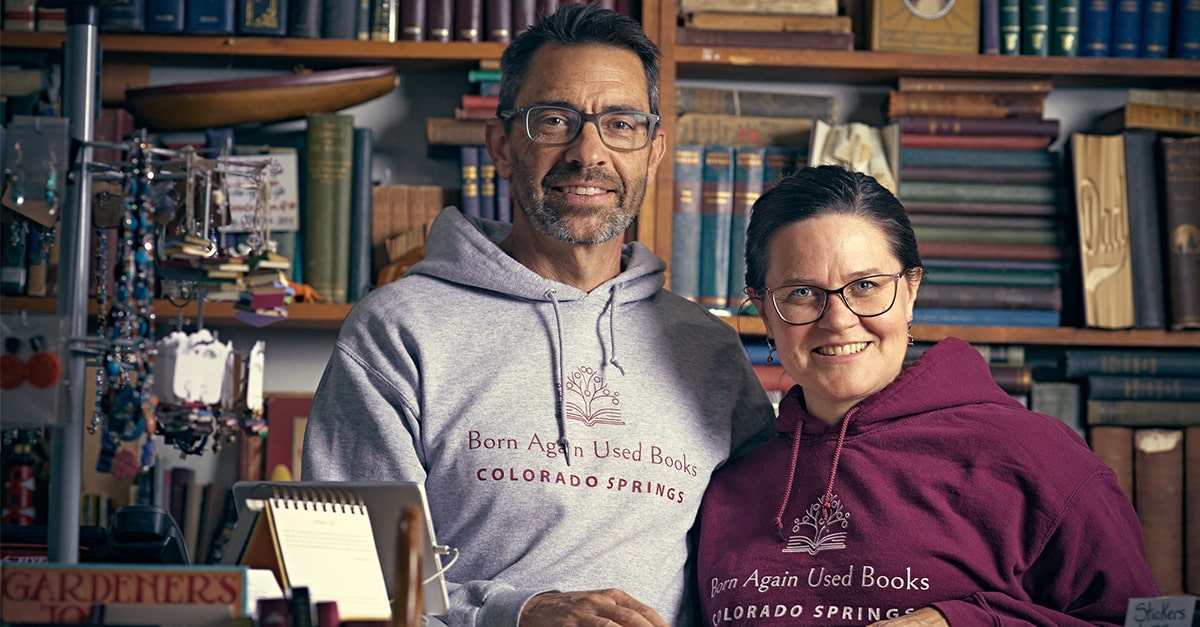
Born Again Used Books is a small, family-run business that openly embraces its Christian foundation. The owners, Eric and Sara Smith, believe that God creates every person as either male or female and that sex is unchangeable. Because of that belief, store employees use pronouns and titles that correspond with a person’s biological sex rather than their gender identity.
The store welcomes all customers and does not discriminate in the services it provides, according to the suit. However, the owners say they draw the line at compelled speech that contradicts their faith. They want to make their policy clear to the public by posting it in the store, writing about it on the store’s blog, and referencing their biblical beliefs. But doing so, the lawsuit says, could result in state penalties.
Under CADA, businesses that refuse to comply with its terms could face significant fines and legal consequences. ADF argues that this puts Born Again Used Books in an unconstitutional position: either speak in a way that goes against its convictions or face punishment from the state.
The lawsuit, Born Again Used Books v. Sullivan, was filed in the U.S. District Court for the District of Colorado. The named defendant, Aubrey Elenis Sullivan, is the director of the Colorado Civil Rights Division, which enforces CADA.
The bookstore’s owners assert that the law doesn’t just restrict their speech in person but also in any written communication, including blog posts and formal policies. ADF attorneys argue that this broad application is a violation of both free speech and religious liberty, as protected under the First Amendment.
The case is the latest in a series of legal challenges in Colorado involving the intersection of state anti-discrimination laws and religious freedom claims.
ADF has previously represented other Colorado businesses in similar disputes, including the high-profile Masterpiece Cakeshop case, in which the U.S. Supreme Court ruled narrowly in favor of Christian baker Jack Phillips who declined to make a custom cake for a same-sex wedding. Phillips would be sued a second time under CADA and spend 12 years fighting legal battles.
Web designer Lorie Smith preemptively challenged Colorado’s Anti‑Discrimination Act starting in 2016, arguing that the law compelled her to create expressive content for same-sex wedding that was contrary to her religious convictions. After a long legal fight, the U.S. Supreme Court ruled in the landmark case of 303 Creative v. Elenis that the state cannot force individuals to produce speech or images that they disagree with.
Colorado later agreed to pay Smith $1.5 million for violating her First Amendment rights; the settlement covers legal costs accrued over years of litigation. And the case of Jack Phillips, the Colorado Supreme Court would eventually dismiss the CADA lawsuit against him based on the 303 Creative ruling.
In the case of Born Again Books, ADF contends that Colorado continues to overstep its constitutional bounds by compelling speech rather than simply prohibiting discriminatory conduct through CADA.
“The government should force no one to say things they do not believe,” Frampton said.
Colorado officials have not yet responded publicly to the lawsuit. The state has defended its anti-discrimination law in past cases, arguing it ensures equal treatment in public accommodations and protects marginalized groups from harm.
Born Again Used Books states that it intends to continue operating in accordance with its beliefs while seeking relief through the courts. The owners hope the legal system will affirm their right to manage their business without being forced to say things they believe are untrue.
The case now heads to federal court, where a judge will decide whether Colorado’s law infringes on the constitutional rights of the bookstore and its owners.

The lawsuit filed by Born Again Used Books against the state of Colorado marks yet another critical moment in the national battle over compelled speech. Can the government force citizens to speak messages they believe are false?
As noted previously, this isn’t a new issue in Colorado. The U.S. Supreme Court already addressed it decisively in 303 Creative v. Elenis, a case that also involved CADA and determined that Colorado could not compel Christian web designer Lorie Smith to create wedding websites for same-sex couples, affirming her First Amendment right to free speech.
Their ruling focused on compelled expression, not religious freedom, a distinction that is essential because it broadens the ruling’s application beyond religious belief to include anyone who objects to government-mandated speech.
The bookstore’s case is a natural extension of 303 Creative. While Lorie Smith’s work was artistic, compelled pronoun use and names based on gender identity are just as much a form of forced expression. The state’s demand that Born Again Used Books use language that contradicts the owners’ understanding of biological reality and biblical truth is a demand to speak a lie. The concern is not only for Christians, but to natural law and the self-evident reality that people are created male and female.
Colorado has a troubling pattern of targeting Christians who dare to dissent from the state’s LGBTQ orthodoxy. From Jack Phillips to Lorie Smith and now to Born Again Used Books, the state continues to elevate sexual ideology above free speech, conscience, and even basic biology. It has become a religion enforced by civil penalties. Courts must draw clear lines protecting the freedom not to speak what a person knows is false.
The Supreme Court was right in 303 Creative. No American, whether an artist, writer, teacher, or bookstore owner, should be compelled to say something they do not believe. The First Amendment protects the individual, not the government’s preferred narrative. If truth is to have any place in public life, this case must reaffirm that principle.
It’s time for the courts to test the strength of 303 Creative and apply its logic consistently. Compelled speech is wrong, whether it happens on a canvas, a website, or in a bookstore. Christians are not seeking special treatment — they’re asking for the same liberty promised to every American.
The owners of Born Again Used Books are not denying anyone service or respect. Instead, they are choosing to honor God with their speech, refusing to say what they believe is untrue. Jesus calls His followers to speak the truth in love (Ephesians 4:15) and to obey God rather than men (Acts 5:29), even when that obedience carries a cost.
This lawsuit serves as a reminder that religious liberty is not guaranteed unless it is actively defended. The freedoms we enjoy are worth protecting, not only for ourselves but for the generations that follow. Born Again Used Books represents thousands of Christian business owners, teachers, and parents who face similar choices each day.
If you like this article and other content that helps you apply a biblical worldview to today’s politics and culture, consider making a donation here.