In the Battle of the Sexes, there have been no real winners and far too many innocent casualties — among them the brilliant thoroughbred filly Ruffian.
On July 6, 1975, the New York Racing Association (NYRA) hosted the “The Great Match Race,” a highly anticipated contest between two thoroughbred racehorses: Ruffian, racing’s undefeated “Queen of the Fillies,” and Foolish Pleasure, who had recently beaten his fellow colts in the Kentucky Derby.
The race was touted as the equine version of the “Battle of the Sexes,” a historic girl-boy confrontation that drew 50,000 spectators to Belmont Park and another 18 million via the live broadcast on CBS Sports.
As one newspaper noted, “Women’s lib is making its presence everywhere…even in horse racing.”
It would not be the first time that a corporate entity exploited a divisive cultural issue for the possibility of great gain — though, in this case, it would end in great loss.
At the time, the feminist movement was dominating culture and making headway in its goals of challenging the “patriarchy” and rewriting the “power dynamics” of a “sexist” society.
The Equal Rights Amendment had been passed by Congress three years prior, and states were in the process of trying to ratify it (though it ultimately failed). That same year, Congress also greenlighted the Title IX amendment to the Civil Rights Act that gave women the same opportunities — and the same funding — as men to compete in their own sports competitions at schools and colleges.
These wins weren’t enough, though. In the sports arena, many feminists believed — and felt it necessary to try and prove — that women were actually superior to men. In 1973, they got some bragging rights when, in another “Battle of the Sexes” event, female tennis great Billie Jean King mopped the court with self-proclaimed “male chauvinist pig” Bobby Riggs in three straight sets.
Now, Riggs had once been a global tennis champion, even winning the Wimbledon singles and doubles titles — but that was in 1939, a little over four years before King was actually born. By the time the two faced off in a primetime, nationally televised match in September 1973, King was 29 years old and ranked as the top female tennis player in the United States, while Riggs, who had devolved into a notorious hustler, gambler, and drinker, was 55 years old and clearly out of shape and out of practice.
No matter. The feminists had managed to place a high-profile mark in the win column, and they were searching for new opportunities to add to the score.
Then the NYRA announced the Great Match Race and naïvely handed up Ruffian on a platter.
The feminists seized on the tall, freakishly fast black beauty of a filly as the perfect symbol for their movement. She had never been behind at any point in her 10 races. Throughout the spring of 1975, she had demolished her female competition, topping her streak with three easy, record-breaking wins in what New York had dubbed the Fillies’ Triple Crown. The pressure was on for her to prove herself against colts.
It didn’t matter that Ruffian was a different species. To the women’s lib movement, she was a fellow sister in the struggle. A four-legged torchbearer for the cause. The “Billie Jean of the turf.” Rosie the Riveter in a size 5 horseshoe. An equine goddess running to ensure “fillies’ lib.”
She even had the right name: Ruffian — which most people thought a strange and unlikely choice for a filly. To the feminists, it showed that their new champion wasn’t some meek damsel in need of rescuing but a rough, tough fighter who could give the boys the beating they so clearly deserved.
The hype — and the narrative — around the race quickly began to build. The New York Times opened a race preview by asking this question: “Can a dream girl from Kentucky put a male chauvinist from Florida in his place?”
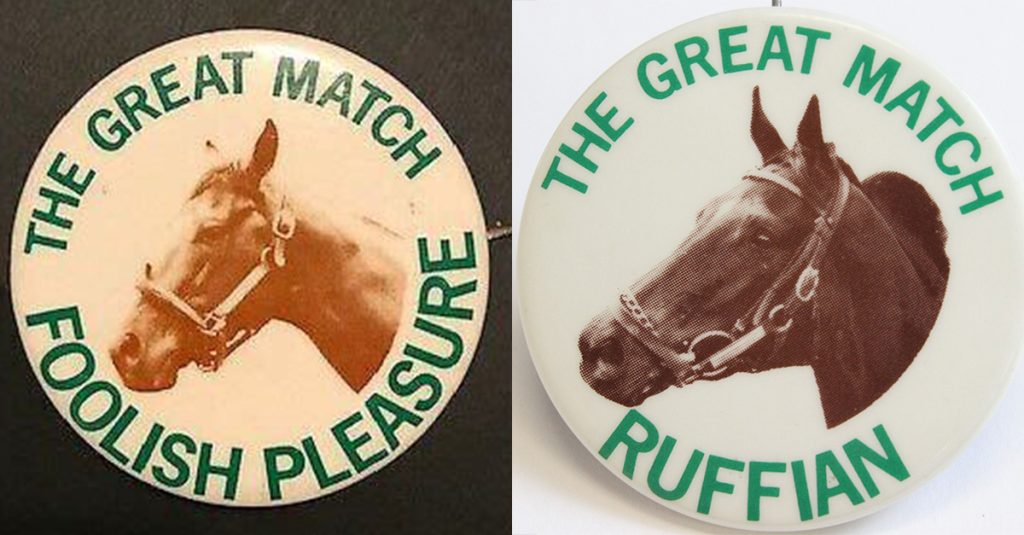
Some 200,000 buttons bearing the photos and names of the two horses were produced. Other buttons read simply “Her” or “Him.” Many fans showed their pick by wearing a t-shirt with the name of their favorite runner along with the corresponding gender symbol: a circle and cross for the filly and a circle and arrow for the colt.
A first-time attendee to the track insisted that the stakes involved in this event went “way beyond” a horse race. “Any woman who wears a Foolish Pleasure button at a time like this ought to be ashamed,” she stated.
In interviews with reporters, husbands openly worried that the women in their lives would be insufferable to be around if Ruffian lost — and equally insufferable if she won.
For Ruffian’s connections, especially her gruff trainer, Frank Whiteley Jr., the whole thing seemed silly. In fact, it seemed silly to most people who knew anything about racehorses.
It was hardly unusual for fillies and mares to run against colts — and even to win on occasion. Tops on that list was the filly Regret, who had beaten the boys in the 1915 Kentucky Derby.
As Dr. Manuel Gilman, then-chief veterinarian for the NYRA, explained in an interview prior to the race, “The margin separating male from female horses is smaller than between the sexes in human athletic competition.” Although colts and older male horses are generally bigger, faster, and hold all the speed records, there are exceptions.
As Gilman saw it, if any horse was the exception, it was Ruffian, who he described as “a big, magnificent specimen of thoroughbred anatomy and the most perfectly conformed filly I’ve ever seen.”
In fact, Whiteley had already planned to run Ruffian against colts and older horses in some prestigious stakes race later that summer after she’d had a rest.
The veteran trainer had strongly resisted the idea of a match race, not because he didn’t think his filly could win but because it involved “the toughest kind of horse racing,” according to Ruffian biographer Edward Claflin. Match races are suicidal speed duels that involve no racing tactics, like dropping back and making one run down the homestretch or going to the lead and trying to control the pace.
“The only way to win,” Claflin explained, “is to run faster and harder than the other horse — all the way.”
But the decision wasn’t up to Whiteley; Ruffian’s owners, Mr. and Mrs. Stuart S. Janney, would make the call. With interest in horse racing and television ratings having dropped precipitously since the glory days of Secretariat’s successful run for the Triple Crown just two years earlier, they agreed with NYRA officials that a boy-girl contest would be good for the sport.
As the day of the big race dawned, Ruffian was favored to win — and not just among the feminists, who made up the majority of the crowd that day. Most trainers and nearly 70 percent of sports and turf writers also thought Ruffian would prevail.
They believed her to be the superior runner over the pedestrian Foolish Pleasure, who, despite being a solid, consistent, accomplished horse, was no Secretariat. He had run 14 times in his career and won on 11 occasions but was currently nursing a two-race losing streak, having finished second to two different horses in the last two races of the Triple Crown.
Ruffian’s racing times were not only faster but her brilliant early speed contrasted sharply with Foolish Pleasure’s come-from-behind style — and in a match race, the horse who can grab the lead at the start almost always wins. To boot, she would carry five pounds less than Foolish Pleasure, a “sex allowance” that is standard any time a filly races against the colts.
And so the horses went to the post. As lightning flashed amid dark skies in the distance, the two horses entered the starting gate. Seconds later, they were off and running at full speed to try to grab the lead.
Who was faster — him or her? The crowd expected to have an answer in approximately two minutes, but the race would be over a little more than 40 seconds in.
As the two approached the half-mile pole, Ruffian was ahead of Foolish Pleasure by a half-length. But then her jockey heard a loud crack and felt her stride shorten and go wobbly, like a boat that unexpectedly hits choppy waters. From the stands, Foolish Pleasure appeared to have suddenly turned on the speed — first drawing even and then quickly pulling ahead and putting distance between the two.
It was an illusion. “Ruffian has broken down! Ruffian has broken down!” race caller Dave Johnson cried out, his voice breaking with emotion.
Foolish Pleasure galloped on alone, but no one was watching him. Instead, the crowd and the cameras kept their eyes on the stricken filly as veterinarians and Ruffian’s connections hurried to her side. The race was over.
So too, the public would learn the next morning, was Ruffian’s life. Despite a heroic attempt by a team of the country’s best veterinary surgeons to try and repair her broken leg, it proved unsuccessful, and the Janneys made the decision to have their champion race filly euthanized.
In the equine Battle of the Sexes, there were no winners, just an innocent casualty.
On the evening of July 7, shortly after the last race was run at Belmont Park, Ruffian was laid to rest in the track infield, her nose pointed, as ever, towards the finish line. Foolish Pleasure continued on with his career, but he would lose every race he ran the rest of the year. While Ruffian would be named champion three-year-old filly at the end of 1975, Foolish Pleasure was passed over for the same accolade in the three-year-old colt category.
Ironically, five years later, Foolish Pleasure’s trainer, Leroy Jolley, would team up with Ruffian’s jockey, Jacinto Vasquez, and quietly enter a filly named Genuine Risk in the 1980 Kentucky Derby. Unfettered by the expectations of a national women’s movement and free to run the race that suited her individual style, the beautiful chestnut filly bolted to the lead at the top of the stretch and held off late-charging colts to become only the second female to win the Run for the Roses.
It was a bright and welcome moment after a dark period for the sport. Ruffian’s tragic end had saddened nearly everyone everywhere, and those in horse racing would spend years reflecting on the loss. To this day, there has never been another match race, and the industry has invested millions of dollars in improving surgery and recovery techniques for injured racehorses.
The women’s lib movement, by contrast, didn’t seem to miss a beat. They quickly moved on to the next opportunity to advance the struggle. “It is not really a blow to women’s lib,” one woman insisted to Dick Young, a columnist for Gannett News Service. “Not the way she [Ruffian] lost. It was a fluke.”
Another woman angrily exclaimed in the immediate aftermath of the breakdown, “I have four daughters and two sons, and I know women are tougher than men, regardless of what happened here today.”
Yet another blamed Foolish Pleasure for the outcome, the colt somehow being “just like all men.”
This response would lead Young to sadly conclude in his July 7 column, “There is no surrender among women. They are hurt. They are depressed. They have lost a battle. The war goes on.”

Indeed, in the 50 years since the Great Match Race, the war between the sexes has gone on. So too has society’s willingness to play along with its absurdities.
Pitting women and men against each other was never just harmless fun. It had and continues to have consequences and harms that are no laughing matter — for born and unborn children, for men and women, for marriage, family, and society at large.
The problem with radical leftist movements is that they rarely know when to stop. What begins as a push for reform often turns into a campaign to upend every norm, until even the movement’s own foundations start to crumble under the weight of its demands.
Instead of affirming women within God’s created design, the feminist movement frequently sought to redefine womanhood by diminishing manhood — turning a noble goal into a cultural rivalry.
In time, that effort morphed into a sub-cultural rivalry between women. Instead of working to provide women with a variety of life choices within society, radical feminists insisted that all women could — and should — try to “have it all,” cruelly denigrating those who felt called to be “only” wives, mothers, and homemakers.
Today, in a further devolution, radical feminism has joined arms with radical gender ideology to enthusiastically champion men who believe they are women over actual women.
The movement that helped pass Title IX to allow expanded opportunities for women to compete against each other in sports now defends the rights of men to compete against women in sports and invade women’s private spaces.
The same movement that rightly pushed to protect women against violence turned a blind eye at last year’s Olympics as a male boxer pummeled a woman boxer in the face and still refuses to speak out against the policy and practice of housing male prisoners with female prisoners.
And the movement that once pushed back against narrowly drawn feminine stereotypes will now insist that confused and unhappy teen girls should be allowed to try to “become” boys via a butch haircut, manly wardrobe, and drugs and surgery.
We are nearing the logical end of radical feminism, a world marked by confusion, detachment from reality, and the erosion of what it means to be human. The outcome was not just possible, it was predictable. When a movement severs itself from biological truth and moral order, disorder is the only destination.
You don’t have to imagine where this leads. You only have to look back 50 years, when a generation of women placed their hopes in a racehorse, convinced that her victory would somehow secure their own. It wasn’t just naïve, it was a warning: When ideology replaces truth, even the most well-meaning aspirations can become tragic.

PHOTOS: (Top) Ruffian races to victory over a field of other fillies in the 1975 Acorn Stakes at Aqueduct Racetrack; (Middle) Buttons worn to tout race-goers’ picks in the Great Match Race on July 6, 1975; (Bottom) Ruffian was originally buried in the infield at Belmont Park, but in 2023 her body was exhumed and moved to her birthplace at Claiborne Farm in Paris, Kentucky, where her grave is marked by this headstone. CREDITS: Bob Coglianese via Alamy; public domain; FindAGrave.com.
If you like this article and other content that helps you apply a biblical worldview to today’s politics and culture, consider making a donation here.