For years, the state had purposefully and unconstitutionally denied Jewish parents the right to use federally mandated monies at religious schools, even though it allowed those same tuition resources to be used at secular private schools.
The state of California has agreed to allow families to use public special education funds for tuition at religious schools, following a legal settlement reached after years of litigation.
The decision marks a significant policy change and aligns the state’s regulations with recent federal court rulings affirming religious rights under the First Amendment.
The settlement stems from a lawsuit filed by Orthodox Jewish families who challenged the state’s long-standing rule that barred the use of publicly funded special education services at religious institutions. Plaintiffs argued that the policy, which required private schools receiving such funding to be nonsectarian, unfairly excluded religious families and violated their constitutional rights.
In the case of Loffman v. California Department of Education, a group of Jewish parents and religious schools challenged the exclusion, arguing that it violated constitutional protections against religious discrimination.
In October 2024, a panel for the Ninth Circuit Court of Appeals ruled 3-0 in favor of the plaintiffs.
A settlement announced this week now makes that ruling permanent, with California and the Los Angeles Unified School District (LAUSD) agreeing to a court order that prohibits the state from excluding religious students and schools from special education funding.
The Individuals with Disabilities Education Act (IDEA) is a federal statute that ensures that children with disabilities receive tailored educational services. While public schools receive funding under IDEA, the law also allows for those resources to be used in private schools when public institutions cannot adequately meet a child’s needs.
Despite this provision, California had maintained a blanket policy that excluded religious schools from eligibility, leaving many faith-based families without viable local options for their children’s education. As a result, some families were forced to leave the state to access necessary services.
The plaintiffs in the lawsuit were Orthodox Jewish parents Chaya and Yoni Loffman, Fedora Nick and Morris Taxon, and Sarah and Ariel Perets. Their children, whose needs could not be met by local public schools, were previously denied access to state-funded placements in religious institutions, such as Shalhevet High School and Yavneh Hebrew Academy, which offer strong academic and support programs.
The legal effort was led by Becket Fund for Religious Liberty, in partnership with Teach Coalition, an Orthodox Union initiative. Together, they successfully challenged the state’s policy, opening the door for religious families across California to receive the same educational funding opportunities afforded to others.
According to recent polling, the outcome aligns with the views of a majority of Californians who support equal access to special education resources regardless of a school’s religious affiliation.
Under the terms of the agreement, the California Department of Education and the LAUSD will stop enforcing the nonsectarian provision. As a result, parents of children with disabilities will now be permitted to seek special education placements in religious schools, provided those institutions meet the academic and service requirements under IDEA.
Eric Rassbach, vice president and senior counsel at Becket, said,
“California spent decades treating Jewish kids like second-class citizens. Today’s settlement ensures that Jewish kids with disabilities can access the resources they need and deserve—just like everyone else.”
Maury Litwack, founder of the EPIC Coalition, added,
“After decades of denying Jewish children with disabilities the crucial support they deserve, California has finally thrown in the towel. This is a triumph for religious schools, the families they serve, and for common sense across the Golden State.”
Religious liberty advocates are hailing the ruling as a step toward greater educational freedom and equality for religious families. They argue that families should not have to choose between their faith and their children’s access to appropriate education.
State officials said the settlement is effective immediately and confirmed they will not challenge the agreement. The decision will likely impact families across California who seek special education services in a faith-based setting and could serve as a model for similar policy shifts in other states.

California’s agreement allowing special education funds to be used at religious schools is more than just a legal win — it’s an affirmation of religious liberty and the biblical role of parents to act as stewards of their children’s education.
For years, religious families in California faced a heartbreaking dilemma: either sacrifice their convictions or their children’s educational needs. This settlement restores what should never have been denied: the freedom to choose a faith-based education while receiving the public support their children are legally entitled to under federal law.
Scripture consistently affirms the God-given responsibility of parents to train up their children “in the way they should go” (Proverbs 22:6). When families are told they must send their children to institutions that may undermine their faith to receive essential services, it places an unjust burden on those striving to honor that biblical mandate. This decision removes that barrier and recognizes that faith and public benefit are not mutually exclusive.
It also underscores the importance of equal treatment under the law. In a society built on freedom of conscience and religious expression, Jewish and Christian families should not be penalized for seeking support in schools that align with their beliefs. Jesus welcomed children and placed a high value on their care (Mark 10:14), and we are called to do the same, especially for those with special needs.
The Bible consistently teaches compassion and justice for the vulnerable, including those with special needs. Scripture affirms that every person is made in the image of God (Genesis 1:27), giving each life inherent dignity and worth.
In Luke 14:13, Jesus says, “But when you give a feast, invite the poor, the crippled, the lame, the blind,” urging care for those often overlooked. Proverbs 31:8 commands, “Speak up for those who cannot speak for themselves.”
Moreover, this case reminds believers to remain involved in key educational and legal issues. The victory was achieved through faithful perseverance and effective legal advocacy. Christians are called to be salt and light (Matthew 5:13-16), standing for truth in the public square and defending the rights of all people to live out their faith. This is a moment to celebrate the outcome and the doors it opens for thousands of children to flourish in schools where both their educational and spiritual needs can be met.
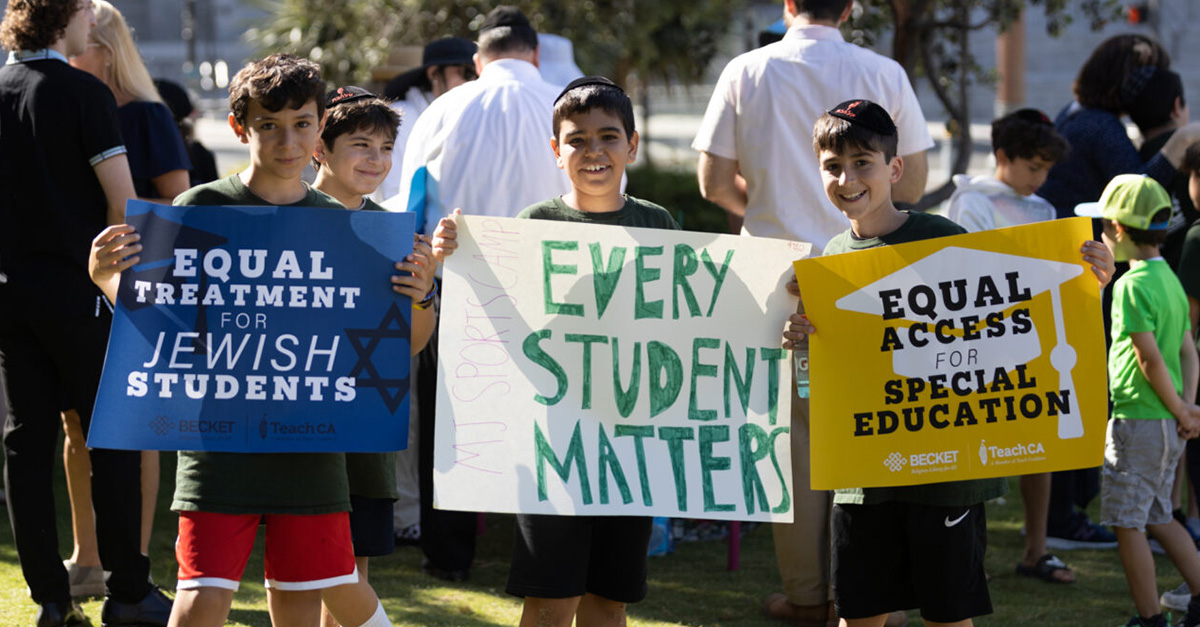
PHOTO: Supporters at a Los Angeles rally for the plaintiffs in the case of Loffman v. California Department of Education CREDIT: Becket
If you like this article and other content that helps you apply a biblical worldview to today’s politics and culture, consider making a donation here.