World War II’s great sea rescue was preceded by a National Day of Prayer that saw millions of British citizens humbly ask God for deliverance from evil — but then Britain forgot His great blessings.
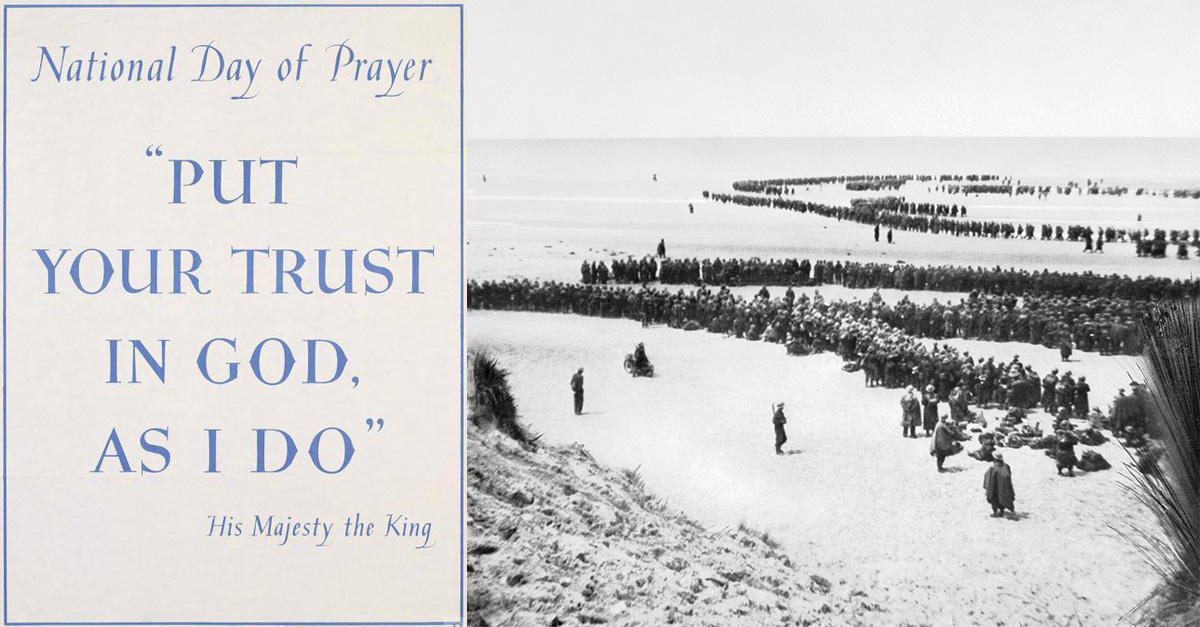
In May 1940, the Nazi War Machine suddenly invaded France, its blitzkrieg tactics overwhelming the British Expeditionary Force (BEF) and other Allied soldiers sent there to defend the country and quickly driving them almost into the sea. By May 26, 1940, some 340,000 troops found themselves trapped on the beaches of Dunkirk and, with no way to escape, facing imminent death or capture.
The panicked question everyone was asking was: Can they be saved?
France’s Premier Paul Reynaud sure didn’t think so. “We have been defeated,” he glumly announced to the newly appointed British Prime Minister Winston Churchill on the morning of May 15. “We are beaten.”
Even the ever-resilient Churchill was a little spooked when his war strategists warned that the only possible rescue effort — an evacuation by sea — would be severely limited by Dunkirk’s shallow harbor and sloping beach, the notoriously stormy and treacherous seas of the English Channel, and relentless Nazi attacks from land, sea, and air.
At best, they predicted, they might be able to rescue 30,000 soldiers.
Resolved nonetheless, Churchill gave the go-ahead for “Operation Dynamo,” which called on British civilians to bring “anything that floats” — fishing vessels, yachts, cruisers, barges, paddleboats, and even rowboats — to get as close to the Dunkirk beach as possible, pick up some soldiers, and ferry them to larger Navy destroyers and minesweepers located further out in the Channel. The Royal Air Force and British Navy would provide defensive cover for the vessels.
On hearing the plan and the relatively gloomy predictions from Churchill, King George VI suggested that Great Britain could greatly increase its odds of success with one additional action.
“We must pray,” he said.
On May 24, as the country braced for the very real possibility that it could lose tens of thousands of its young men, along with the war, the king went on national radio and called on his people to participate in what would be the first National Day of Prayer of World War II:
“Let us with one heart and soul, humbly but confidently, commit our cause to God and ask his aid, that we may valiantly defend the right as it is given to us to see it…. With God’s help, we shall not fail.”
Two days later, millions of British men, women, and children of all denominations poured into churches and cathedrals around the country. In fact, “there was not enough room for all who went,” one local paper noted, forcing many worshippers to stand in the aisles or outside on the streets or to pray with loved ones at home. They sang hymns, listened to sermons, and Bible readings, and asked God for forgiveness, mercy, and deliverance.
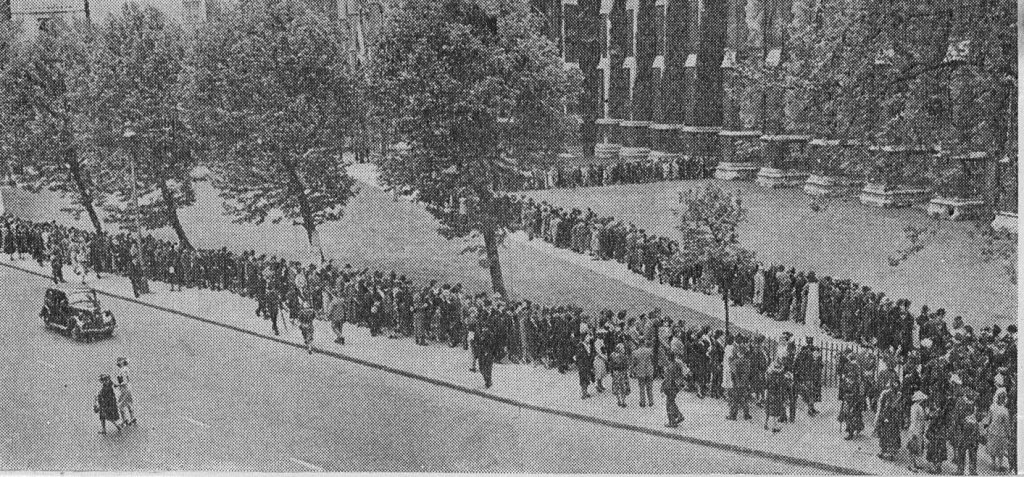
British citizens line up outside of Westminster Abby on May 26, 1940 to pray for the deliverance of 340,000 Allied troops trapped in France.
King George VI, his wife, Queen Elizabeth, and Queen Wilhelmina of the Netherlands attended the special service at Westminster Abbey, along with Winston Churchill, the cabinet, members of Parliament, military leaders, and other high-profile Londoners. Photographs and newsreels of the time show hundreds of everyday Brits queued up outside, hoping to also get a seat.
One newspaper noted, “Nothing like this has ever happened before.”
At St. Andrew’s Church in Maghull, a small rural town near Liverpool, the Rev. Canon Henry Frazer encouraged his congregants with the words of Psalm 50:14-15, “Offer unto God thanksgiving; and pay thy vows unto the most High: And call upon me in the day of trouble: I will deliver thee, and thou shalt glorify me.”
He also told them to trust God and His will, saying,
“We must pray not only now but every day, believing that God will deliver us. The help may not come in the way we expect, but it will come.”
Frazer’s words proved prophetic. No one in Britain or France could have possibly expected the multiple miracles that God would employ over the next nine days to bring about the greatest sea rescue since He parted the Red Sea and delivered the Israelites from the Egyptians.
The first miracle happened just moments after King George VI announced the National Day of Prayer. In what is considered the greatest, most inexplicable military blunder in history, Hitler suddenly ordered his generals to halt the Nazi panzer tanks that had rumbled to within 10 miles of Dunkirk. For the Allies, this was a critical lifeline as it gave them three valuable days to build up the defenses necessary to protect the soldiers as they evacuated the beaches.
Just minutes before Sunday’s special prayer service began, the “armada of little ships” was given the go-ahead to start their perilous 21-mile journey across the English Channel. At the same time, the German High Command ordered its Army to advance once again against the Allied forces in Dunkirk. With that, they announced the “coming annihilation” of the BEF.
But then came the second miracle: A freak storm broke out over Flanders, where the Nazis’ air force was stationed, causing Gen. Franz Halder, chief of the German General Staff, to lament in his diary, “Bad weather has grounded the Luftwaffe and now we must stand by and watch countless thousands of the enemy getting away to England under our noses.”
At the same time, just 100 kilometers away in Dunkirk, a “great calm settled on the Channel” and the waters were so still they “looked like glass,” according to one observer. This was the third miracle.
Unfettered by any waves, the little ships were able to move at a dizzying pace, going back and forth to shore to pick up soldiers and deposit them on the larger ships. In the skies above, Royal Air Force pilot Douglas Bader later wrote that the English Channel from Dunkirk to Dover “looked like any coastal road in England on a bank holiday. It was solid with shipping.”
Indeed, there was an odd normalcy that seemed to set in over the next nine days. One soldier noted the unexpected patience and peace-filled demeanor of those lined up for evacuation. “You had the impression of people standing waiting for a bus. There was no pushing or shoving.”
The storm eventually subsided in Flanders, setting the Luftwaffe free to launch attacks from the air, but then came Miracle No. 4: a low fog cover descended and a slight breeze picked up, blowing black smoke over the beaches and the Channel. As the German airplanes took to the skies, their plan to shoot or drop bombs on boats or escaping soldiers was thwarted by the fact that they couldn’t clearly see their targets.
There were other miracles that those who survived would later recount. For example, a chaplain told a Daily Telegraph reporter of the “strange immunity by which the troops at times were favored.”
He explained, at one point, more than 60 enemy aircraft targeted him and 400 men, systematically machine-gunning and bombing the group as they lay on the beach, but “in the end, there was not a single casualty.” Another chaplain said that when he rose up, he looked down to see that “the sand all around” where he had lain “was pitted with bullet holes” and that his figure “was thus outlined on the ground.”
By June 4, against all possible odds, the Allies had successfully evacuated 338,226 soldiers trapped on the beaches, including approximately 140,000 French and other Allied soldiers.
On Sunday, June 9, Britain’s citizens headed to church once more, this time for a National Day of Thanksgiving. The response was again overwhelming, the Daily Herald reported, as “millions of churchgoers, most of whom participated in the Day of National Prayer a fortnight ago, knelt beside the men who have come back and offered prayers of thanksgiving.”
Writing in the Daily Telegraph, the Rev. Canon C.B. Mortlock, stated unequivocally that “the prayers of the nation were answered” and that “the God of hosts himself has supported the valiant men of the British Expeditionary Force.”
In fact, the belief that the Dunkirk evacuations were the result of divine intervention was first voiced by Walter Matthews, an Anglican priest and dean of St. Paul’s, who dubbed the event “The Miracle of Dunkirk” two days before the evacuation had even been completed.
Churchill himself would refer to Dunkirk as “The Miracle of Deliverance.”
Writing in diaries, sermons, and other publications, many of those who had participated in the National Day of Prayer or had actually been rescued from the beaches would refer to it more specifically as “God’s Miracle at Dunkirk” — ensuring that glory was given where glory was due.
The people of Britain would continue to pray and deepen their faith throughout World War II. King George VI called for six more National Days of Prayer during World War II and another one in 1947, when the country sank into an anxious malaise in the post-war era. With his death in 1952, however, there would never again be another National Day of Prayer held in the U.K.

Long before a miracle took place on the beaches of Dunkirk, it had started in the hearts of a praying people.
Unfortunately, as the people of Britain moved beyond the post-war era, they forgot about the miraculous events at Dunkirk and the reality that God can and will answer the prayers of a nation.
By the 1960s, secular and atheist academics at elite British universities were openly “debunking” the idea that the sea rescue was somehow an act of God, and journalists at the BBC today attribute the miraculous events to the “Dunkirk spirit” — but, of course, we all know that there is not enough individual verve or national pluck to raise the winds and calm the seas on command.
But Britain didn’t just forget about God’s Miracle at Dunkirk — they also forgot about God. And they did it pretty rapidly, embracing a secular future over their Christian foundations.
Callum G. Brown, a professor of social and cultural history at the University of Glasgow, first alerted the world to this reality in his 2001 book The Death of Christian Britain, a provocative title that, nonetheless, appeared to raise no complaints among the Brits themselves, as one reviewer observed. “It seems it is a common idea in the U.K. that Christian Britain has died,” he wrote.
In the 20-plus years since, it’s only gotten worse. In 2022, the U.K. Office for National Statistics released a 2021 survey showing that for the first time, Christianity was no longer the majority religion in England and Wales, with the percentage of people identifying as Christian dropping from 59 percent to 46 percent in just 10 years. At the same time, the number of “nones,” people who don’t believe in any religion, increased to 37.2 percent.
Worse yet are the fruits of that unbelief.
The U.K. now arrests those Christians who pray for the deliverance of lives that are in mortal danger. It no longer protects its people from invaders but instead protects the invaders. Its cathedrals and churches host not National Days of Prayer but disco raves, rainbow flags, and gender-neutral descriptions of God. The nation’s monarch today doesn’t call his people to repentance, humility, and deep faith in Christ but instead conflates the Gospel message with religious pluralism on, of all days, Easter.
Can Britain be saved? It is a question that should concern everyone. Like those once stranded at Dunkirk, the U.K. is on a perilous shore in the midst of evil. But there is the hope of rescue if they will humbly but confidently pray to Jesus and put their faith in Him — for He is the only One with the power to truly save.
PHOTOS: (Top left) A poster announcing the National Day of Prayer called by King George VI on May 26, 1940. (Top Right) Thousands of troops queue up on the beaches of Dunkirk in hopes of being evacuated across the English Channel. CREDIT: Imperial War Museum/Creative Commons
If you like this article and other content that helps you apply a biblical worldview to today’s politics and culture, consider making a donation here.