Instead of letting the left recast Thanksgiving as a day of mourning, Christians must follow the example of the Pilgrims by spending it with their families and gratefully worshiping God for His faithfulness and providence.
This article is a lightly-edited transcript of the “Here’s the Point” podcast by Ryan Helfenbein, executive director of the Standing for Freedom Center.
What is the real story of Thanksgiving? Was it a celebration of conquest, or a feast of gratitude to God? And why are some public schools now teaching our children to see it as a day of mourning?
Before we talk about how Thanksgiving is being rewritten, we need to tell the story the way the Pilgrims told it themselves — in their own words.
Once you hear it, you will understand why the left wants it forgotten.
In 1607, the Pilgrims left England under religious persecution as English Separatists who believed the Church of England retained church practices not consistent with the Bible and not adequately reformed.
They left for Holland, settled in Leidon, and were under the leadership of Pastor John Robinson. While there for 11 years, economic hardship forced the entire family, including children, into hard labor. The older children were assimilating into Dutch culture, leaving the church, and taking jobs as soldiers and sailors.
Concerned about their future, their loss of religious distinctiveness, and their English heritage, while the threat of war loomed over the Dutch and the Spanish, they looked to move again.
In July 1620, before the Pilgrims left Holland, their pastor, John Robinson, called for a day of fasting and preached from Ezra 8:21. He wrote: “I proclaimed a fast…that we might humble ourselves before our God, and seek of him a right way for us, and for our children.”
Far from oppressors, the early Pilgrims were a religious minority group who were deeply self-reliant and put their ultimate faith in God, not in government power or authority.
William Bradford, Plymouth’s longtime governor, described the parting,
“They knew they were Pilgrims, and looked not much on those things, but lifted their eyes to the heavens, their dearest country.”
After 66 days alone, half-starved on a violent Atlantic journey, Bradford wrote that when they reached Cape Cod, “they fell upon their knees and blessed the God of Heaven who had brought them over the vast and furious ocean.”
The first act of the Pilgrims in the New World was not a war. It was worship. They had no conscripted army, no edicts from a king or emperor. These were desperate families — fathers, mothers, and children — looking for a new home where they could thrive, free from religious persecution, and were free from the political turmoil of longstanding empires, kings, despots, and the edicts of the elites.
Before a single family stepped ashore, William Bradford and 41 men signed the Mayflower Compact on November 11, 1620. It is America’s first framework of self-government, written and signed in an American harbor.
It begins with a declaration of faith: “In the name of God, Amen.”
The signers declared in the Compact that they had undertaken the voyage “for the glory of God” and “the advancement of the Christian faith,” that they would “covenant and combine” themselves “together into a civil body politic.”
Notice the order, similar to the Declaration of Independence: God first, then the covenant, then the law.
This was the first form of American self-government under God — the seminal seed of the American Republic for more than 150 years before the Declaration of Independence.
That first winter, half of the Mayflower’s passengers died. In fact, they died in one of the greatest early lessons the Pilgrims would never forget.
Under the original business arrangement that financed their journey to the New World, Pilgrims would work under a collective system of farming, fishing, and trade, with all shared property and labor. In other words, the means of production and labor was communal. It led to greater resentment and early deprivation.
Stronger workers objected to not receiving their just compensation. Young men resented working to support families they did not have. Married women objected to cooking and cleaning for other households and to provide for children who were not theirs.
As a result, the communal arrangement — otherwise known as socialism — failed spectacularly: People starved, and they died.
In Bradfords’ own words, it “was found to breed much confusion and discontent.” It hurt “much employment, that would have been to their benefit and comfort.”
This led to major changes by 1623, when Bradford assigned family parcels of land proportional to their size, where each family could work to provide for themselves and sell the excess for profits. Private ownership of property and labor had fundamentally changed the economic conditions, and it saved the colony.
Bradford, writing of the change, said, “This had very good success; for it made all hands very industrious, so as much more corn was planted, than otherwise would have been.”
But in that winter of 1621, before those new arrangements, the Pilgrims had all but destroyed their economy with this early communal arrangement.
Yet God provided in the form of a local native tribe, the Wampanoag. Among them was a man who fully knew English. His name was Squanto. Someone who years earlier was kidnapped by a British privateer and sold into slavery in Spain. But Squanto made it to England, was educated there, and later returned home two years before the Pilgrims arrived.
Bradford called Squanto “a special instrument sent of God for their good beyond their expectation.”
In March 1621, the Pilgrims and the Wampanoag made a treaty of peace that held for more than 50 years. The Wampanoag taught them how to plant corn, beans, squash, and pumpkins and how to fertilize the soil using fish. In the first year, Pilgrims grew more than 20 acres of corn, and many of their English crops brought over by ship did not succeed.
But the Pilgrims had much to celebrate. Thanks to the local tribe and, by God’s providence, thanks to Squanto, they did not starve any further and were able to save their colony.
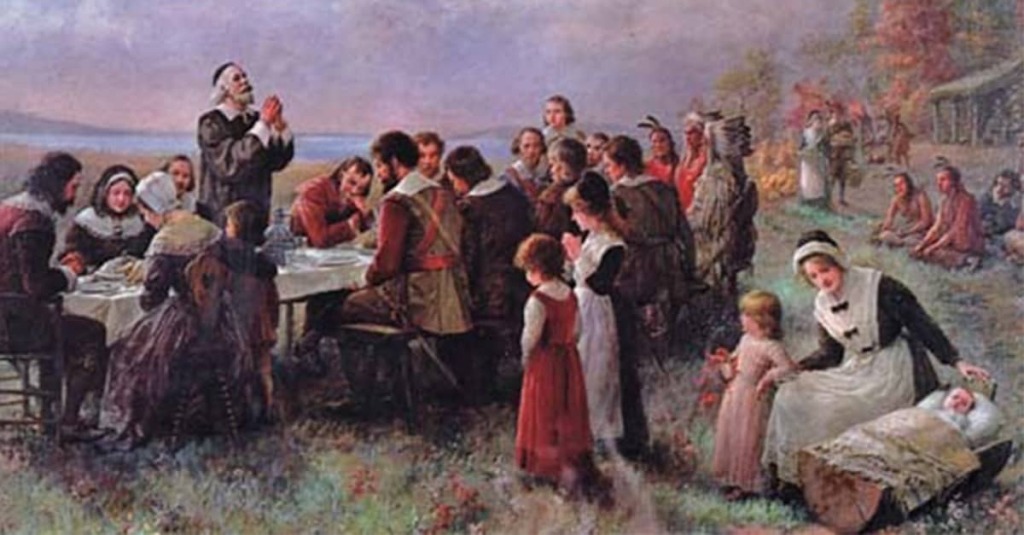
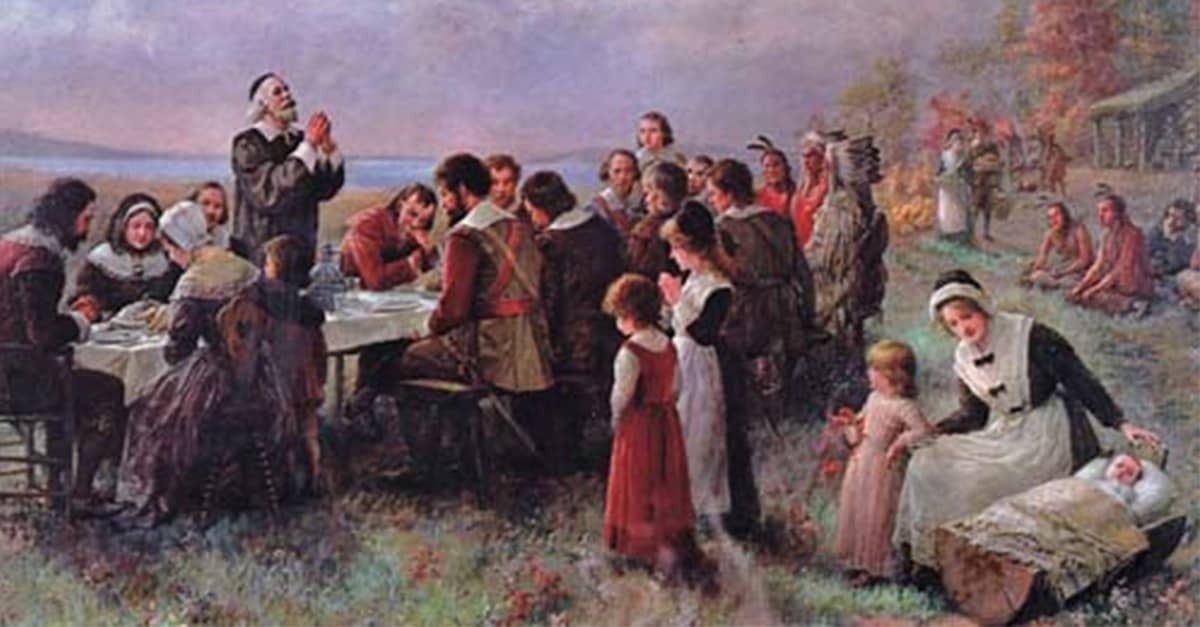
That fall, Edward Winslow wrote that Massasoit, the local chief, came “with some ninety men… bringing five deer to serve in the feast and they were there for three days.”
He wrote, “by the goodness of God, we are so far from want that we often wish you partakers of our plenty.”
That became known as the first Thanksgiving. The first celebration of God’s blessing and intervention in what could have been a tragic end to Plymouth Colony and the early Pilgrims.
And that tradition carried forward — from Washington’s 1789 proclamation giving thanks to “that great and glorious Being” to Lincoln’s 1863 proclamation and call to thank “our beneficent Father who dwelleth in the Heavens.”
Thanksgiving is a cornerstone of American history and our Christian heritage in this nation. It is our first national holiday for good reason.
But for more than 50 years, the diabolical left has worked to destroy and replace that history.
The first “National Day of Mourning” protest began at Plymouth, Massachusetts, in 1970, on the 350th anniversary of the Pilgrims’ arrival to the New World. The idea is simple: undermine and spoil any sense of our original history, reshape the narrative, and replace it with a new dogmatic belief that our forefathers were oppressive men who committed mass atrocities on stolen land. Delegitimize our founding and embrace Marxist dogma.
This month, it was uncovered that Loudoun County Public Schools in the Commonwealth of Virginia had put out a guide recommending a lesson called “The Real Story of Thanksgiving” for grades two through five.
One slide is titled, “Day of Mourning,” and tells children as young as seven that Thanksgiving “marks the beginning of a long period of violence and discrimination.”
The project is more than a simple rewrite; the idea is to remove gratitude to God by laying accusation and blame. For the leftist, it is grievance over gratitude, grievance always, grievance yesterday, today, and forevermore.
So what do we do as Christians? First, we must keep Thanksgiving by keeping it in our hearts. Pray continuously, and in everything give thanks to God for what is ours in Christ Jesus (1 Thessalonians 5:17-18). That is the first duty of every Christian.
Second, celebrate thanksgiving with your family. It is a duty of Christian parents to mark these holidays, tell the history of our nation, read the Mayflower Compact, and model faith that can be passed on to the next generation.
Psalm 78:4 says this: “We will not hide them from their children, but tell the coming generation the glorious deeds of the Lord” (Psalm 78:4).
Remember the words of Bradford: “As one small candle may light a thousand, so the light here kindled hath shown unto many, yea in some sort to our whole nation.”
Thanksgiving is not a day of mourning. Thanksgiving is a Day of Celebration. It is a Day of Worship. Don’t deprive your children of their Christian history and heritage. That is the duty of every patriotic parent, and it will help save the nation.
So, to all of you, on behalf of the Standing for Freedom Center, I want to wish you a Happy Thanksgiving.
If you like this article and other content that helps you apply a biblical worldview to today’s politics and culture, consider making a donation here.