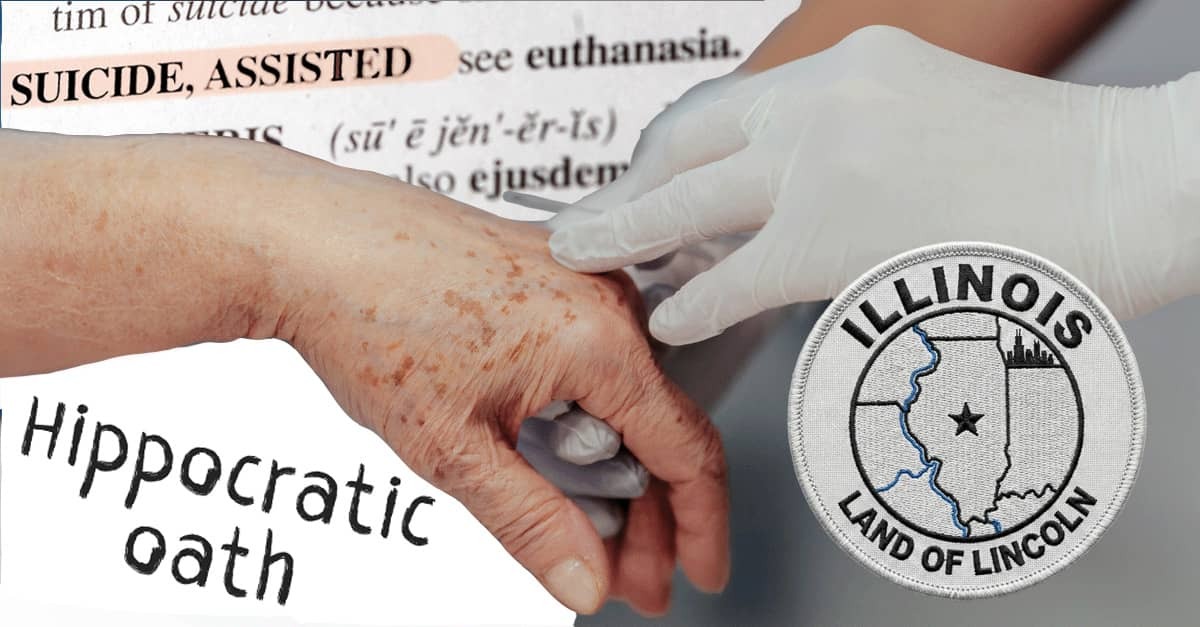
The temporary ruling protects only the doctors and faith-based providers who sued, leaving Illinois’s broader mandate intact and raising the deeper question of who holds authority over life and death: the state, physicians, or God.
A federal judge has issued a temporary restraining order (TRO) blocking Illinois from enforcing parts of its End-of-Life Options for Terminally Ill Patients Act (EOLO) against certain doctors and health systems.
The court reprieve comes after four doctors sued the state over the EOLO. Their challenge was also joined by the Lutheran Care Center of Altamont, Illinois, which is owned and operated by 20 local churches, and the Most Reverend Thomas J. Paprocki of the Roman Catholic Diocese of Springfield, Illinois.
The EOLO was never a standalone piece of legislation but was added as an amendment to the Sanitary Food Preparation Bill, which was then signed into law last December by Democratic Gov. J.B. Pritzker. The EOLO is scheduled to take effect on September 12, legalizing assisted suicide in the Land of Lincoln.
The suit, known as Kirchoff v. Treto, calls out the lack of any conscience protections in the new law. The plaintiffs are challenging the EOLO’s mandate that all doctors discuss assisted suicide and its alleged “benefits” with terminally ill patients and, if they are unwilling themselves to prescribe the pills that will end the patient’s life, to refer patients to doctors who will.
Doctors who refuse to participate face fines of up to $10,000 per violation, the loss of their medical license, and criminal prosecution.
“Illinois’s new law forces faithful health care providers to cooperate in the state’s suicide promotion scheme, and this agreement protects our clients from this grave assault on their religious beliefs,” explained Peter Breen, executive vice president and head of litigation at Thomas More Society, which is representing the plaintiffs.
Assisted suicide, which Illinois calls “aid in dying,” is defined in the law as an “end-of-life care option.”
The plaintiffs argue that by mandating doctors and medical systems to participate in assisted suicide the government violates their right to free exercise of religion, their right of conscience, and the Hippocratic oath.
They also argue that the law violates their right to freedom of speech by compelling them to speak of the benefits of “aid in dying,” while barring so-called “misinformation” that may hinder a patient from choosing assisted suicide.
Their suit also cites provisions of the law that they say force them to lie about a patient’s cause of death. According to the EOLO, if a patient dies of assisted suicide, the cause of death will be listed as the terminal illness, not assisted suicide, and it will not be recorded on the death certificate that the patient self-administered lethal drugs to end their life.
The law’s text further includes this Orwellian disclaimer:
“Actions taken in accordance with this Act do not, for any purposes, constitute suicide, assisted suicide, euthanasia, mercy killing, homicide, murder, manslaughter, elder abuse or neglect, or any other civil or criminal violation under the law.”
After the suit was filed, Illinois agreed not to enforce the EOLO’s provisions against the plaintiffs while the case goes forward. U.S. District Court Judge Franklin U. Valderrama’s TRO ensures that Illinois adheres to its agreement until another court rules otherwise.
“No government has the power to tell a bishop what is or isn’t moral or to require doctors to violate their oath to respect and protect human life,” said Breen. “This is a critical first victory for these faithful doctors, for Bishop Paprocki’s Catholic hospitals, and for the Lutheran Care Center.”
Dr. Mary Keen Kirchoff, one of the plaintiffs, was relieved to learn that the TRO had been officially signed. As a devout Catholic, she says that she cannot and will not comply with the law’s demands that she discuss or participate in assisted suicide, so the initial relief she sought and received in court “means I can go back to focusing on caring for my patients instead of wondering whether staying true to who I am is going to cost me my career.”
She added,
“For months I’ve faced the real possibility that I could lose my license, be fined, or even face criminal charges simply for refusing to promote or refer patients toward death. I’m relieved the State agreed to pause enforcement while the courts weigh in, and I’m grateful I can keep practicing medicine according to my integrity and my faith without that threat hanging over me—for now.”
The TRO is limited, providing protection only to the plaintiffs who brought the suit. Other doctors and care facilities must abide by the law until the case is heard on its merits, but Breen promised, “We will not rest until Illinois’s immoral and coercive assisted suicide mandate is struck down for good, and every doctor and health care ministry in the state is free to heal without fear of the State’s deadly agenda.”

Thomas More Society also represents clients in Schroeder v. Treto, a case that involves similar challenges to an amendment passed in 2016 to the Illinois Health Care Right of Conscience Act requiring physicians to promote the benefits of abortion and provide referrals.
When the EOLO takes effect this month, Illinois will be the 11th state (along with the District of Columbia) that has legalized physician-assisted suicide. Meanwhile, Canada’s Medical Assistance in Dying (MAID) program, initially applicable to terminal patients before being expanded to include those with quality-of-life issues, has now actively euthanized more than 100,000 Canadians since 2016, including those who are depressed, disabled, homeless, or suicidal.

Illinois knows that its new law is morally wrong. That’s why the EOLO was hidden in a “food safety” bill and why its advocates insist on using the passive and euphemistic phrase “aid in dying” while also claiming that assisted suicide isn’t actually assisted suicide.
In reality, “aid in dying” is state-orchestrated euthanasia. And while Illinois can lie on death certificates or in legislation, the truth is that a patient who knowingly self-administers lethal drugs has committed suicide and a doctor who prescribes those same drugs to hasten a patient’s death is participating in a “mercy killing” or murder.
No amount of PR spin, no creative euphemisms, and no legislative blessings can change that cruel, dark, and unavoidable reality.
It is not for a physician to decide how long a person has to live and whether that life is worth living. It is for God to decide.
Psalm 139:16 declares God’s sovereignty over human life:
“Your eyes have seen my unformed substance;
And in Your book were all written
The days that were ordained for me,
When as yet there was not one of them.”
To force a doctor or hospital to promote assisted suicide to a patient — a patient they have sworn not to harm, but to help — or to provide a referral is no different than forcing them to actually prescribe or administer the drugs.
And thus, it is also forcing them to step into the role of God and take a human life.
Christians must develop their ethic on assisted suicide from Scripture and not state legislatures. And they must also understand that while medically assisted “aid in dying” may be marketed as merciful, it is nothing more than man’s latest attempt to wrench control from God.
When life, conscience, and truth are under pressure, we need more than headlines – we need clarity. If this article helped you see the stakes through a biblical worldview, consider supporting the Standing For Freedom Center with a tax-deductible gift.