Can a local government weaponize the zoning process to shut down a Jewish man’s prayer meeting in his own living room without violating his religious liberty and property rights? The U.S. Supreme Court will soon decide.
It started with a simple email invite to a few friends. It ended with a cease-and-desist order from the government.
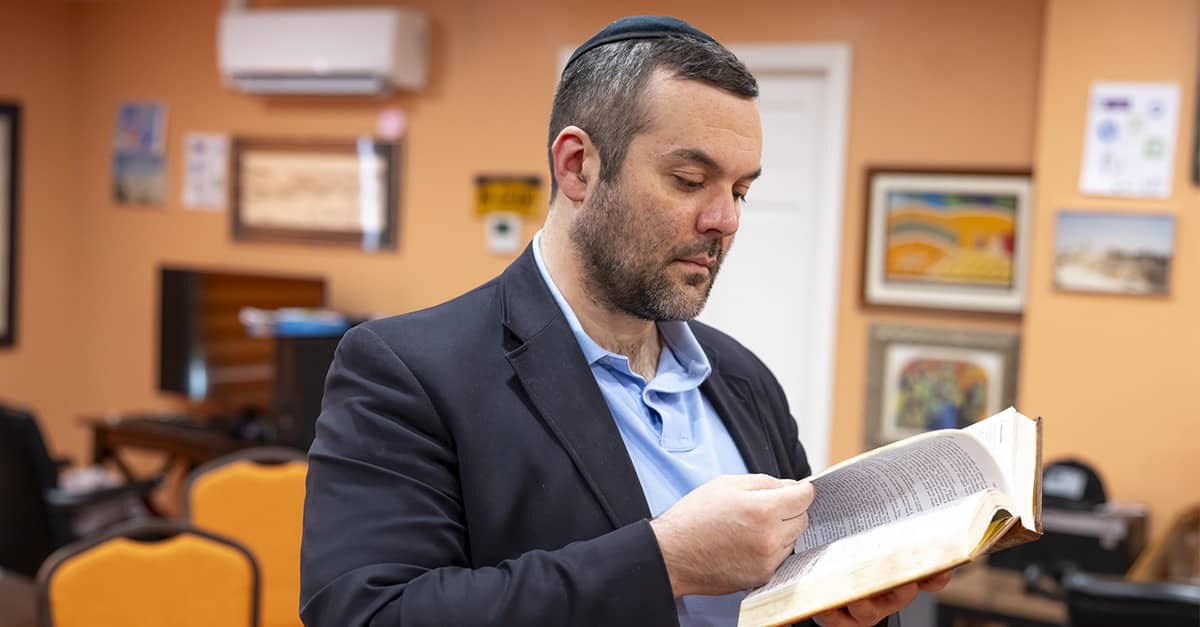
Daniel Grand hadn’t broken into a building, disrupted traffic, or violated a noise ordinance. He had merely invited a small group over to his University Heights, Ohio, home for Friday night prayers.
Had he invited those same friends over to watch a Final Four basketball game or enjoy a book club discussion, city officials wouldn’t have blinked. But Grand wanted to host a prayer meeting, and so before a single guest had stepped onto his front porch, the state had mobilized to shut down the evening. Why? Because local bureaucrats had deemed Grand’s private living room as an “illegal place of religious assembly.”
That’s right, in America, a local government told a Jewish man that he is not allowed to pray with friends in his own living room.

Fortunately, the U.S. Supreme Court has just agreed to hear Grand’s case. While the legal community will focus intensely on procedural doctrines regarding whether a plaintiff must fully exhaust a bureaucratic permitting process before filing a lawsuit, the rest of us need to look at this case for what it truly is: a terrifying assault on the basic sanctity of the American home and religious liberty.
If the government can dictate who you pray with in your own living room, then the concept of private property is an illusion.
The Pretext of “Zoning”
What happened to Daniel Grand in University Heights reads less like a zoning dispute and more like a targeted campaign of civic intimidation. For Orthodox Jews, a minyan, comprised of a group of ten or more Jewish adults, is a fundamental threshold requirement for the most sacred acts of communal worship, including reading from the Torah.
Yet, local officials chose to weaponize the city’s zoning code, which mandates “special use permits” for houses of worship in residential districts. Grand never tried to turn his home into a commercial synagogue. He was simply trying to live out his faith with his friends.
When Grand tried applying for the permit, the process unraveled into overt prejudice. Neighbors submitted public letters declaring, “I am not Jewish, and I do not want our neighborhood labeled as Jewish.” Rather than ending this bigotry, the city broadcast a public hearing that became a show of hostility toward Jewish religious practice.
When the commission demanded even more hoops for Grand to jump through, he withdrew his application. He realized that to obtain a permit to host his friends, the city would require him to legally convert his residence into a house of worship, which would mean he and his family would no longer be allowed to live there.
Worse, the city’s enforcement went far beyond letters. According to court briefs, officials ordered police officers to spy on Grand’s home, encouraged neighbors to keep tabs on his visitors, issued unfounded property violations, and withheld his tax abatements and certificate of occupancy. They even stopped collecting his trash.
This is not zoning enforcement. It’s religious discrimination bordering on persecution.
Grand reached out to Alliance Defending Freedom (ADF), which gladly took up his case. “Every American has the right to host a prayer gathering in his home, and he certainly doesn’t need a city permit to do so,” said ADF Senior Counsel and Vice President of Appellate Advocacy John Bursch. “When government officials forbid that, courts must hold those individuals accountable, immediately,”
The Bureaucratic Snare
Unfortunately, when Grand first turned to the federal courts to protect his First Amendment rights, the doors were slammed in his face. Both a federal district court and an appellate court dismissed his lawsuit, relying on a technical legal doctrine. They argued that because Grand had not finished the city’s hostile permitting process, his case was not “ripe” for judicial review.
The courts effectively told an American citizen that before he can ask a judge to defend his constitutional rights, he must first submit himself to religious hostility, spend thousands of dollars, and potentially sign away the right to live in his own house.
The deep hypocrisy at the heart of the University Heights position is the unequal treatment of identical physical acts.
If Grand had hosted the same group of friends to watch a football game, the traffic and parking demands would be similar, though the noise would no doubt be louder. But because the purpose of the gathering was prayer rather than watching television, the city somehow viewed the activity as an existential threat to the neighborhood’s residential character.
This is a classic example of viewpoint discrimination dressed up in the boring, technical language of urban planning. Local governments across the United States have increasingly discovered that zoning laws are an incredibly effective, low-scrutiny weapon for squeezing out unpopular minorities, unconventional lifestyles, or religious groups that do not fit the preferred demographic profile of the town council. Because courts have historically deferred to cities on zoning matters, bureaucrats use that deference as a blank check to discriminate with plausible deniability.
If allowed to stand, the lower courts’ rulings create a blueprint for any intolerant municipality. If you want to rid your town of a specific religious group, you don’t pass an unconstitutional ban on their religion. Instead, you simply write a zoning ordinance that requires a complex, expensive, and deeply invasive permit for any “religious assembly” in a private home.
Then, you make the permitting process so hostile, prolonged, and degrading that no reasonable person would ever finish it. When the applicant sues, you simply tell the judge, “They didn’t finish the paperwork.”
This targeting of private religious gatherings is not an isolated incident. Just two years ago in Hawaii County, local officials fined a Jewish rabbi over $40,000 for hosting Sabbath meals and small prayer gatherings in his home. In this case, governing authorities also claimed the homeowner was operating an unauthorized religious assembly, ignoring the fact that similar non-religious gatherings occurred freely throughout the neighborhood.
The constitutional hypocrisy of this approach has already been rejected. During the pandemic, the U.S. Supreme Court struck down public health restrictions that shut down in-home Bible studies while allowing Super Bowl viewing parties. In the landmark case of Tandon v. Newsom, the justices ruled that the government cannot impose stricter rules on religious exercise than it places on similar secular activities. As the justices emphasized, the Free Exercise Clause demands equal treatment.
Protecting the Sanctuary of the Home
At its core, this case is about the legal concept of the home as a sanctuary. According to the Third and Fourth Amendments of our Constitution, the home has always been understood as a space where the government’s power stops at the doorway. It is the one place where an individual is supposed to enjoy freedom to think, speak, and pray out of the sight and reach of the state.
When we lose the right to invite friends into our homes for prayer without first asking for city approval, we lose the very essence of a free society. The Supreme Court now has an opportunity to fix this dangerous drift.
The justices must clarify that our fundamental constitutional rights do not take a backseat to local zoning boards. American citizens should never have to beg for a permit just to pray in their own living rooms.
Grand’s fight is not just about a Jewish prayer gathering in Ohio. It is a battle for the privacy and liberty of every single American, regardless of what they believe.
A home should be a place where faith can breathe freely — not where Americans must ask permission to pray. If this kind of biblical, truth-telling coverage helps you stand for liberty with clarity and courage, please consider supporting the Standing for Freedom Center.