Gen. Benjamin O. Davis Sr. broke barriers in a segregated Army, but his greatest legacy was the son he helped shape — a Tuskegee Airman whose discipline, courage, and service helped change America.
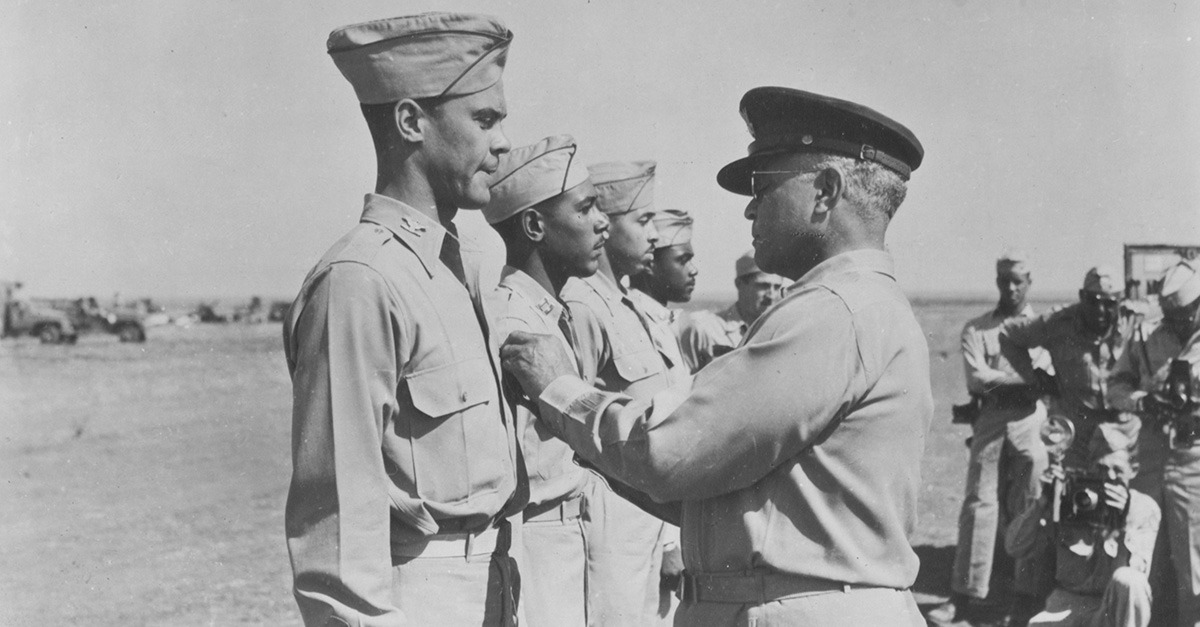
In September 1944, on a dusty airfield in Ramitelli, Italy, Col. Benjamin O. Davis Jr. stood at attention as his father, Brig. Gen. Benjamin O. Davis Sr., pinned a Distinguished Flying Cross to his chest. Afterward, father and son saluted one another, their eyes meeting and surely flickering with pride, gratitude, and appreciation.
Only the two of them would ever know the struggles and sacrifices that made the historic occasion possible. In contrast to today, when 63 percent of black male children grow up without a father in the home but are told that one of their biggest hurdles to success is systemic racism, the Davises prove the power of committed fatherhood and family stability in the face of true racism and discrimination.
Benjamin O. Davis Sr. was sworn into a segregated U.S. Army on June 14, 1899, and became America’s first black general in 1940. After serving his country for 50 years, he retired in a 1948 White House ceremony overseen by President Harry Truman after having earned numerous honors, including a Bronze Star and the Distinguished Service Medal.
His career proved that black officers could lead at the highest levels despite segregation and racial discrimination. The path he’d cleared would later be trod by his son, Benjamin O. Davis Jr., who commanded the famous Tuskegee Airmen, World War II’s all-black squadron, before becoming the first black general in the U.S. Air Force in 1954. After retiring on January 31, 1970, he continued to serve under multiple presidential administrations, including as the director of civil aviation security.
Beyond their military achievements, though, the Davises’ story is really about fatherhood — the lessons a father can impart to his son about leadership, discipline, purpose, resilience, and legacy.
Lesson 1: Lead By Example
“The righteous man walks in his integrity;
His children are blessed after him.”
–Proverbs 20:7 (NKJV)
One evening at the Tuskegee Institute, Ben Davis sat on his front porch wearing his white dress uniform, his wife and children by his side. Mere feet in front of their home, a group of Ku Klux Klan members marched down the street. The Klan’s torches illuminated the night sky and highlighted their white robes and hoods.
The institute had told its faculty and staff to stay indoors and keep the lights off. Ben Sr., however, refused to cower.
“The whole incident impressed me,” Ben Jr. recounted in America’s First Black General by Marvin E. Fletcher. “Inherent also in my father’s action was his strong belief that we need never demand that people like us, but by our actions we must always demand that they respect us.”
That scene was one of many when the elder Davis’s behavior impacted Ben Jr., who would later write in his autobiography, “How lucky I was to have a father who, in spite of formidable obstacles, would fight for his beliefs and ambitions and win! Throughout my own military career and beyond, his achievements stood as an example of what could be accomplished in the face of seemingly impossible social opposition.”
Davis Sr. taught composure, dignity, and endurance not only by instruction but also by example. Ben Jr. grew up observing his father’s values and actions align, a standard of conduct that would serve him well throughout his life.
Lesson 2: Use Discipline as Preparation
“Foolishness is bound up in the heart of a child;
The rod of correction will drive it far from him.”
–Proverbs 22:15
The Davis home was characterized by structure and high expectations, and Ben Sr. used the same disciplined approach to train his children as he did his ROTC cadets. Ben Jr. recalled that he’d been “whipped” a few times and that he’d likely deserved those punishments.
Ben Sr.’s approach might seem draconian by modern standards, but Ben Jr. expressed gratitude for it, explaining, “I respected both my parents and was proud of our family. We arrived on time for meals, sat up straight at the table, and ate all the food on our plates. Punctuality, neatness, and obedience were the rules; there was no such thing as talking back. Even as a child I could appreciate what was being done for us, and I never resented the decisions my parents made.”
For black Americans in the early 20th century, the need for discipline went beyond strictness; it was a form of protection as well as preparation. Ben Sr. understood that his children would be judged more harshly than their white peers. He knew that people would seek excuses to criticize and dismiss them.
In that context, fatherhood meant preparing children for hardship and leveraging discipline to foster resilience. One day, Ben Jr. would serve in the same segregated military system, and self-control would be essential to his survival and his success.
Lesson 3: Give Your Children a Sense of Purpose
“A man’s heart plans his way,
But the Lord directs his steps.”
–Proverbs 16:9
Somewhere over Washington, D.C., soaring just below the white clouds punctuating the blue sky, a teenaged Benjamin O. Davis Jr. knew that he wanted to become a pilot. The idea was born when Ben Sr. paid for his son to fly with a barnstormer, a moment that changed the course of Ben Jr.’s life.
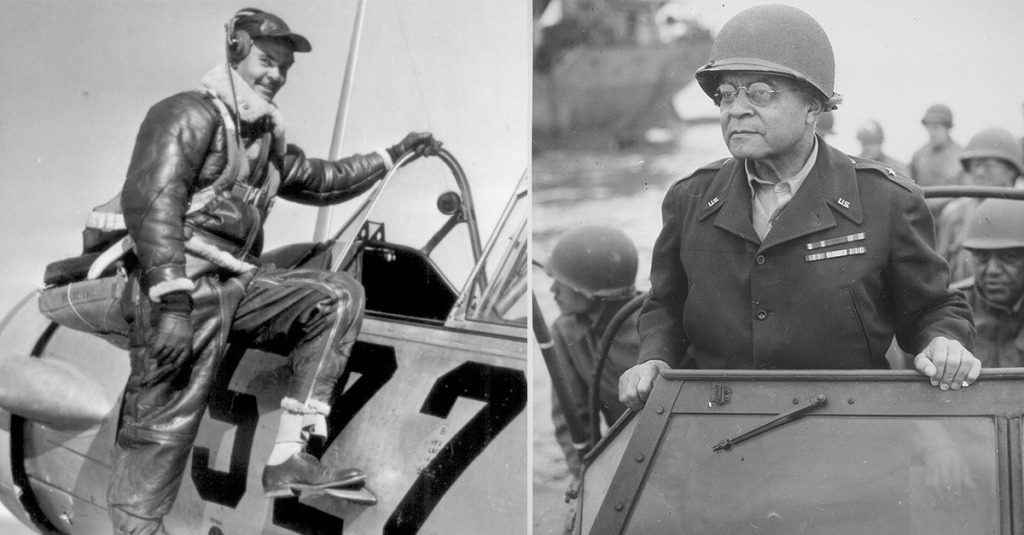
At the time, black pilots were few and far between. They weren’t allowed to fly commercially, and the military wouldn’t start training black soldiers as pilots until World War II. However, Ben Sr. was working every day to challenge inequality and expand opportunities.
He himself had wanted to attend West Point, but for political reasons, President William McKinley wouldn’t appoint a black man to the renowned military institute. Ben Jr. knew his father wanted him to go there, though the issue was never forced. In time, he resolved to pursue the path his father had been denied.
Upon Ben Jr.’s acceptance to West Point, his father wrote him a letter expressing joy and pride. As only the fourth black cadet admitted to the academy, Ben Jr. recognized the significance: “In spite of the attitudes of whites in the United States toward all people of color, [my father] had managed to buck the system and accomplish his goals. He had made life easier for me. Now it was my turn to make things better for those who would come after me. I was determined to succeed.”
Lesson 4: Teach Resilience Without Hardening the Heart
“Train up a child in the way he should go,
And when he is old he will not depart from it.”
–Proverbs 22:15
In 1932, Ben Jr. reported to West Point and encountered a cruel tradition called “silencing,” in which a targeted cadet was spoken to only on matters of duty. As a result, Ben Jr. ended up bunking and eating meals alone for the next four years and was never befriended by a single cadet.
Ben Jr. had witnessed his father face racism, discrimination, and daily indignities with professionalism and dignity. Thus, he too was undeterred: “This cruel treatment was designed to make me buckle, but I refused to buckle in any way. I maintained my self-respect. … I made my mind up that I would continue to hold my head high. At no time did I consciously show that I was hurt; even at this early date, I took solace in the fact that I was mature enough to live through anything other people might submit me to, particularly people I considered to be misguided.”
Ben Jr. not only endured but he graduated in the top 12 percent of the class of 1936. It would have been understandable for him to be resentful about his experience, but he emerged with his personality, regard for others, and sense of humor intact.
After he received his commission, for the first time, the U.S. Army had two black officers at the same time: a father and his son.
Lesson 5: Build a Legacy with a Long View
“Children’s children are the crown of old men,
And the glory of children is their father.”
–Proverbs 17:6
Ben Sr. retired just before President Harry S. Truman desegregated the military in 1948, but the general had worked behind the scenes advocating for that executive order — even as his daily performance demonstrated black competence and leadership in an institution that often refused to acknowledge it.
Ben Sr.’s biographer Marvin Fletcher summarized his contributions as service to his country and to the black community, emphasizing that his commitment to his duty allowed him to enact improvements in the U.S. Army. “The life of Benjamin O. Davis did prove that one could advance and achieve success by doing one’s job to the best of one’s ability,” he stated.
Ben Jr. would carry his father’s work forward almost to the 21st century. The Air Force became a separate entity in 1947 and was the first military branch to fully desegregate. Ben Jr. was a key figure in that process, which EBONY magazine described as the “swiftest and most amazing upset of racial policy in the history of the U.S. military.” As the first black general in the Air Force, he helped lay a foundation for a culture rooted in merit, technical superiority, and discipline — principles he’d learned from his father.
The Davises’ story demonstrates that family legacy is about more than the present — it’s about what a child receives, carries, and passes on to the next generation. Their influence shaped not only their own family but also institutions, their country, and history itself.
What Modern Fathers Can Learn from the Davises
“Hear, my children, the instruction of a father,
And give attention to know understanding…”
–Proverbs 4:1
Strong fatherhood requires presence, example, and preparation. Benjamin O. Davis Sr. was deeply involved in raising his children and taught them that life was primarily about service, not about being served.
The bond the Davis men shared shows that leadership in the home and leadership in public life are connected.
Family formation shapes society, and research supports this truth. A robust study conducted in 2019 by researchers from Harvard and the U.S. Census Bureau found that for black boys, the presence of a father is associated with fewer behavioral problems at school, better academic performance, higher graduation rates, and significantly lower incarceration rates. In stark contrast to today’s assumption that children can only succeed if they have the right skin color, economic status, or education, the Davises are a real-world testament to the idea that the greatest privilege a child can have is the love and attention of a strong, caring, and present father.
Ben Sr. and Jr. weren’t solely military pioneers — they were a father and son who influenced and supported one another. They spoke of each other with respect and affection, and their relationship offers a model of love expressed through discipline, duty, and sacrifice. Their story also demonstrates the reality that fathers must prepare their children not for comfort but for a higher calling.
Perhaps the most important lesson from their story is this: A father’s greatest legacy may not be what he personally achieves but what he helps his child become.
Amanda C. Bauch is an award-winning writer and the editor of numerous bestselling books. She co-wrote Invisible Generals: Rediscovering Family Legacy, and a Quest to Honor America’s First Black Generals with Doug Melville, the great-nephew of Gen. Benjamin O. Davis Jr. Alongside her pastor-husband, she’s raising a son and a daughter in Nashville, Tennessee. You can read more about her passion for service, sacrifice, and family in her book, One Nation Under God: 40 Devotions for Patriotic Women.
Stories like the Davises’ remind us that strong families help build strong nations. Your tax-deductible gift helps the Standing for Freedom Center defend faith, family, and freedom while equipping believers to raise the next generation with courage, conviction, and biblical truth.