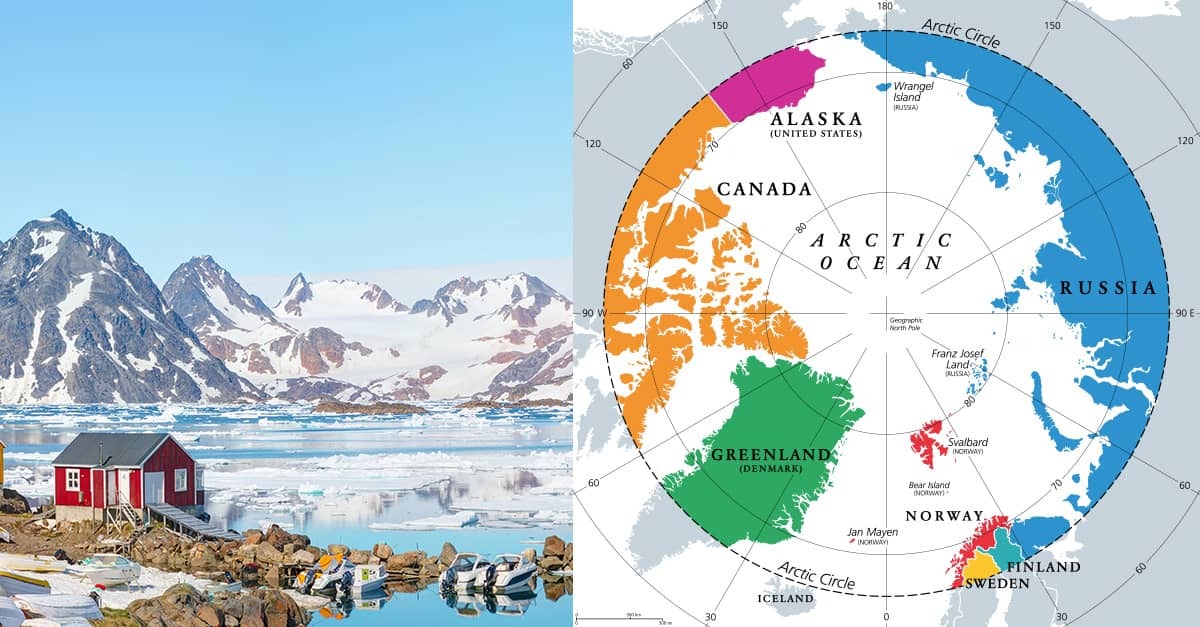
Other presidents going back to 1867 have tried to acquire Greenland from Denmark, but President Trump now recognizes that the consequences to U.S. national security will be catastrophic if China or Russia end up getting it first.
This article is a lightly edited transcript of the “Here’s the Point” podcast by Ryan Helfenbein, executive director of the Standing for Freedom Center.
The Trump administration has renewed America’s interest in Greenland — not as a real estate deal but as a critical piece of national security infrastructure. The strategic importance of Greenland has been recognized by American leadership for more than 150 years. And what was true going all the way back to 1867 is even more urgent in 2026.
Greenland has been a Danish colony since Christian missionaries first arrived in 1721. The island gained home rule in 1979 and expanded sovereignty in 2009, controlling most domestic affairs except foreign policy, defense, and monetary policy — which still remain under Danish authority today.
But Greenland’s value to the United States has nothing to do with Denmark’s colonial legacy and everything to do with geography, national defense, and natural resources to the benefit of all Western nations.
So why does Greenland matter?
First, Greenland’s location provides unmatched strategic advantages for national security.
Positioned at the intersection of North America, Europe, and the Arctic circle, Greenland sits at one of the most critical geographic chokepoints in the world — the GIUK Gap. This corridor between Greenland, Iceland, and the United Kingdom is the gateway for monitoring submarine and air traffic between the Atlantic Ocean and the Arctic.
Control over this gap means control over Russian and Chinese naval movements into the Western Hemisphere and beyond.
The United States already operates a strategic military base in Greenland — one of America’s most critical military installations to date. It provides missile early warning systems, Space Force operations, and anti-submarine warfare capabilities.
During the Cold War, this base was essential for detecting Soviet missile launches. Today, it’s equally vital for countering threats from Russia and China in the Arctic region.
Second, American interest in Greenland isn’t new. It’s been consistent for over 150 years.
The United States first attempted to purchase Greenland in 1867, the same year the U.S. purchased the Alaskan territory from the Russian Empire. We tried to purchase Greenland from the Danish government again in 1910 and again in 1946.
This wasn’t imperial ambition — it was strategic foresight. During World War II, the United States occupied Greenland to prevent Nazi Germany from establishing a foothold in the Western hemisphere. That occupation established America’s long-term military presence, which continues today.
President Trump’s renewed interest reflects the same strategic calculation that motivated every American president who understood Arctic geopolitics. The difference now is that China and Russia are aggressively expanding their Arctic presence, making Greenland’s strategic value greater than ever.
Third, Greenland holds massive, untapped reserves of rare earth minerals critical for American economic and military security.
Greenland possesses potentially the world’s largest deposits of rare earth elements — materials essential for advanced technology, semiconductors, and modern electronics and appliances. Currently, China dominates by 80 percent global rare earth production and uses this virtual monopoly as economic leverage against the United States and Western nations.
Securing access to Greenland’s rare earth reserves would fundamentally shift the balance of power in global supply chains. It would reduce American dependence on China for critical materials needed for, among other things, national defense, advanced manufacturing, and emerging technologies.
This isn’t just about military hardware — it’s about economic sovereignty to the benefit of both the United States and all Western nations.
Finally, whoever controls the Arctic will shape the 21st century, and America cannot cede that ground to China or Russia.
As the Arctic ice melts in the cyclical patterns of geo cooling and heating, new shipping routes and resource extraction opportunities are opening up. China has declared itself a “near-Arctic state” despite being nowhere near the Arctic Circle, and it is investing billions in Arctic infrastructure through its Belt and Road Initiative. Russia is militarizing the Arctic at an unprecedented pace, reopening Cold War-era bases and establishing new ones.
If the United States does not secure its position in Greenland and the broader Arctic region, China and Russia will fill that void. The strategic consequences would be catastrophic — losing control of critical sea lanes, missile defense positioning, and access to resources that will fuel our economies well into the 22nd century.
Make no mistake: Greenland isn’t just about real estate. It’s about securing America’s defense perimeter, countering Chinese and Russian expansion, and protecting the Western Hemisphere from hostile powers.
The Trump administration understands what presidents have known for 150 years: Greenland’s strategic value to the United States cannot be overstated.
If you like this article and other content that helps you apply a biblical worldview to today’s politics and culture, consider making a donation here.