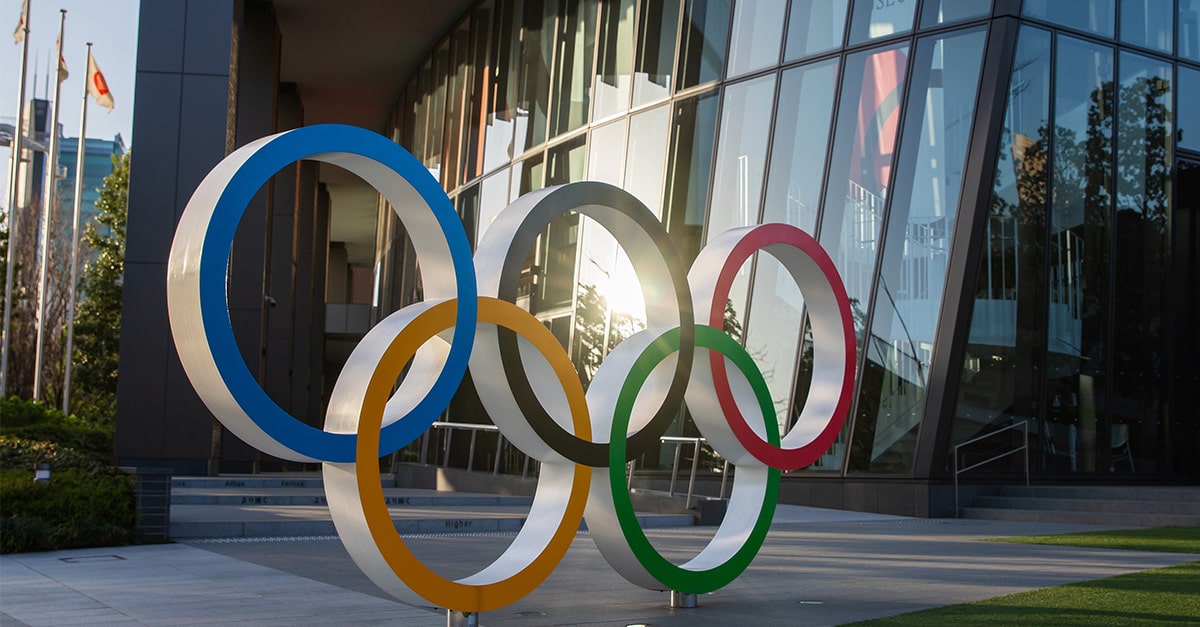
The new policy follows President Trump’s executive order ensuring the fairness, integrity, and safety of women’s sports and applies to all U.S. Olympic and Paralympic athletes.
[UPDATE] On Monday the U.S. Olympic and Paralympic Committee (USPOC) posted an updated policy stating that it will follow President Donald Trump’s Executive Order banning men from women’s sports.
While the committee updated the policy on June 18, it was not made public until this week.
The change was made with little publicity, and the policy update was so understated it would be difficult to detect without it being pointed out.
In Section 3.3 of the 27-page document, the committee added an addendum entitled “Additional Requirements” which states:
“The USOPC is committed to protecting opportunities for athletes participating in sport. The USOPC will continue to collaborate with various stakeholders with oversight responsibilities, e.g., IOC, IPC, NGBs, to ensure that women have a fair and safe competition environment consistent with Executive Order 14201 and the Ted Stevens Olympic & Amateur Sports Act.”
President Donald Trump signed Executive Order 14201, known as “Keeping Men Out of Women’s Sports,” in February. The order requires educational institutions and sports governing bodies to follow Title IX and ensure the safety and fairness of women’s sports by creating policies that keep males from competing in female sports.
The order specifically calls on the Secretary of State to ensure that the International Olympic Committee adopts policies that ban males from women’s sports.
When Trump signed the order, he made statements regarding the decision to allow two males to compete in women’s boxing in the 2024 Olympics.
USOPC CEO Sarah Hirshland and President Gene Sykes wrote in a letter regarding the updated policy, “As a federally chartered organization, we have an obligation to comply with federal expectations. Our revised policy emphasizes the importance of ensuring fair and safe competition environments for women. All National Governing Bodies are required to update their applicable policies in alignment.”
Eligibility for the Olympics is largely determined by the governing bodies of individual sports.
At a USPOC meeting in April, Hirshland said the eligibility policy would not change heading into the 2028 Summer Olympics in Los Angeles, California.
“So typically speaking at an international level, the international federations will define eligibility criteria for the events in which they own jurisdiction — world cups, world championships, etc. — and the national governing bodies domestically would define eligibility criteria for their events,” she explained. “In some cases those may be elite-level events, national championships, and things. In other cases, those may be lower-level grassroots youth sport competitions and things of that nature. So we do not have, nor will we have, an eligibility policy. It wouldn’t be appropriate—it’s not our role to take on that position.”
Some international bodies have already banned males or most males from competing in women’s sports.
In 2022, FINA, now known as World Aquatics, banned males who had reached age 12 or Tanner Stage 2 of puberty before undergoing gender transitions from competing in women’s swimming, diving, and other aquatic sports.
In 2023, the World Athletics Council, the governing body for track and field, banned males who had been through puberty from competing in women’s events.
Other organizations in the United States such as the NCAA and the Ladies’ Professional Golf Association (LPGA) have also implemented policies to bar most males from women’s sports. The LPGA took the same approach as World Aquatics and World Athletics, banning males who had reached age 12 or Tanner Stage 2 of puberty.
USPOC policy should ensure that no male athlete competes for women’s teams representing the United States in the Olympics, although the policy does not provide any specific information on how the USPOC will protect women’s sports. If it relies on a competitor’s birth certificate, as the NCAA does, transgender athletes can get around the rules as some states allow transgender-identifying residents to alter their birth certificate.
It is unclear what effect, if any, the decision will have on the ability of male athletes to compete representing other nations in 2026 Winter Olympics in Italy or the 2028 Summer Olympics in Los Angeles.
In his executive order, President Trump instructed the Secretary of State and Secretary of Homeland Security to bar entry to the country for males seeking to compete in women’s sports at the Los Angeles Olympic Games. This will likely lead to a legal battle if any male athletes do seek to compete for other nations in the 2028 Olympics.
ORIGINAL STORY
{Published on June 13, 2024} William “Lia” Thomas, the transgender swimmer who sparked controversy after dominating collegiate women’s swimming and claiming a national title, has lost his case to compete against women in elite swimming competitions and the Olympics.
Thomas, 25, who adopted the name “Lia” in 2020, was ranked 554th among freestyle swimmers in men’s collegiate competition during his time at the University of Pennsylvania. His prospects dramatically changed when he started identifying as a woman.
Thomas entered women’s races and began crushing the competition, winning the NCAA national title in the women’s 500-yard freestyle in 2022.
Thomas’s inclusion in women’s swimming, as well as numerous victories in women’s competition by other male athletes identifying as female, has sparked backlash from female athletes and sports governing bodies.
This includes World Aquatics (WA), formerly known as FINA, which has a policy barring males who began transitioning after the Tanner Stage 2 of puberty, or around age 12, from competing in women’s events.
World Aquatics is the global governing body for swimming.
As such, Thomas is barred from competing in the Olympics as a female.
Thomas challenged the ban at the Court of Arbitration for Sport, which dismissed the case.
The panel of judges ruled that Thomas “is simply not entitled to engage with eligibility to compete,” noting that “since the athlete is not entitled to participate in ‘Elite Events’ within the meaning of USA Swimming Policy, let alone to compete in a WA competition,” then the athlete “is simply not entitled to engage with eligibility to compete in WA competitions.”
That means he won’t be competing in this Saturday’s Olympic swimming trials or in the Summer Olympics in Paris, which get underway on July 26.
World Aquatics praised the ruling, calling it a “major step forward” in protecting women’s sports. In a statement, the group said,
“World Aquatics is dedicated to fostering an environment that promotes fairness, respect, and equal opportunities for athletes of all genders and we reaffirm this pledge. Our policies and practices are continuously evaluated to ensure they align with these core values, which led to the introduction of our open category.
We remain committed to working collaboratively with all stakeholders to uphold the principles of inclusivity in aquatic sports and remain confident that our gender inclusion policy represents a fair approach.”
World Aquatics permits athletes who are female but identify as male to compete against males or to compete against females if they keep their testosterone level below a certain number.
Male athletes who identify as female and transitioned after age 12 must compete against men.
Riley Gaines, the former University of Kentucky swimmer who tied with Thomas in an event at the national championships and has since joined in a lawsuit against the NCAA over its policy of allowing males to compete against women, said on X,
“Great news! Lia Thomas won’t be able to compete in women’s category at the Olympics or any other elite competition. He has just lost his legal battle in Court of Arbitration for Sport ruling. This is a victory for women and girls everywhere.”

Will Thomas fairly accomplished something that few people do: he became a competitive collegiate swimmer in the men’s division. He wasn’t the best, but conceivably he did his best and improved his technique and times in the three years he competed as a member of UPenn’s swimming team.
But Thomas wanted to do more. He has stated that it was his lifelong dream to compete in the Olympics and win Olympic gold. While anyone can understand the disappointment of not seeing your dreams realized, the fact is, there are many women with similar dreams.
It was the dream of women swimmers to compete at the 2022 NCAA championships and enjoy a fair competition. It was the dream of many to win a national title or at least stand on the podium, but that chance was taken from them by a male with an unfair biological advantage.
Just like Thomas, there are girls and women around the globe who have also had lifelong dreams of competing at the highest levels of their fields. Those women likely trained day and night, meticulously watched their diet, honed their technique, and sacrificed their time and social opportunities, all to have a fair chance at competing in the Olympics and bringing home a medal for their country. The inclusion of Thomas and other males would have taken slots on Olympic and elite teams, and very likely medals, from those women.
No one is banning people who identify as transgender from competing in athletics.
If they want to compete, they must do so either in the open category or against those of their biological sex. That is the only way to maintain the integrity of competition and any sense of fairness.
If you like this article and other content that helps you apply a biblical worldview to today’s politics and culture, consider making a donation here.