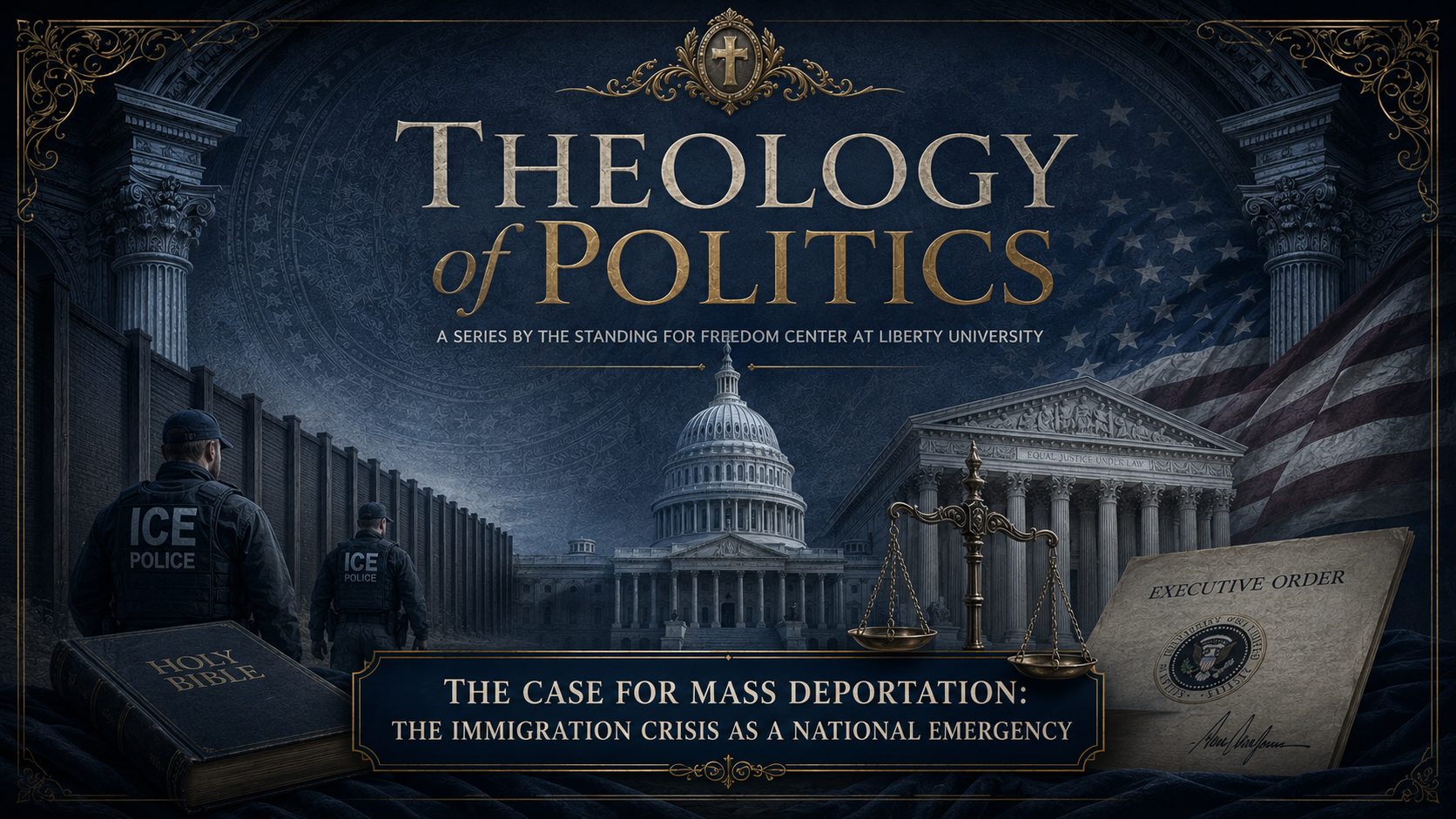
“Mass deportation is not radical – it is rational. It is not cruel – it is clarifying. It represents America’s reclamation of its sovereign right to determine who enters its territory and under what conditions.”
– Virgil Walker, Standing For Freedom Center
A Nation Under Siege
The United States has been under siege – not by an invading army with tanks and missiles, but by a relentless, unchecked flood of illegal migration that has eroded national security, overwhelmed social systems, and undermined the rule of law. With over 300,000 illegal aliens arrested in 2025 alone, the Trump administration has wasted no time proving that decisive leadership produces measurable results. Congress has finally provided the tools for victory, approving $170 billion in immigration enforcement funding, including $46.5 billion to complete the border wall that should have been finished decades ago. While the crisis has slowed under the Trump administration, the damage from decades of neglect remains. The situation with mass migration is not an administrative hiccup – it is a full-scale emergency with measurable, deadly consequences.[1]
The numbers alone paint a dire picture. Over 11 million illegal immigrants reside in the U.S. – and that’s a conservative estimate. The actual number is likely far higher, given the previous administration’s systematic refusal to track, detain, or deport those who enter the country illegally. The financial burden on American taxpayers exceeds $150 billion annually, draining resources meant for American citizens and legal residents.[2] But this is not just a question of dollars and cents – it is a matter of life and death.
Fentanyl, pouring across the southern border, now claims over 100,000 American lives per year.[3] This is not a byproduct of immigration; it is a deliberate cartel-driven operation, aided by weak border enforcement, political cowardice, and an immigration system that functions more like an open-door invitation to criminal enterprises. The crisis extends beyond drugs. Human traffickers, emboldened by the U.S. government’s refusal to enforce its own laws, are raking in billions by smuggling women and children into modern-day slavery.[4]
When Americans demand action, they are met with gaslighting from the political class. The same leaders who live in gated communities and send their children to private schools tell you that the border is “secure.” They tell you that mass deportation is “cruel” and “impractical” while ignoring the real cruelty – the rape, the exploitation, and the murder that is happening because they refuse to enforce the law.
History tells us that when a nation abandons its borders, it abandons its people. The fall of Rome didn’t come overnight – it was the product of political decay, a weakened military, and an influx of foreign settlers who held no allegiance to the empire. America is following the same trajectory.[5] The question is: Will we learn from history, or will we repeat its mistakes? If we do not act now, we may not have a country left to save.
Who Speaks for the Victims?
The political elites wring their hands over the rights of illegal immigrants, but who speaks for the Americans who have suffered at their hands? Who speaks for:
● Laken Riley, a 22-year-old nursing student, brutally murdered by an illegal immigrant who never should have been here in the first place.[6]
● Kate Steinle, gunned down in broad daylight by a repeat offender, deported five times, only to be released yet again.[7]
● The thousands of families shattered by fentanyl overdoses, their children poisoned by drugs trafficked over the very border the federal government refuses to secure.[8]
● The countless women and children trafficked into sexual slavery, used as pawns in fraudulent asylum schemes, and discarded by the very system that claims to “protect” them.[9]
For decades, the political establishment has turned a blind eye to these victims. Only now, under the Trump administration, has the issue been forced into the national spotlight. Unlike his predecessors, President Trump has taken decisive action to restore law and order, including appointing Tom Homan, the former acting director of (ICE), to spearhead the administration’s renewed focus on border enforcement and mass deportation. Homan, one of the strongest voices for immigration enforcement, has been clear: the failure to deport criminal illegal aliens costs American lives – and he is committed to putting an end to the lawlessness.[10]
In January 2025, Trump signed the Laken Riley Act, named after the young woman brutally murdered by an illegal immigrant. The bill requires ICE to detain and deport illegal aliens who commit theft and other serious crimes – something that should have been common sense all along. Yet, 168 House Democrats refused to support the bill, exposing their priorities for all to see.[11] Their refusal to stand with American victims in favor of shielding illegal criminals is a damning indictment of their political motivations.
Even worse, some states – run by leftist politicians – are still refusing to fully participate in the deportation process. Sanctuary states like California, New York, and Illinois remain committed to harboring criminal illegal aliens, defying federal law and putting their own citizens at risk. In these states, illegal immigrants enjoy greater protections than American citizens, while law enforcement officers are handcuffed by radical policies that prevent cooperation with ICE.[12]
This is the reality: While President Trump and his administration fight to restore law and order, Democrats at every level are actively resisting enforcement efforts. They are not just neglecting their duty – they are obstructing justice. How many more Americans must die before we take this crisis seriously?
The Bipartisan Betrayal: How Both Political Parties Enabled the Crisis
The immigration crisis is not an accident – it is the result of decades of deliberate policy failures by both Democrats and Republicans. Each party has played a different role in creating and maintaining this crisis, prioritizing political gain and economic interests over national security.
“The immigration crisis is not an accident – it is the result of decades of deliberate policy failures by both Democrats and Republicans …“
Democrats have long used immigration as a tool for political dominance. Since the passage of the 1965 Immigration Act, leftist politicians have shifted policies to encourage mass migration, knowing that a growing demographic of dependent voters will strengthen their political base.[13] Sanctuary cities, weakened border policies, and amnesty proposals are all part of this strategy. Their ultimate goal is clear: reshape the electorate to ensure long-term power.
Republicans, on the other hand, have been complicit in allowing illegal immigration to persist. While conservative voters overwhelmingly demand border security, establishment Republicans have frequently caved to corporate interests that benefit from an influx of cheap, unregulated labor.[14] From Reagan’s 1986 amnesty deal to Bush’s failed 2007 immigration reform, many Republican leaders have prioritized economic benefits over the enforcement of immigration laws.
The result? Decades of mass migration without assimilation, weakening American identity and creating deep cultural fragmentation.
A Historical Shift: From Controlled Naturalization to Open Borders
Historically, U.S. immigration policies were designed to ensure assimilation, national security, and economic stability. Unrestricted migration has dismantled that framework, creating a chaotic, fractured nation.
● The 1924 Immigration Act (Johnson-Reed Act) limited mass migration to allow immigrants time to integrate. It prioritized national interest over open borders.[15]
● Operation Wetback (1954) under President Dwight D. Eisenhower marked the most aggressive deportation effort in U.S. history. With an estimated 1.3 million illegal immigrants deported, it proved mass removal was both possible and effective. However, its gains were erased by the decades of political inaction that followed.[16]
● The Bracero Program (1942-1964) temporarily allowed Mexican laborers into the U.S. legally. Its expiration led to an explosion of illegal crossings, paving the way for the 1965 Immigration Act.[17]
● The 1965 Immigration Act, signed by President Lyndon B. Johnson, abolished the national origins quota system, prioritizing family reunification over skills-based entry. This act flooded the U.S. with unassimilated migrants and transformed America’s demographic and cultural landscape without a plan for integration.[18]
● The 1986 Immigration Reform and Control Act (IRCA), signed by President Ronald Reagan, granted amnesty to nearly 3 million illegal immigrants under the false promise of tougher border enforcement. Instead, it encouraged further illegal migration, setting a precedent that rewarded lawbreaking over deterrence.[19]
● The 1990 Immigration Act under President George H.W. Bush expanded visas and made it easier for non-citizens to obtain permanent residency, continuing the trend of prioritizing migration over assimilation.[20]
● President Barack Obama’s Deferred Action for Childhood Arrivals (DACA) program (2012) further eroded enforcement by shielding certain illegal immigrants from deportation. This sent a message to future migrants that illegal entry into the U.S. would not necessarily result in removal.[21]
The cumulative effect of these policies? A nation flooded with unassimilated populations, lawlessness at the border, and the erosion of national identity.
For decades, Americans have been lied to. They were told the border was secure. They were told deportation was impractical. They were told amnesty was the only solution. But both parties deliberately refused to fix the problem because it benefited them.
The Biblical Case for Border Security and the Rule of Law
God’s Word provides clear guidance on the issue of national sovereignty and border security. The Bible consistently affirms the legitimacy of nations, borders, and the rule of law — principles that are under assault in today’s immigration debate.
The Bible consistently affirms the legitimacy of nations, borders, and the rule of law – principles that are under assault in today’s immigration debate.
Nations and Borders: God’s Design
Scripture clearly establishes that nations with defined borders are part of God’s design for human governance. Acts 17:26 declares that God “made from one man every nation of mankind to live on all the face of the earth, having determined allotted periods and the boundaries of their dwelling place.” This passage explicitly affirms that national boundaries are not arbitrary human constructs but divinely established parameters for ordered human society.
Throughout the Old Testament, we see Israel’s borders clearly defined and defended. In Numbers 20:14-21, Moses respected Edom’s territorial sovereignty, even taking a longer route when denied passage. In the book of Nehemiah, the rebuilding of Jerusalem’s walls was a godly act of national restoration and security. Walls weren’t built out of hatred for outsiders but out of love for the order, security, and flourishing of those within.
Government’s Biblical Mandate: Protection of Citizens
Romans 13:1-4 establishes that government exists primarily to protect its citizens and punish wrongdoers. When the federal government refuses to enforce immigration laws, it abdicates its God-given responsibility to “bear the sword” against those who break the law. This dereliction of duty is not compassion — it is a violation of Biblical justice.
Proverbs 21:15 states clearly: “When justice is done, it is a joy to the righteous but terror to evildoers.” A government that refuses to enforce its immigration laws creates terror for the righteous and joy for evildoers, inverting God’s moral order.
The Misuse of Scripture to Justify Open Borders
Many advocates of unrestricted immigration misuse Scripture to justify policies that undermine national sovereignty:
1. Misuse of “Love the Foreigner” Passages: Texts like Exodus 23:9 command Israel not to oppress the “sojourner.” However, these passages refer to legal foreign residents who submitted to Israel’s laws and customs – not those who illegally entered the land or refused to assimilate.
2. Misapplication of the Good Samaritan: Luke 10:25-37 teaches individual compassion for the wounded stranger, not national policy that compromises security. The Samaritan helped one injured man; he did not demand mass migration policies that endangered his entire community.
3. False Parallel to Jesus as Refugee: Matthew 2:13-15 records Joseph and Mary fleeing with Jesus to Egypt temporarily, then returning home. Jesus never demanded that Egypt abandon its sovereignty or laws. Seeking temporary refuge from persecution is fundamentally different from demanding permanent residency and benefits while violating a nation’s laws.
4. Conflating Mercy with Lawlessness: The biblical concept of mercy never negates justice. Jesus said, “I desire mercy and not sacrifice” (Matthew 9:13), but He also upheld the law. True mercy addresses needs while respecting order – it never encourages lawlessness.
Christians who selectively cite biblical passages about compassion while ignoring equally clear teachings on law, order, and national sovereignty are not being faithful to the full counsel of Scripture. Loving our neighbor must include protecting citizens from the crime, economic strain, and cultural dissolution that result from unchecked illegal immigration.
The Five Pillars of Crisis: Why Mass Deportation Has Become Necessary
1. National Security: The Existential Threat
The primary duty of any government is to protect its citizens from external threats. Today, the southern border has become a pipeline for criminal organizations that directly threaten American lives. In fiscal year 2023 alone, U.S. Border Patrol apprehended 169 individuals on the terror watch list attempting to cross the southern border – an unprecedented number that signals a grave national security vulnerability.[22] These are not isolated incidents but evidence of a systematic exploitation of our porous borders by those who wish America harm.
Transnational criminal organizations, particularly Mexican cartels and Venezuelan gangs, like Tren de Aragua, have established operational footholds throughout the United States. These groups don’t merely smuggle drugs and humans; they establish territorial control in American cities, corrupting local institutions and bringing the brutality that has plagued parts of Latin America directly to American communities.[23]
2. Economic Justice: Protecting American Workers
Illegal immigration creates a shadow labor market that undermines wages, working conditions, and job opportunities for American citizens and legal immigrants. This is not merely an economic inconvenience – it is an injustice to America’s most vulnerable workers.
According to a February 2024 Monmouth University poll, 28 percent of Americans believe illegal immigrants take jobs away from citizens – a concern particularly acute among blue-collar and lower-income communities.[24] These Americans are not expressing xenophobia but legitimate economic anxiety as they watch their wages stagnate and job security evaporate.
Industries that rely heavily on illegal labor – including agriculture, construction, hospitality, and food processing – have little incentive to improve wages or working conditions when they can exploit a virtually unlimited pool of unauthorized workers who fear deportation too much to report abuses. This creates a race to the bottom that harms all workers, especially those at the lower end of the economic spectrum.
The economic burden extends beyond the labor market. Public schools, emergency rooms, and social services are strained to the breaking point in communities with high concentrations of illegal immigrants. These fiscal costs – estimated at over $150 billion annually – represent resources diverted from American citizens who have first claim on their government’s support.[25]
Mass deportation would restore economic justice by eliminating unfair labor competition, raising wages for legal workers, and redirecting public resources to the citizens and legal residents who have played by the rules.
3. Rule of Law: The Foundation of Civilization
Perhaps the most insidious aspect of unchecked illegal immigration is its corrosive effect on respect for the rule of law. When millions of people openly violate immigration laws without consequence, it sends a powerful message: Some laws don’t matter. This undermines the very foundation of ordered liberty in America.
Sanctuary cities compound this problem by explicitly defying federal immigration law. When local officials refuse to cooperate with ICE, they are not merely expressing disagreement with federal policy – they are rejecting the constitutional order itself. This normalization of lawlessness has spread like a cancer through our legal system, encouraging disrespect for other laws as well.
The impact on legal immigrants is particularly cruel. Millions have followed the complex, expensive, and time-consuming legal process to enter the United States properly. When those who circumvent this process are rewarded with de facto amnesty, it devalues the sacrifice and commitment of those who respected American law from the beginning.
Mass deportation is not about punishing people – it is about restoring the principle that laws matter. Without enforcement, law becomes mere suggestion, and a nation of suggestions quickly devolves into chaos.
4. Cultural Cohesion: The Need for Assimilation
America has always been a nation of immigrants, but historically immigration was paired with an expectation of assimilation. Today’s mass illegal immigration – combined with multicultural ideology that discourages integration – has created parallel societies within America’s borders.
Unlike the Ellis Island era, when immigrants were expected to learn English, adopt American values, and integrate into the broader culture, today’s immigration system often enables cultural isolation. This is not enrichment – it is Balkanization. Communities where English is rarely spoken, where American civic traditions are unknown, and where allegiance to the homeland supersedes identification with America are not evidence of diversity’s strength but of a nation coming apart at the seams.
The consequences reach far beyond cultural concerns. When immigrants remain unassimilated, they often face economic marginalization, social isolation, and vulnerability to criminal exploitation. True compassion requires not just allowing people to enter America but also ensuring they become fully American in their civic identity and cultural participation.
Mass deportation, coupled with reformed legal immigration that prioritizes those willing to assimilate, would restore America’s tradition of e pluribus unum – out of many, one. Without this restoration, America risks becoming not a nation but merely a geographical area inhabited by mutually suspicious enclaves.
5. Humanitarian Reality: The Cruel Consequences of Open Borders
Perhaps the greatest deception in the immigration debate is the notion that permissive border policies are “compassionate.” The reality is far different: Open borders create humanitarian catastrophes for migrants themselves and for communities on both sides of the border.
The journey to the U.S. border has become a gauntlet of horrors. Women and girls face astronomical rates of sexual assault. Children are rented or sold to strangers to exploit asylum loopholes. Thousands die of thirst in remote deserts or drown crossing rivers. These tragedies are the direct result of policies that incentivize illegal entry.[26]
Human trafficking networks have become sophisticated criminal enterprises, generating billions in profit by exploiting America’s border vulnerabilities. These modern-day slave traders promise desperate people safe passage and opportunity, only to trap them in debt bondage, forced labor, or sexual exploitation once they reach American soil.[27]
Even those who escape the worst abuses often find themselves living in the shadows, vulnerable to exploitation by employers, landlords, and criminals who know they cannot report crimes without risking deportation. This creates a permanent underclass living in fear – hardly the American dream they were promised.
Mass deportation, by clearly signaling that illegal entry will not be rewarded, would dramatically reduce these humanitarian catastrophes. When potential migrants understand that breaking American law leads to removal rather than residence, they are far less likely to risk the dangerous journey or place themselves at the mercy of traffickers.
True compassion requires clarity and consistency. By enforcing our laws through mass deportation, America would ultimately save countless lives and prevent immeasurable suffering.
The Feasibility of Mass Deportation: Learning from History
Opponents of immigration enforcement often claim that mass deportation is logistically impossible. History proves otherwise. Operation Wetback under President Eisenhower successfully removed over one million illegal immigrants in the 1950s – a time when America had far fewer technological and logistical resources than today.[28]
A contemporary mass deportation strategy would leverage several key advantages:
1. Self-Deportation Through Enforcement
When immigration laws are consistently enforced, many illegal immigrants choose to return to their home countries voluntarily. Mandatory E-Verify, strict penalties for employers who hire unauthorized workers, and the elimination of benefits and services would create powerful incentives for self-deportation, dramatically reducing the need for direct government action.
2. Technological Advantages
Unlike the 1950s, today’s immigration enforcement can leverage sophisticated databases, biometric identification, and advanced surveillance technologies. Digital systems enable swift identification of immigration violators, and modern transportation makes removal more efficient than ever before.
3. Strategic Prioritization
A well-designed deportation strategy would begin with criminal aliens, gang members, and national security threats. This focus would significantly reduce crime and violence in affected communities while building public support for broader enforcement measures.
4. Coordination with Source Countries
Diplomatic engagement with source countries, combined with the threat of aid reductions or visa restrictions, could ensure cooperation in accepting their deported citizens. This would streamline the removal process and prevent the “catch and release” cycle that has plagued past enforcement efforts.
5. Legal Reforms to Streamline Proceedings
Current immigration court backlogs could be addressed through statutory reforms that expedite removal proceedings, limit frivolous appeals, and expand the authority of immigration officers to order immediate removal when appropriate. These reforms would dramatically accelerate the deportation process.
Mass deportation is not only possible – it is necessary to restore the rule of law and protect American sovereignty. The operational challenges are real but solvable with political will and strategic implementation.
The Trump Approach: Decisive Action vs. Political Paralysis
President Trump’s immigration enforcement strategy represents a fundamental paradigm shift from the policies of previous administrations. Instead of prioritizing political expediency over national security, Trump has shown the courage to address illegal immigration head-on.
The appointment of Tom Homan as “border czar” signals this commitment. Homan, a career law enforcement professional with decades of immigration experience, has consistently emphasized that effective enforcement requires more than rhetoric — it requires action. His statement that “we need to take handcuffs off ICE, not put handcuffs on ICE agents” encapsulates the administration’s approach: empower enforcement agencies to do their jobs without political interference.[29]
The Trump administration’s border strategy is comprehensive, including:
1. Physical Barriers: Continued construction of border walls and barriers in strategic high-traffic areas.
2. Technology Enhancement: Deployment of advanced surveillance systems, sensors, and drones to detect illegal crossings.
3. Personnel Increases: Significant expansion of Border Patrol and ICE staffing, with a focus on enforcement specialists.
4. Diplomatic Pressure: Engagement with Mexico and Central American nations to prevent mass migration through economic incentives and consequences.
5. Legal Reforms: Executive and legislative initiatives to close asylum loopholes and expedite the removal of illegal entrants.
This multi-faceted approach acknowledges a fundamental truth: There is no single solution to the immigration crisis. Effective enforcement requires using every available tool, from physical barriers to policy changes to diplomatic pressure.
Critics who frame Trump’s approach as cruel misunderstand both his policies and the nature of genuine compassion. True compassion does not encourage lawlessness or reward behavior that undermines national sovereignty. It provides clear boundaries, consistent enforcement, and pathways for those willing to enter legally and assimilate into American society.
The contrast with previous administrations could not be starker. For decades, both Republican and Democratic presidents have offered tough rhetoric on immigration while systematically undermining enforcement through bureaucratic obstruction, funding cuts, and policy restrictions. Trump’s willingness to match his words with actions represents a historic opportunity to finally address the immigration crisis with more than empty promises.
True compassion does not encourage lawlessness or reward behavior that undermines national sovereignty. It provides clear boundaries, consistent enforcement, and pathways for those willing to enter legally and assimilate into American society.
America’s Critical Choice: Sovereignty or Surrender
The United States stands at a crossroads. The choice before us is not between compassion and cruelty, as immigration activists falsely frame it. It is between national sovereignty and national surrender – between the rule of law and the rule of chaos.
A February 2024 Gallup poll revealed that 28 percent of Americans now identify immigration as the nation’s most pressing issue – higher than inflation, healthcare, or crime.[30] This reflects growing recognition that the immigration crisis touches every aspect of American life, from economic security to public safety to national identity.
The American people are increasingly rejecting the false choice presented by open-borders advocates. They understand that a nation can be both welcoming to legal immigrants and firm in enforcing its borders. They recognize that mass deportation is not an extreme position but the only viable solution to restore order from chaos.
This recognition is reflected in the 2024 election results, where Trump secured 43 percent of Hispanic votes, compared to 35 percent in 2020, with 55 percent of Hispanic men supporting him.[31] These voters – many of whom come from immigrant families themselves – understand that unchecked illegal immigration harms everyone, including legal immigrants who played by the rules.
Hispanic Americans who back immigration enforcement are not betraying their heritage – they are affirming America’s tradition of lawful, orderly immigration that has strengthened the nation for generations. They recognize what the political establishment has forgotten: that borders exist to protect nations, not to punish outsiders.
The Path Forward: Restoring America’s Immigration System
Mass deportation is not an end in itself but a critical step toward rebuilding a functional, just immigration system that serves America’s interests. Once illegal immigration is brought under control through enforcement, America can implement positive reforms that welcome legal immigrants who will strengthen the nation.
A revitalized immigration system should include:
1. Merit-Based Legal Immigration: Transition from family-based chain migration to a skills-based system that prioritizes those with education, specialized abilities, and English proficiency
2. Numerical Limits Based on Assimilation Capacity: Set annual immigration levels that allow for proper absorption and integration of newcomers into American society.
3. Enforcement Technology Investment: Develop and deploy cutting-edge systems to prevent illegal entry and quickly identify visa overstays.
4. Reformed Asylum System: Process claims outside the U.S. to prevent the exploitation of asylum laws as a backdoor to illegal entry.
5. Mandatory E-Verify Nationwide: Require all employers to verify work eligibility, eliminating the job magnet that drives illegal immigration.
6. Elimination of Birthright Citizenship for Illegal Aliens: End the practice of granting automatic citizenship to children born to those illegally present, removing a key incentive for illegal entry.
These reforms would restore integrity to America’s immigration system, ensuring that those who enter do so legally, contribute positively, and assimilate into American society. They would transform immigration from a national vulnerability into a national strength.
A Call to Moral Clarity and Courageous Action
The time for half-measures and empty rhetoric has passed. The immigration crisis demands moral clarity and decisive action. Every day that deportation is delayed, more Americans suffer the consequences of a broken system that prioritizes political correctness over public safety.
Truth is not negotiable. Justice is not optional. National sovereignty is not expendable.
America’s churches must lead with biblical conviction, not political expediency. Religious leaders who enable lawlessness in the name of compassion are not following Christ but compromising with chaos. True Christian compassion upholds justice, protects the vulnerable, and respects the God-ordained role of government in maintaining order.
American citizens must demand that their representatives fulfill their first duty: protecting the nation from external threats. Politicians who prioritize foreign citizens over American citizens have abandoned their constitutional oath and should be removed from office.
Mass deportation is not radical — it is rational. It is not cruel — it is clarifying. It represents America’s reclamation of its sovereign right to determine who enters its territory and under what conditions.
The choice is stark: Will we be a nation of laws, secure borders, and shared identity? Or will we surrender to lawlessness, porous boundaries, and fragmented communities? History will judge our decision, with the consequences felt not in history books but in American lives — either protected by a government that fulfills its most basic duty or abandoned by leaders who placed political convenience above national survival.
America was built by immigrants who respected its laws, embraced its values, and contributed to its greatness. Those who enter illegally, regardless of their intentions, begin their American journey by violating the very legal framework that makes America worth entering. No nation can survive such fundamental contradiction indefinitely.
The time has come to restore immigration sanity through mass deportation. Our nation’s security, sovereignty, and soul depend on it.
Conclusion
Nations cannot exist without borders. The open border policies of recent years have threatened our national security, overwhelmed our social welfare programs, and damaged our cultural identity.
For far too long, Christians have been gaslit into supporting irresponsible immigration policies in the name of compassion and charity. It’s time for Americans to stand boldly against these policies and protect our national sovereignty, enforce our immigration laws, and secure the southern border.
Ryan Helfenbein
Ryan Helfenbein is the Executive Director of the Standing for Freedom Center and Vice President of Communications and Public Engagement at Liberty University. With a background in theology, economics, and public policy, he brings a wealth of experience in government and advocacy for faith and freedom. Ryan holds an M.Div. from Southern Baptist Theological Seminary and a B.A. in economics from the University of Texas at Austin. Ryan and his wife, Lauren, have four children.
Virgil Walker
Virgil Walker is an author, ministry leader, and astute cultural commentator. He has co-authored several books that focus on applying the truth of God’s Word to today’s most contentious cultural issues. Through in-depth articles, hard-hitting social media content, and frequent media appearances, Virgil shares the truth with a culture that is desperate for it. He holds an MBA from Southern Nazarene University and a Master of Theological Studies from Midwestern Baptist Theological Seminary. Virgil and his wife, Tomeka, have three adult children.
Sources
[1], [2], [25] Federation for American Immigration Reform (2023). The Fiscal Burden of Illegal Immigration on United States Taxpayers
[3], [8] National Institute on Drug Abuse (2024). Overdose Death Rates
[4] U.S. Department of Homeland Security (2024). DHS Anti-Human Trafficking Efforts – Blue Campaign Info Sheet
[5] Ward-Perkins, Bryan, The Fall of Rome and the End of Civilization. (Oxford, U.K.: Oxford University Press, 2005), p. 87.
[6] New York Post (2024). Laken Riley’s Suspected Killer Illegally Entered US in 2022
[7] ABC7 Bay Area News (2024). Kate Steinle Shooter to Be Deported to Mexico
[9] U.S. Department of Homeland Security (2025). Human Trafficking: Quick Facts
[10], [29] Homan, Tom, Defend the Border and Save Lives: Solving Our Most Important Humanitarian and Security Crisis, (New York, N.Y.: Center Street, 2020)
[11] The Times (2025). Laken Riley Act: Trump’s First Step Towards Immigration Overhaul
[12] Federation for American Immigration Reform (2025). Sanctuary Jurisdictions, Laws, & Policies
[13], [18] Pew Research Center (2015). Chapter 1: The Nation’s Immigration Laws, 1920 to Today
[14], [19] Library of Congress. The Immigration Reform and Control Act of 1986
[15] U.S. Department of State. The Immigration Act of 1924 (Johnson-Reed Act)
[16] Encyclopedia Britannica. Operation Wetback
[17] Wikipedia (2024). History of Laws Concerning Immigration and Naturalization in the United States
[20] Center for Immigration Studies. Historical Overview of U.S. Immigration Policy
[21] Dickerson, Caitlin (2017). Trump Ends DACA, Calls on Congress to Act
[22] U.S. Customs and Border Protection (2023). CBP Enforcement Statistics
[23] New York Post (2024). FBI: Venezuelan Gang Tren de Aragua Could Team Up with MS-13
[24] Monmouth University Polling Institute (2024). National: Immigration Concerns Rise
[26] U.S. Department of Homeland Security (2024). Border Security and Immigration Enforcement Statistics
[27] U.S. Department of State (2024). Trafficking in Persons Report
[28] Blakemore, Erin (2019). The Largest Mass Deportation in American History
[30] Jones, Jeffrey M (2024). Immigration Surges to Top of Most Important Problem List
[31] Axios San Antonio (2024). Chart du Jour: Trump’s Latino Vote