Emilee Carpenter is the latest Christian entrepreneur to benefit from the Supreme Court’s ruling in 303 Creative v. Elenis, which found that the state cannot force Americans to speak or create a message with which they disagree.
[UPDATE] The U.S. District Court for the Western District of New York has ruled that New York may not enforce parts of its public accommodations laws against photographer Emilee Carpenter as it would require her to create messages that violate her religious beliefs.
Under the laws, New York could have revoked Carpenter’s business license, fined her up to $100,000, and put her in prison for up to one year.
Carpenter brought the suit against New York Attorney General Letitia James in 2021. It asked for a preliminary injunction on the basis that New York’s public accommodations laws violated her constitutional rights to free association, free speech, free exercise of religion, and due process and also violated the Establishment Clause.
Carpenter creates custom blogs and photographs for weddings and says that New York’s laws would require her to create messages celebrating same-sex or other types of modern marriages that violate her deeply held religious belief that marriage is between a man and a woman and is a gift from God.
On December 13, 2021, the U.S. District Court dismissed all of Carpenter’s claims. Carpenter filed an appeal with the U.S. Court of Appeals for the Second Circuit, but before the Second Circuit ruled on the appeal, the Supreme Court issued its decision in 303 Creative v. Elenis.
In that case, the Supreme Court ruled in favor of web designer Lorie Smith who had also filed for a preliminary injunction against Colorado’s public accommodations law that would have required her to create websites for same-sex weddings against her religious beliefs.
The Supreme Court ruled based on her free speech claims, stating that governments cannot, through public accommodations laws, force artists to express messages that they otherwise would not create.
In light of the landmark ruling, the Second Circuit affirmed in part and reversed in part the district court’s ruling. The Second Circuit affirmed the dismissal of all of Carpenter’s claims, except for her free speech claim, which it reinstated. The Second Circuit sent the case back to the district court to rule on the facts of the case with the benefit of the Supreme Court’s ruling.
“Given the Supreme Court’s decision in 303 Creative, it is now beyond debate that a state’s public accommodations law may not be ‘applied to expressive activity to compel speech,’” the district court reasoned.
The district court said that its task was to administer a two-part test given by the Second Circuit.
The court said that the first question “is whether ‘the law at issue [] compel[s] a business owner to engage in activity she would not otherwise engage in.’ The second question is whether that activity constitutes ‘the owner’s expressive activity.’ If so, the law violates the First Amendment ‘because it impermissibly compel[s] speech.’”
The district court reasoned that the answer to both of those questions is “yes.”
Though the state had claimed Carpenter’s work was simply to document the weddings and was not expressive, the court disagreed.
“From start to finish, Plaintiff provides a customized, tailored photography service that is guided by her own artistic and moral judgment,” the court wrote, adding:
“[T]he wedding photographs Plaintiff creates are her expressive activity, insofar as she both ‘create[s] [] expressive content herself’ and ‘curat[es] third-party content’ through her photography. While Plaintiff is not responsible for the wedding events themselves, she is responsible for capturing those events in a manner that conveys her particular artistic and aesthetic sensibilities. As a result, for First Amendment purposes, Plaintiff’s photography constitutes her expressive activity.”
As a result of this finding, the court enjoined the state from enforcing provisions of its public accommodations laws that would have required Carpenter to 1) offer same-sex couples the same engagement or wedding services as opposite-sex couples; 2) stopped her from adopting her desired policy of her beliefs and practices; 3) prevented her from asking prospective clients questions to ascertain whether they sought services for a same-sex marriage; and 4) prohibited her from making statements on her website about her policies and beliefs.
Carpenter was represented by Alliance Defending Freedom (ADF). In the immediate aftermath of the district court’s ruling, ADF Senior Counsel Bryan Neihart stated,
“The U.S. Constitution protects Emilee’s freedom to express her own views as she continues to serve clients of all backgrounds and beliefs. The district court rightly upheld this freedom and followed Supreme Court precedent. Emilee can now enjoy the freedom to create and express herself, a freedom that protects all Americans regardless of their views.”
ORIGINAL STORY
{Published on July 18, 2023} In the wake of the Supreme Court’s decision in 303 Creative v. Elenis, Alliance Defending Freedom (ADF) has filed briefs in two U.S. Courts of Appeals urging that their clients be protected from state and local laws requiring them to express messages they disagree with.
ADF’s briefs were filed last week and state that 303 Creative resolves their two cases. The first brief, filed Thursday with the 6th Circuit Court of Appeals, is the case of Chelsey Nelson. Nelson is a Christian photographer who filed suit in 2019 against the City of Louisville, Kentucky, due to its Fairness Ordinance, which would have required her to photograph same-sex weddings and create blog posts celebrating them.
In August 2022, U.S. District Court Judge Benjamin Beaton granted an injunction to Nelson, which prohibited Louisville from enforcing its ordinance against Nelson. “The City treats the equal status of same-sex marriages as fixed. As a matter of law, it is,” he explained. “But today’s dispute concerns whether the government may conform speech to that development. Under the First Amendment, it may not. The freedom of speech—especially for minority views—is a core premise of our democratic republic.”
Louisville appealed Beaton’s ruling, and the case awaits decision by the 6th Circuit. In the time since, the Supreme Court handed down its ruling in 303 Creative, a case which the City of Louisville has stated is “nearly identical” to Nelson’s. In 303 Creative the Supreme Court ruled that the state of Colorado could not force web designer Lorie Smith to make websites for gay weddings nor bar her from posting a message on her website that she only creates sites for heterosexual weddings. Because of the similarities in the cases, ADF argues Nelson’s case is resolved, writing,
“The Supreme Court’s decision in 303 Creative proves the district court correctly granted Nelson injunctive and declaratory relief and upheld the First Amendment’s promise,” wrote ADF. “‘The First Amendment envisions the United States as a rich and complex place where all persons are free to think and speak as they wish, not as the government demands.’ Smith, Nelson, the ‘Muslim movie director,’ the ‘atheist muralist,’ the LGBT photographer, and many others of all views benefit from this protection. This Court should affirm, consider the supplemental materials, facially enjoin the Unwelcome Clause, and reinstate Nelson’s damages.”
Last Friday ADF filed a brief at the 2nd Circuit Court of Appeals on behalf of Emilee Carpenter, also a photographer, after a district court ruled that the state of New York and a local district attorney could force Carpenter to create messages and blog posts that violate her religious beliefs. New York’s statute threatens to revoke her business license, fine her up to $100,000, and put her in jail for up to a year for violating the law.
ADF argues that as in Nelson’s case, both the district court and the state of New York recognized the similarities between Carpenter’s case and 303 Creative. ADF argued, “The district court relied on the Tenth Circuit’s now-reversed 303 Creative opinion throughout its order. New York and the County claimed that 303 Creative and Emilee’s case present largely identical issues.’ They’re correct: those similarities resolve her case.”
ADF legal counsel Bryan Neihart released a statement which said:
“Free speech is for everyone. As the Supreme Court recently reaffirmed in 303 Creative, the government can’t force Americans to say things they don’t believe…The U.S. Constitution ensures Lorie Smith, Chelsey Nelson, Emilee Carpenter—and indeed, every American—can speak consistent with her convictions. Now we urge the 6th Circuit and 2nd Circuit to uphold this freedom and follow Supreme Court precedent so that Chelsey and Emilee can speak freely without being threatened by the government with steep fines and penalties.”

When Beaton ruled in Nelson’s favor, the Freedom Center wrote a Takeaway criticizing the Supreme Court’s weak ruling in Masterpiece Cakeshop v. Colorado Civil Rights Commission that allowed artists to be compelled to express messages they opposed, including baker Jack Phillips. Beaton reflected on that decision, stating, “…the Supreme Court approached the question, but didn’t make it all the way down the aisle” and “didn’t resolve the underlying constitutional question regarding the tension between the First Amendment and Colorado’s public-accommodations law.”
As we noted, the Court had an opportunity to right its wrong in 303 Creative and now it has done just that. These two cases for Nelson and Carpenter should be quickly dismissed and both photographers free to pursue their craft and their conscience. That is, if courts follow the Supreme Court’s precedent.
Beaton quoted West Virginia State Board of Education v. Barnette in his decision for Nelson, writing, “If there is any fixed star in our constitutional constellation, no official, high or petty, can prescribe what shall be orthodox in politics, nationalism, religion, or other matters of opinion or force citizens to confess by word or act their faith therein.”
He then continued, “The Supreme Court has continued to navigate by that star through changing currents of speech and conscience. And lower courts are bound to follow. Because the U.S. Constitution supersedes Louisville’s Fairness Ordinance as a matter of law, this Court enjoins the City from either compelling or suppressing Nelson’s photography and writing.”
That was true when he wrote it and it is true still. Now that the Supreme Court has clearly articulated the rights of artists, only an openly defiant court would rule against Nelson and Carpenter. If the 2nd and 6th Circuit Courts rule as expected, it will show the future that the Supreme Court has created with 303 Creative — a future where everyone is free to speak (and not speak) their beliefs.
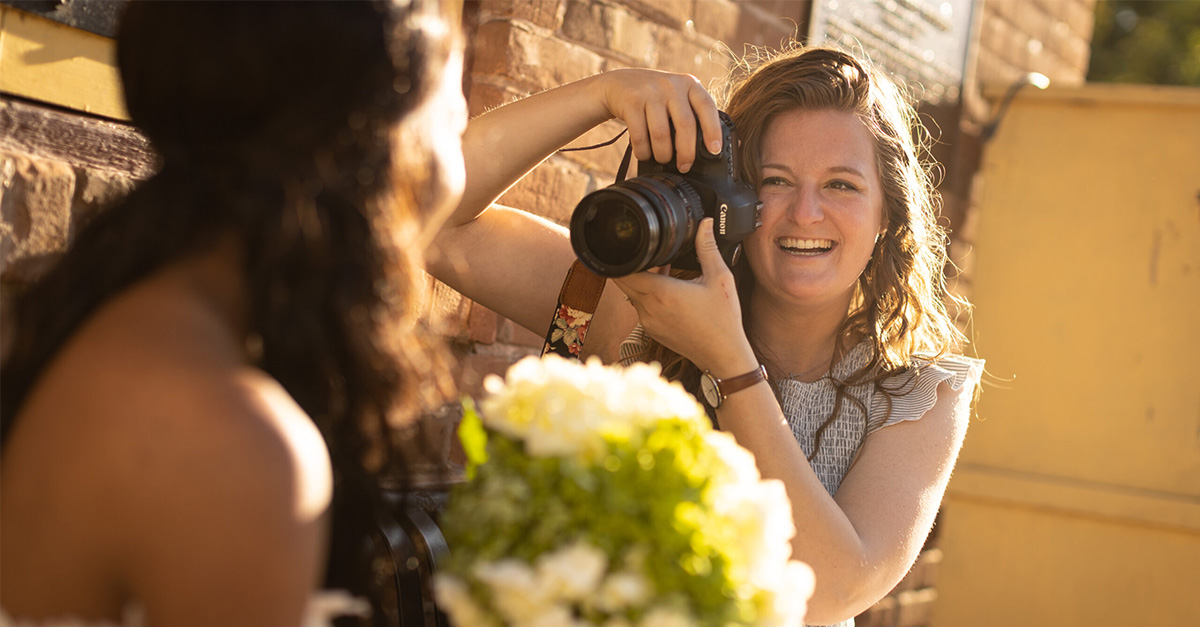
PHOTO: New York photographer and business owner Emilee Carpenter CREDIT: Courtesy of Alliance Defending Freedom
If you like this article and other content that helps you apply a biblical worldview to today’s politics and culture, consider making a donation here.