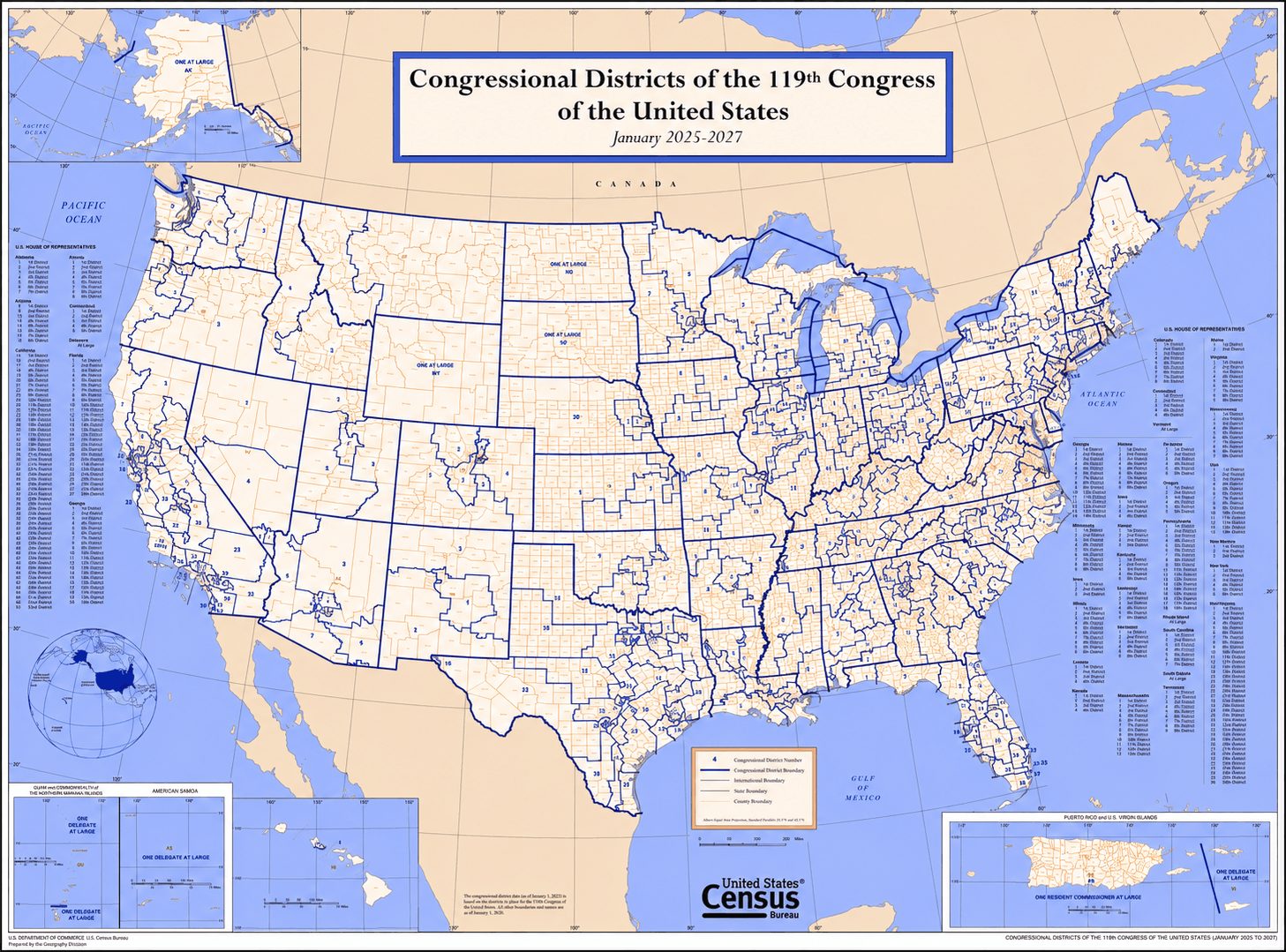
After the Supreme Court’s decision in Louisiana v. Callais, states are redrawing congressional maps ahead of the 2026 midterms. With control of the House resting on a narrow margin, the fight now centers on equal protection, voter representation, and whether a handful of districts could reshape the second half of President Trump’s term.
This article is a lightly-edited transcript of the “Here’s the Point” podcast by Ryan Helfenbein, executive director of the Standing for Freedom Center.
Update (June 10, 2026): The national redistricting fight has accelerated since the Supreme Court’s April 29 ruling in Louisiana v. Callais. Florida Gov. Ron DeSantis has signed a new congressional map that could expand the GOP’s advantage in the state from 20–8 to 24–4, while Tennessee Republicans have approved a map that could eliminate the state’s only Democratic-held House seat. The Supreme Court has also cleared the way for Alabama to use a Republican-favored map that reduces the number of districts where black voters make up a majority or near-majority from two to one, while Louisiana lawmakers have approved a new map that could move the state’s delegation from 4–2 Republican to 5–1.
The battle is already reaching beyond the midterms: New York Democrats have advanced a proposed constitutional amendment that could permit a new map for the 2028 cycle. The map war is national, fast-moving, and central to control of Congress. The standard should remain consistent in every state: follow the Constitution, apply the law faithfully, and do not treat voters merely as racial or partisan units.
Original: The redistricting war for the 2026 midterms is on – and it may be the most aggressive mid-decade, multi-state map fight of the modern era.
Since the Supreme Court’s decision in Louisiana v. Callais, states have moved at different speeds and through different legal paths. Florida, Tennessee, Louisiana, Alabama, and Virginia have already become major battlegrounds. The June 10 update above captures the latest developments.
The larger point is clear: mid-decade redistricting has returned with unusual force. The resulting maps could shape the balance of power in the House and determine whether President Trump’s agenda advances through Congress or faces resistance from a different majority.
A Democratic-controlled House could change everything for the political fortunes of President Donald Trump, who by now is a veteran to partisanship and measures that Democrats are willing to take as the ruling party in the House of Representatives.
Mid-decade redistricting is unusual in the modern era, but it is not unprecedented. The practice was far more common during the intensely partisan politics of the late 19th century. What makes the current moment notable is its scale: multiple states are revisiting congressional lines before the next census while control of the House rests on a narrow margin.
So how exactly did the Supreme Court play into these changes this year?
In Louisiana v. Callais, the Supreme Court, in a 6-3 opinion by Justice Samuel Alito, affirmed a lower court ruling that Louisiana’s 2024 congressional map was an unconstitutional racial gerrymander. That map had created a second majority-black district – a sprawling district that connected separate black populations from different regions of the state, subordinating traditional districting principles to racial considerations.
The Court held it was an unconstitutional racial gerrymander under the 14th Amendment’s Equal Protection Clause. The Court made it clear that race cannot predominate in the drawing of districts without a compelling justification that survives strict scrutiny. While the ruling did not fully eliminate Section 2 of the Voting Rights Act, it sharply limited its application when it comes to creating majority-minority districts.
And here is the argument conservatives must be willing to make clearly and without apology: This ruling is more consistent with the spirit of the Civil Rights movement than the left’s framing lets on. Before this ruling, race-based mapmaking often concentrated black voters into specially drawn districts, limiting their influence elsewhere and treating them less as citizens with varied convictions than as racial blocs to be managed. This actually did more harm for black voters than it created opportunity for them or for greater political participation or for influence. These districts segregated and isolated voters from one another.
They treated voters not as individuals with ideas or convictions but as racial blocs to be sorted and shuffled. And that has by no means been within the spirit or purpose of the Civil Rights Movement or what full equality sought to achieve. While Jim Crow sought to exclude black voters from full participation, the corrective racial gerrymander sought to contain black voters from true political influence.
So why does this matter for 2026?
Both political parties are on a razor-thin margin for majority and minority control of the House of Representatives.
The redistricting fight is not procedural housekeeping. It is a legal and political battle over equal protection, voter representation, and control of the House.
For President Trump, the practical stakes are clear: A House majority could determine whether his agenda advances through Congress or encounters investigations, resistance, and legislative gridlock. For voters, the principle should remain consistent regardless of which party benefits: The rules matter, the process matters, and every state should be held to the same constitutional standard.
The lines may be drawn on a map, but their consequences will reach far beyond Election Day.
Lines on a map become laws in Washington. Your gift helps the Standing for Freedom Center bring biblical clarity, constitutional truth, and steady courage to the decisions shaping America’s future. Make your tax-deductible gift today.