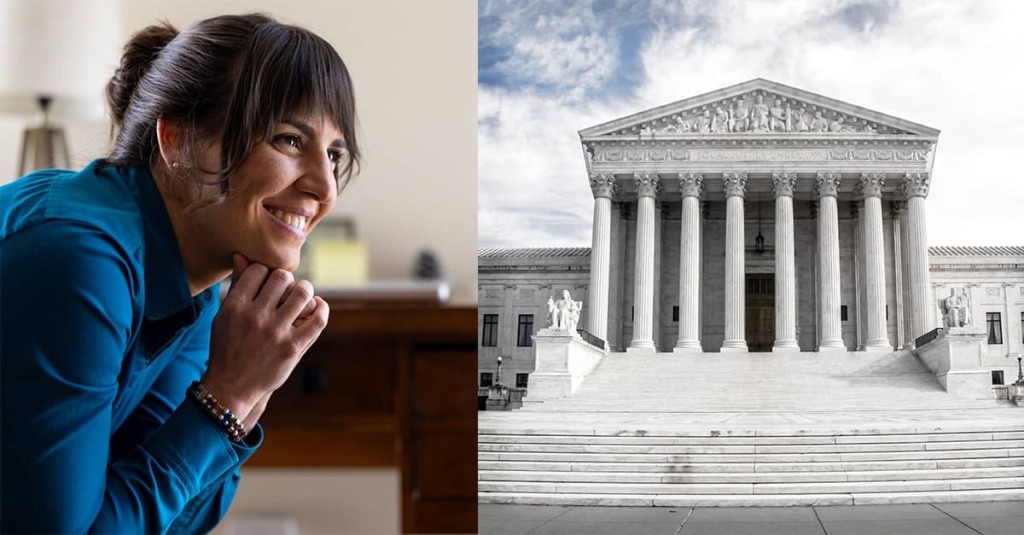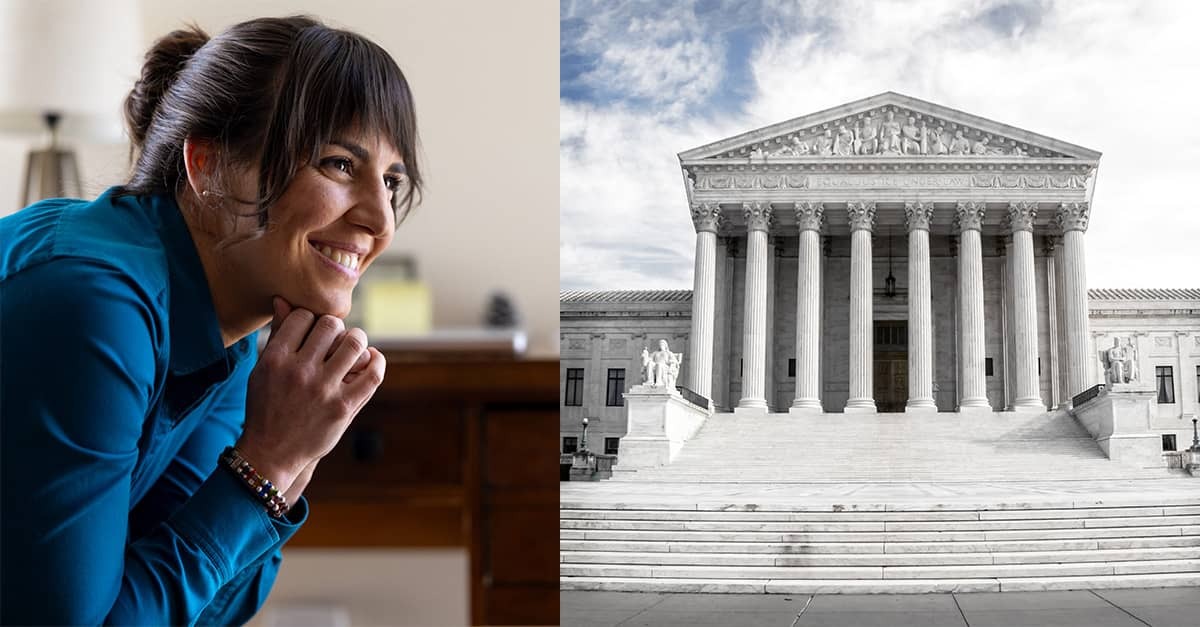
In Chiles v. Salazar, the Supreme Court ruled 8-to-1 that Colorado’s law unconstitutionally restricted what Christian counselor Kaley Chiles could say in counseling sessions, a major First Amendment win.
In what is being hailed as a massive win for free speech and common sense, the Supreme Court yesterday struck down a Colorado law that banned so-called “conversion therapy” for children who are grappling with their gender identity or sexual orientation.
In an 8-1 ruling, the majority determined that the law discriminated against the viewpoint of Kaley Chiles, a Christian counselor who uses talk therapy to try to help gender-confused children learn to become comfortable with their bodies rather than direct them into medical and surgical interventions that permanently change their bodies.
Chiles had previously lost her lawsuit challenging the law at the district court level and again at the 10th Circuit Court of Appeals. However, both of those rulings determined that Colorado’s law regulated only professional conduct, not speech. As a result, both of those rulings failed to apply strict scrutiny, the highest standard of judicial review a court must use when evaluating laws that infringe on fundamental rights.
In Chiles v. Salazar, the Supreme Court stated that Colorado’s law is actually an “egregious assault” on the First Amendment and that lower courts erred by not applying strict scrutiny when reviewing Colorado’s law.
Neil Gorsuch, writing for the majority, stated:
“While the First Amendment protects many and varied forms of expression, the spoken word is perhaps the quintessential form of protected speech. And that is exactly the kind of expression in which Ms. Chiles seeks to engage. Colorado’s law does not just regulate the content of Ms. Chiles’s speech. It goes a step further, prescribing what views she may and may not express.”
Beginning in 2012 with California, more than 20 states and hundreds of municipalities have passed legislation and executive orders that banned therapists and psychiatrists from engaging in so-called “conversion therapy.” The law conflated long-since abandoned aversive treatments conducted by the mental health industry, such as electroshock therapy, with talk therapy. To comply with the law, counselors had to either unquestionably affirm a patient’s gender dysphoria or sexual orientation or avoid taking on such patients altogether; counselors found to be in violation of the law were subject to fines, probation, or the loss of their license.
Colorado argued that any attempt to change a child’s gender identity or sexual orientation “is ineffective and is associated with harms that include depression, anxiety, loss of faith, and suicidality” and, as such, its law was necessary to “safeguard public health and safety.”
In response, Gorsuch wrote,
“Colorado may regard its policy as essential to public health and safety. Certainly, censorious governments throughout history have believed the same. But the First Amendment stands as a shield against any effort to enforce orthodoxy in thought or speech in this country. It reflects instead a judgment that every American possesses an inalienable right to think and speak freely, and a faith in the free marketplace of ideas as the best means for discovering truth.”
Justice Ketanji Brown Jackson was the lone dissenter. In a sign of how passionately she disagreed with the majority, she read her 35-page dissent out loud, insisting, among other points, that “under our precedents, bedrock First Amendment principles have far less salience when the speakers are medical professionals and their treatment-related speech is being restricted incidentally to the State’s regulation of the provision of medical care.”
Brown was clearly out of step with the majority, who noted at one point that the case of NIFLA v. Button “expressly rejected the notion that professional speech is subject to ‘diminished constitutional protection.’”
Even stalwart liberal Justice Elena Kagan pushed back against Jackson in a short but powerful concurring opinion, joined by Justice Sonia Sotomayor. In it, she amplified the law’s open hostility to all viewpoints but one.
“If the First Amendment prohibits anything, it is the “official suppression of ideas,” she wrote. Colorado’s law, she explained, violates the First Amendment because it “enables ‘speech on only one side’—the State’s preferred side—of an ideologically charged issue,” noting that the same would be true if a state law took the opposite stance.
The reaction to the Supreme Court’s decision was swift and predictable. Conservatives lauded the ruling, while LGBTQ activists and blue state leaders denounced it.
Jim Campbell, chief legal counsel for Alliance Defending Freedom, who argued Chiles’s position before the Court in October, stated,
“Kids deserve real help affirming that their bodies are not a mistake and that they are wonderfully made. The U.S. Supreme Court’s decision today is a significant win for free speech, common sense, and families desperate to help their children. States cannot silence voluntary conversations that help young people seeking to grow comfortable with their bodies.”
Chiles mirrored that sentiment, noting that the victory provides an open door for the mental health profession to step up and truly help young people struggling with gender issues. Numerous studies have shown that gender dysphoria in children is often a symptom of other underlying issues, including trauma, anxiety, depression, and autism. And yet, many children don’t receive even a mental health assessment before being fast-tracked into “gender-affirming” medical treatments that are irreversible and only exacerbate existing issues, in addition to causing new harms.
She also called on her fellow therapists “to rethink gender ideology’s claim that it’s possible to be born in the wrong body and to recommit to protecting young people. Research indicates that most children experiencing gender dysphoria — including about 90% of children before puberty — will desist, meaning they will come to identify with their given sex. But those natural desistance rates collapse once kids begin to socially transition and are treated like the opposite sex. And less desistance means an increased number of kids eventually undergoing harmful drugs and surgeries with no proven benefits.”
Yesterday’s ruling marks the third time that the Supreme Court has shot down a Colorado law designed to elevate the demands of LGBTQ activists over the religious liberty and free speech rights of Christians. The other two were Masterpiece Cakeshop v. Colorado Civil Rights Commission, in which the Court found that the state had shown hostility to the religious beliefs of Christian baker Jack Phillips in enforcing its anti-discrimination law, and 303 Creative v. Elenis, wherein the Court ruled that the state violated the free speech rights of Christian web designer Lorie Smith when it tried to compel her to express ideas that went against her beliefs.

Chiles v. Salazar is a landmark ruling by the Supreme Court in which only one ideologically controlled justice dissented. It should stand as a guard against the more than 20 U.S. states that currently ban mental health professionals from helping a patient with unwanted same-sex attraction or gender dysphoria.
As the justices stated, this is “an egregious assault” on the Constitution’s guarantee of the right to speak a person’s beliefs as they see fit, rather than according to a government-compelled belief system.
But there’s one thing the justices got wrong: The justices graciously afforded the possibility that this law was well-intentioned. It was not.
As the majority pointed out, “conversion therapy” bans are something that one would see in the most dictatorial regimes, evoking the feeling of a dystopian science fiction story in which the government threatens mental health professionals to force people into delusions and cruel experiments. Only it’s not science fiction; it is literally what Colorado was doing.
Colorado banned counselors from helping patients who wanted help with their same-sex attraction or gender identity questions. It was Colorado who was engaging in conversion therapy, mandating that children and adults struggling with confusion over their gender or unwanted feelings of same-sex attractions be automatically and forever locked into being transgender or homosexual.
The law did this by “encouraging” counselors on threat of losing their license to affirm gender dysphoria and to push patients into medical interventions, including mutilating surgeries, that will cost them their health, their future possibility of parenthood, and their happiness.
This was not a misguided attempt to protect children from harm; it was a brazen effort to enforce a state religion where the goal is to permanently trans as many children as possible. Laws like this are every bit as evil as the policies of a fictional villain or a real-world dictator.
We should all be prayerfully grateful that the Supreme Court finally took on this issue and got it right. Hopefully, this precedent will quickly lead to the downfall of other states’ mandated conversion laws — and finally free mental health counselors to be open and honest so they can effectively help their patients, not harm them.
If you want more fearless reporting that defends free speech, parental rights, and biblical truth against state coercion, make a tax-deductible gift to the Standing for Freedom Center today. Your generosity helps expose unconstitutional overreach, equip families, and defend the liberties that keep America free.