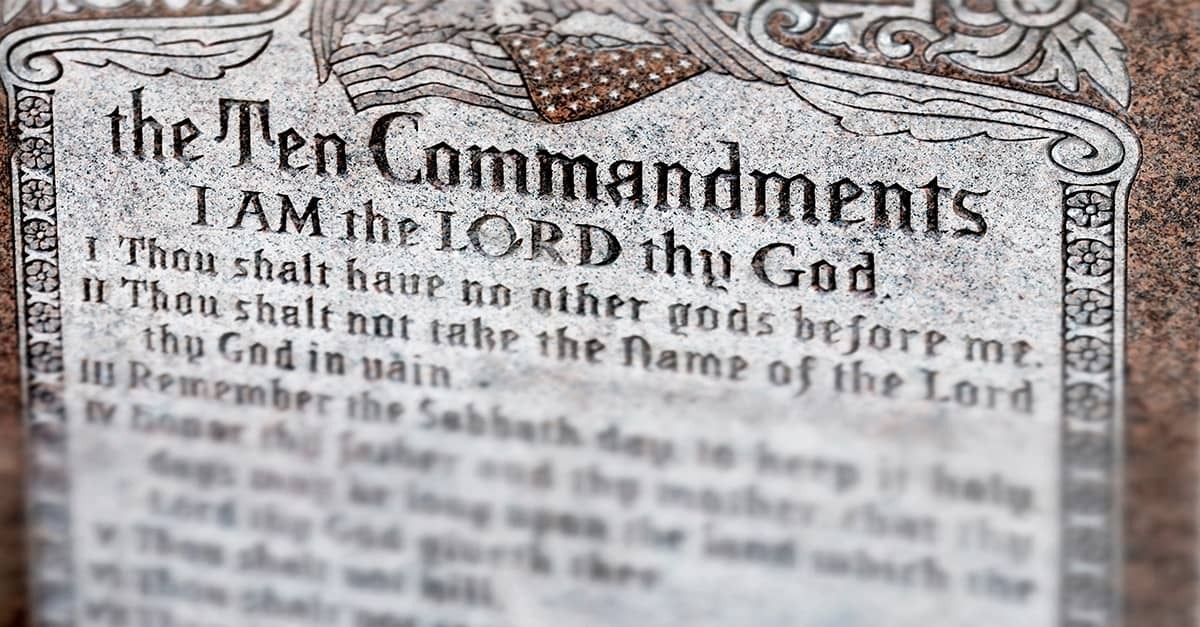
Students who don’t understand the Ten Commandments and its historical, legal, and moral significance cannot properly understand the Constitution, effectively participate in self-governance, or defend liberty when it’s being threatened.
This article is a lightly edited transcript of the “Here’s the Point” podcast by Ryan Helfenbein, executive director of the Standing for Freedom Center.
On June 19, 2024, Louisiana Gov. Jeff Landry signed HB 71, requiring large, readable posters of the Ten Commandments with historical context in every public K-12 and college classroom. Texas followed suit in 2025 with SB 10, signed by Gov. Greg Abbott, mandating donated 16 x 20-inch posters of the Ten Commandments in all public school classrooms.
Both laws are currently blocked by federal district courts, but a pivotal legal battle is now underway.
On January 20, 2026, the full Fifth Circuit Court of Appeals — with a 12-judge conservative majority — heard oral arguments in New Orleans. The judges pressed challenges on historical precedent and specifically referenced the Supreme Court’s 2022 Kennedy v. Bremerton decision, which abandoned the old Lemon test that had been used for decades to remove religious displays from public spaces.
This includes a Supreme Court decision on the Ten Commandments, Stone v. Graham, which struck down the Kentucky law on the Ten Commandments using the Lemon Test.
We have a whole new legal environment today. The questioning at the Fifth Circuit hearing focused on whether passive posters in classrooms constitute government coercion or simply acknowledge America’s religious heritage and tradition.
This case matters because it’s not just about posters. It’s about worldview, ideology, and the entire framework of constitutional freedom we use as a foundation to teach the next generation about law, morality, and human dignity.
Why does this matter? Why such an emphasis on reintroducing the Ten Commandments in the classroom?
First, worldview matters — and secularism has failed to deliver on its promises.
For over 60 years, American public education has operated under the assumption that removing religious content creates a safe, neutral, tolerant environment. But neutrality is a myth. Every education system teaches a worldview, whether explicitly or implicitly. The question isn’t whether students will be taught a moral framework but which moral framework they’ll be taught.
Secularism promised a free society built on human reason and tolerance, independent from any “oppressive” religious framework. What we’ve gotten instead is chaos.
Schools that removed the Ten Commandments replaced them with liberalism, critical race theory, radical gender ideology, and an ever-shifting morality divorced from any transcendent and timeless standard.
Students are taught that truth is subjective, that biology is a social construct, and that America’s founding principles are oppressive.
The result? A suicidal culture bent on destruction. A generation that can’t define basic concepts like “man” and “woman,” who treat their own bodies like a Picasso painting. And an education system that produces activists and conformists rather than critical thinkers who can read, write, or do basic math at their achieved level. Educators want to do away with standardized testing because are continually reminded that no one is achieving academically.
Secularism hasn’t freed anyone. It has enslaved an entire generation to confusion, hopelessness, moral relativism, as well as illiteracy and academic failure. Kids who age out of education without reading or writing are more likely to break the law and become a part of the endless cycle of the justice system.
Gov. Landry was right when he said schools should “embrace Judeo-Christian principles or students will learn the criminal code.” That’s not religious extremism — that’s observable reality based on an honest assessment of how the secular experiment has been going for the last several decades.
When you remove objective moral standards, you don’t get freedom. You get lawlessness and an entire generation of lost boys and girls.
Second, history and legal precedent support religious expression in public spaces.
The Supreme Court’s 2022 Kennedy v. Bremerton decision fundamentally changed the legal landscape back in favor of our American religious tradition. That tradition was always based on freedom.
The Court abandoned the Lemon test, which had been used since 1971 to strike down religious displays, and replaced it with a history-and-tradition test. This matters enormously for cases like Louisiana and Texas.
America’s founding generation understood that religious principles — particularly those derived from Christianity — were essential for maintaining a free republic. The majority of our Founders were church-goers and lay leaders. The Bible was the most cited source in the founding-era political writings from 1760 to 1805.
John Quincy Adams explicitly stated that the principles of the Declaration of Independence were derived from Christianity. Benjamin Rush argued that Christianity was essential for republican government.
The Ten Commandments specifically influenced Western legal tradition and early American common law. Moses holding the Ten Commandments appears in the frieze above the Supreme Court bench. Colonial education integrated biblical moral instruction.
The Constitution itself — with its checks and balances, separation of powers, and recognition of human fallibility — reflects a Christian understanding of human nature. That is why the American system of government is far superior as a republic than popular democracies around the world that have introduced sweeping societal changes and government collapses that did not last.
Our entire legal framework assumes objective moral truth, the dignity of every human being as made in God’s image, and the necessity of restraining government power.
Make no mistake: Removing the Ten Commandments from classrooms in the 1980s wasn’t about neutrality. It was about replacing one worldview with another. And now, with Kennedy v. Bremerton as precedent, we have an opportunity to restore what was wrongly taken away.
Third, this is critically important for restoring law and order to American society.
The Ten Commandments aren’t just historical artifacts. They establish the moral foundation for equal rights, due process, and human dignity. Without them, you cannot coherently defend the very freedoms secularists claim to champion.
Equal protection under the law? That comes from “You shall not show partiality.” Due process? That flows from “You shall not bear false witness.” The right to property? “You shall not steal.” The sanctity of human life? “You shall not murder.” Marriage and family stability? “You shall not commit adultery.”
Even freedom of speech and religion flow from the First Commandment’s recognition that there is a higher authority than government. His name is Jesus Christ, and the government rests upon His shoulders.
These aren’t merely religious principles — they’re the bedrock of Western civilization and American law.
Students who graduate without understanding them cannot properly understand the Constitution, they cannot effectively participate in self-governance, and they cannot defend liberty when it’s being threatened.
The Ten Commandments belong in America’s classrooms. They shaped our founding, they sustain our freedom, and they remain essential for the next generation. And this is our moment as a nation to get that right.