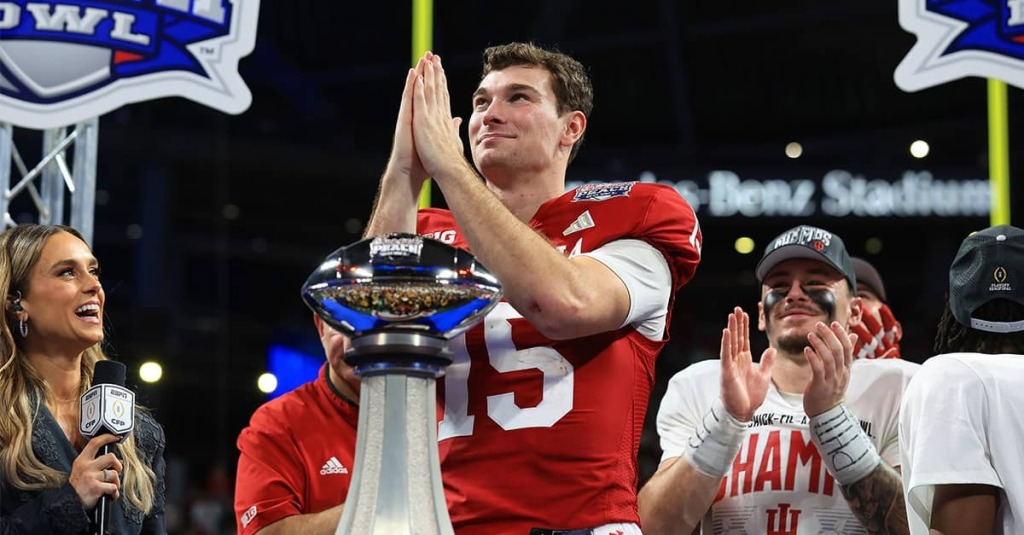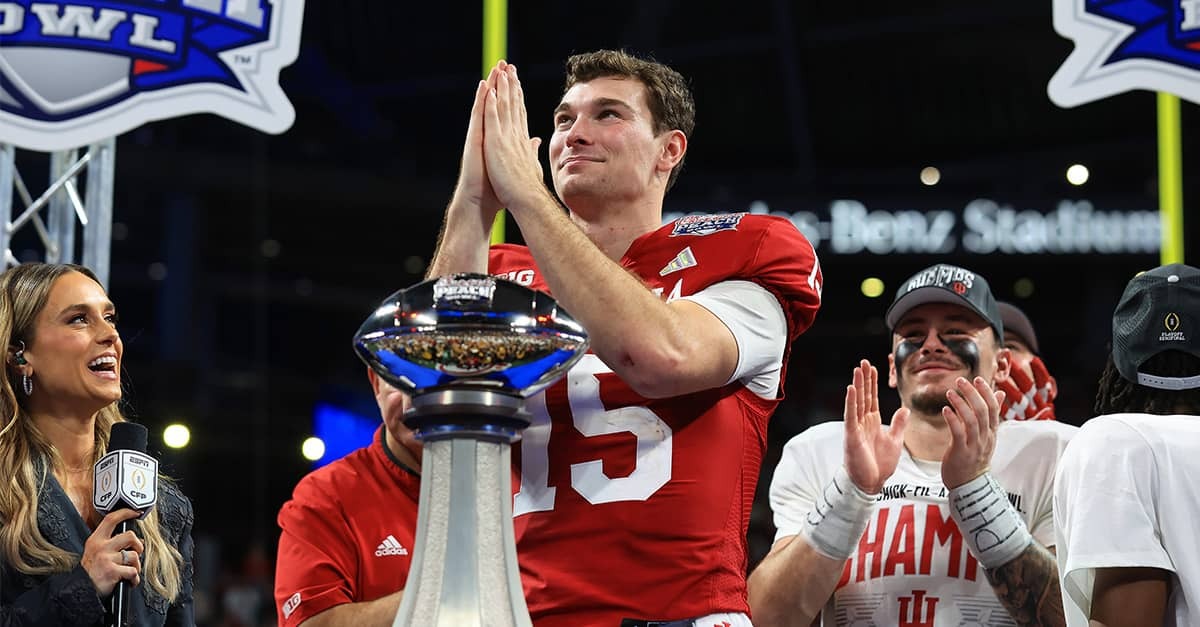
As Indiana quarterback Fernando Mendoza prepares for the NFL Draft and the life-changing wealth that awaits, the real question isn’t whether he can throw touchdowns at the professional level but whether he will continue pointing away from himself and upward to God when he does.
Minutes after leading Indiana University to its first national football championship in a 27-21 victory over the University of Miami last Monday, quarterback Fernando Mendoza stood on the field at Hard Rock Stadium, tears streaming down his face, and did something that defines who he is.
He pointed away from himself.
“I want to give all the glory and thanks to God,” Mendoza told ESPN’s national audience, his voice breaking with emotion. Then he said it again: “I just give all the glory to God.”
The 6-foot-5 Heisman Trophy winner had just completed one of the most dominant seasons in college football history — 41 touchdown passes, a national championship, and an improbable 16-0 season, ensuring himself a bright future that will likely include being the first overall pick in the 2026 NFL Draft.
Yet his first instinct wasn’t to celebrate his talent or his suddenly guaranteed multimillion-dollar future. It was to worship.
Now comes the harder test.
The Road Ahead
Mendoza is not the first Christian quarterback to attempt to successfully navigate the challenging transition from college glory to professional football. The transition from campus chapels to NFL stadiums has claimed many who started strong. The temptations are real — wealth beyond imagination, fame that opens every door, and the cultural pressure to mute the very faith that sustained them.
But it can be done. And it has been done.
Tim Tebow’s name became synonymous with public faith in the NFL. The 2007 Heisman winner endured relentless mockery for his outspoken Christianity, yet he never wavered. When his NFL career stalled and critics claimed his faith was just performance, Tebow’s response revealed the difference between genuine conviction and religious branding. He continued serving, continued proclaiming Christ, and continued living as if Jesus mattered more than football.
The lesson? Authentic faith doesn’t disappear when the cameras turn off or when the contracts dry up.
C.J. Stroud, the Houston Texans’ young star, offers a more recent model. Despite immediate NFL success — Offensive Rookie of the Year, Pro Bowl honors, multimillion dollar contracts — Stroud has emphasized faith, humility, and community service through his foundation. He supports single mothers and children of incarcerated parents, channeling his platform into Kingdom work rather than self-promotion.
And Will Howard, though earlier in his journey, demonstrated something crucial: He spoke openly about his faith before the money arrived, before draft positioning mattered, before media training could flatten his testimony into brand-safe language. He credited God after losses, not just wins. He spoke of identity rooted in Christ, not performance. His faith showed the marks of formation rather than performance — ordered, consistent, real.
What Mendoza Has Already Shown
Mendoza’s pattern suggests he understands what’s at stake. On Christmas Eve, fresh off winning the Heisman Trophy, he brought the award to St. Paul Catholic Center in Bloomington to show Father Patrick Hyde and the priests who’d mentored him. Not to a sponsor. Not to a party. To his church.
“I’m a Catholic man, and they’ve done so much for me,” Mendoza explained. “I really give a lot that I have accomplished this season to the Lord.”
Before games, while teammates blast music to get psych themselves up, Mendoza prays. “I honestly don’t listen to hype songs because I have to stay cool, calm, and collected,” he said. “I actually meditate before the game. I meditate. I pray.”
In his Heisman acceptance speech, he dedicated the trophy to his mother Elsa, who battles multiple sclerosis: “This is your trophy as much as it is mine. Your sacrifices, courage, love — those have been my first playbook.”
These aren’t calculated PR moves. They’re the habits of a young man whose identity is settled before the spotlight arrives.
The Temptations Are Real, But Christ Is Sufficient
Make no mistake — the pressures Mendoza will face are intense. NFL wealth can purchase any pleasure, any distraction, any counterfeit comfort. The fame opens doors to temptations that would destroy most men. The culture celebrates excess and mocks restraint.
But Scripture promises that “No temptation has overtaken you that is not common to man. God is faithful, and He will not let you be tempted beyond your ability, but with the temptation He will also provide the way of escape” (1 Corinthians 10:13).
The way of escape isn’t isolation. It’s community. It’s accountability. It’s staying rooted in the local church even when you’re rich enough to start your own. It’s maintaining the spiritual disciplines that preceded success — the Sunday church attendance, fasting, worshipping God, and the prayers before the pressure.
It’s remembering that football is temporary and Christ is eternal.
What the Church Must Do
Young Christian men entering professional sports don’t need our naivete about the challenges ahead. They need our prayers, our accountability, and our refusal to make idols of them.
The Church must celebrate a faithful witness like Mendoza’s while remembering that he is a 21-year-old who will face temptations we can barely imagine. We must pray for his perseverance, not just his performance. We must hold him accountable to the faith he’s proclaimed, offering both encouragement when he stumbles and correction when he strays.
Most importantly, we must point Mendoza and other young athletes back to the examples of faithful Christians who’ve walked this road before — men like Tebow who weathered mockery, like Stroud who uses platform for ministry, like Howard who maintained conviction through success and struggle.
The Ultimate Victory
Mendoza’s national championship will be remembered in Indiana forever. His Heisman Trophy has earned him a place in college football history. His NFL contract will secure his family’s financial future.
But none of that matters if he loses his soul.
Jesus asked the question that every Christian athlete must answer: “For what does it profit a man to gain the whole world and forfeit his soul?” (Mark 8:36).
As Mendoza prepares for the NFL Draft and the life-changing wealth that awaits, the real question isn’t whether he can throw touchdowns at the professional level but whether he will continue pointing away from himself and upward to God when he does.
The early signs are encouraging. The pattern of faithful witness is there. The spiritual formation appears genuine.
Now comes the test of endurance — not just through one championship season but through a career, through wealth, through fame, through the inevitable valleys that follow every peak.
May Fernando Mendoza and every Christian athlete who follows him run the race set before them with perseverance, “looking to Jesus, the founder and perfecter of our faith” (Hebrews 12:2).
That would be the ultimate championship.
If you like this article and other content that helps you apply a biblical worldview to today’s politics and culture, consider making a donation here.