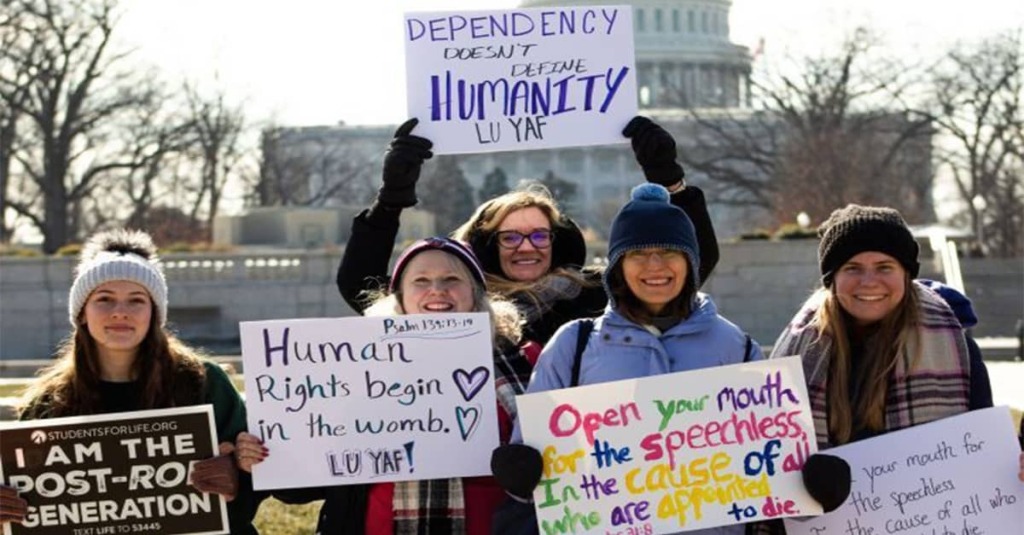
Amid the many challenges of a post-Roe world, the pro-life movement must unify, represent righteousness, and remember why we fight: Because the unborn are made in the image of God and deserve equal protection and the chance to live.
This article is a lightly edited transcript of the “Here’s the Point” podcast by Ryan Helfenbein, executive director of the Standing for Freedom Center.
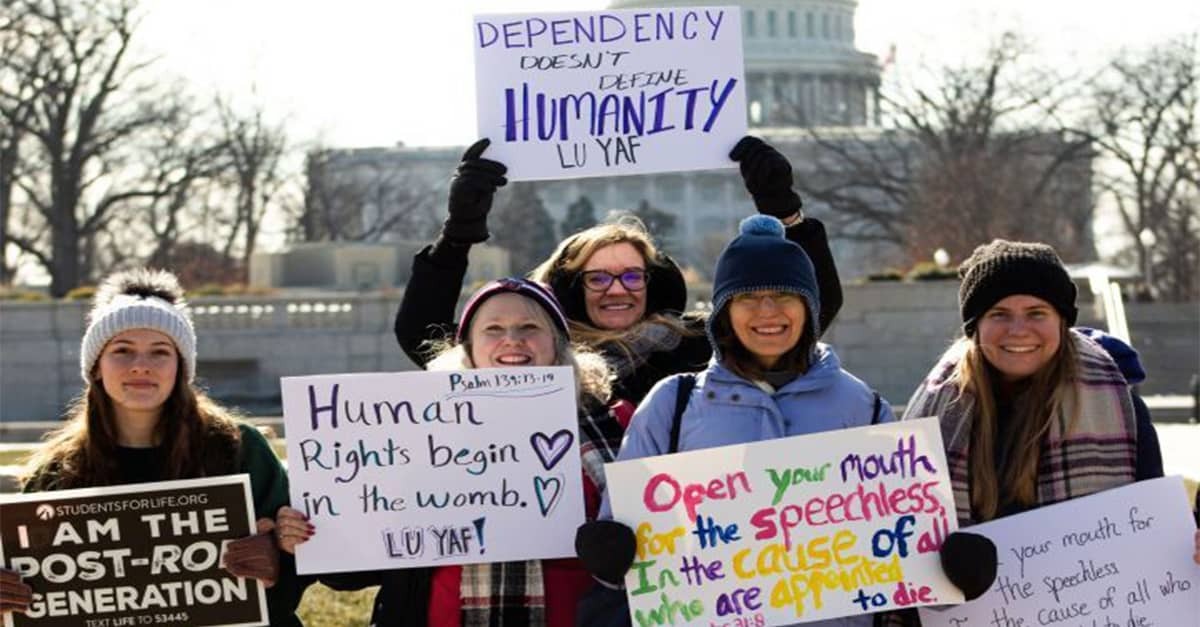
Today marks the 53rd annual March for Life and the 4th annual March since the Supreme Court’s overturning of Roe v. Wade. The Standing for Freedom Center will be taking 1,000 Liberty students to participate in this march, as has been our custom for decades. And quite honestly, the pro-life movement stands as the essential keystone and buttress of the entire conservative movement. Everything essential for safeguarding life, liberty, and the pursuit of happiness begins in the womb.
But the post-Dobbs world has presented a whole list of challenges for the pro-life camp. Even after victory laps were taken in 2022 and many were ready to say “mission accomplished” job well done, let’s go home, but it’s not over.
Except the mission wasn’t accomplished. Not even close.
While we celebrated Dobbs, abortion activists were already executing the playbook they’d been preparing for decades. They knew this day would eventually come. They planned for it. They funded it. They had contingencies in place for the purpose of advancing and not retreating. And now they’re winning. They’re winning on messaging. They’re winning on strategy. They’re winning on legislative victories. And the death toll is rising.
Since Dobbs, abortion-rights advocates have run the table at the state level. They’ve passed radical abortion amendments in Ohio, Kansas, Michigan, Montana, and California. Even in red states like Ohio, voters approved constitutional amendments enshrining abortion rights. In 2024 alone, 10 states had abortion on the ballot. Pro-life advocates won in only three, including Florida, where the majority of voters wanted abortion but failed to meet the critical 60 percent threshold needed to get it passed. Virginia’s General Assembly just passed a constitutional amendment on abortion up to birth, which will go to the ballot in the 2026 mid-term elections.
Make no mistake: The abortion industry is not retreating. It’s adapting. And it’s winning.
While abortion clinics close in states with protective laws, chemical abortion has surged to an all-time high. More than 70 percent of all abortions in America today are now induced by medication, often mailed without a single in-person doctor visit. The pills arrive in unmarked packages. No oversight. No medical supervision. No accountability.
This is the new battlefield in 2026. And we were unprepared for it.
But the crisis runs deeper than legislative losses or chemical abortion statistics. The pro-life movement itself is fracturing from within. A civil war has been brewing for years, and it’s now breaking into the open. On one side stand Incrementalists — the longstanding national organizations, political strategists, and legislative architects who have guided this movement for decades. On the other side stand the Abolitionists — a younger, far more conservative, and aggressive wing demanding immediate, total abolition of abortion with no exception and no compromise.
The Incrementalists have pursued gradual progress through achievable legislation and that has been their sole strategy for decades. This includes: 15-week bans, heartbeat bills, parental notification laws, protecting the Hyde amendment, and defunding Planned Parenthood.
They point to decades of incremental gains that ultimately led to Dobbs. The Abolitionists counter that incremental strategies implicitly accept that some abortion is permissible, that some babies can be sacrificed on the altar of political pragmatism. Perhaps the most pointed criticism is the refusal of incrementalists to ever pursue equal protection bills for the unborn or to ever hold mothers who abort their babies responsible.
Both sides have a point. Both sides also have serious problems.
We need to be honest: Many national pro-life organizations have grown comfortable with the status quo. They’ve built entire infrastructures around fighting abortion in circles — fundraising apparatuses, political action committees, lobbying operations. For some, the cause has become a career with zero end in sight. The question must be asked: Do these organizations truly intend to end abortion, or have they become dependent on its existence? And that’s a fair question.
And yet the Abolitionists face their own challenges: They often lack a realpolitik when it comes to advancing their agenda, even at a local level. There are practical considerations for how abortion will be fought and won in deep blue states, even like Virginia, where significant gains have been made in recent months. Demanding all-or-nothing abolition in Massachusetts or California or New York is fantasy. Without a strategic framework for incremental progress in hostile territory, Abolitionist purity becomes political impotence or, worse, self-righteous theatrics.
The result? A movement that seems presently stalled, divided at the exact moment we need unity the most. Abolitionists are right and we need them, but so are the Incrementalists — especially the ones who are honest about ending abortion and who have every intention of getting equal protection bills passed while absolving no one of their responsibility, and that starts with the father and the mother.
The rise of the Abolitionist movement, particularly among younger conservatives, is a welcomed blessing. This generation refuses to be satisfied with managing or coddling abortion. They want it ended. They are sincere in their effort. That conviction, that unwillingness to compromise on the sanctity of life, is exactly what this movement needs. The question is whether we can harness that passion with the political wisdom necessary to actually save babies.
William Wilberforce is perhaps one of the best inspirations for seeking full abolition of slavery without compromise while simultaneously receiving it in major increments over a period of four decades. No one accuses Wilberforce of compromise. Many would have been satisfied with far less, yet his dogmatic pursuit achieved total victory at the end of his career.
The pro-life movement suffers from several challenges: the lack of unity, clarity, strategy and the perverting effects of political and cultural rot, including RINO conservatism and Nicki Haley-style feminism.
We must unify around truth, common goals, and common sense. Honest Incrementalists and stubborn Abolitionists need each other, both strategic wisdom and legislative experience, along with moral clarity and prophetic urgency.
Finally, we must remember why we march. We march because the unborn are made in the image of God. Every single one. No exception. No compromise. Not because they’re wanted or viable or convenient, but because they bear God’s sacred image.
We march because we are not alone. The pro-life movement needs one another and to be reminded that it is on a scale so large that it includes Catholics, Evangelicals, Protestants, all of them working together.
We also march because abortion is not ended. Not in America. Not anywhere. As long as babies are dying, we must show up, speak up, represent righteousness, and we must march. As long as babies are dying, we march. As long as mothers are suffering, we march. As long as the culture of death reigns, we march.
We also march because Christ is Lord over life and death. We march because God’s image is sacred. And we march because the permanent things must win. After all, Jesus Christ — the resurrection and the life — has overcome the world.