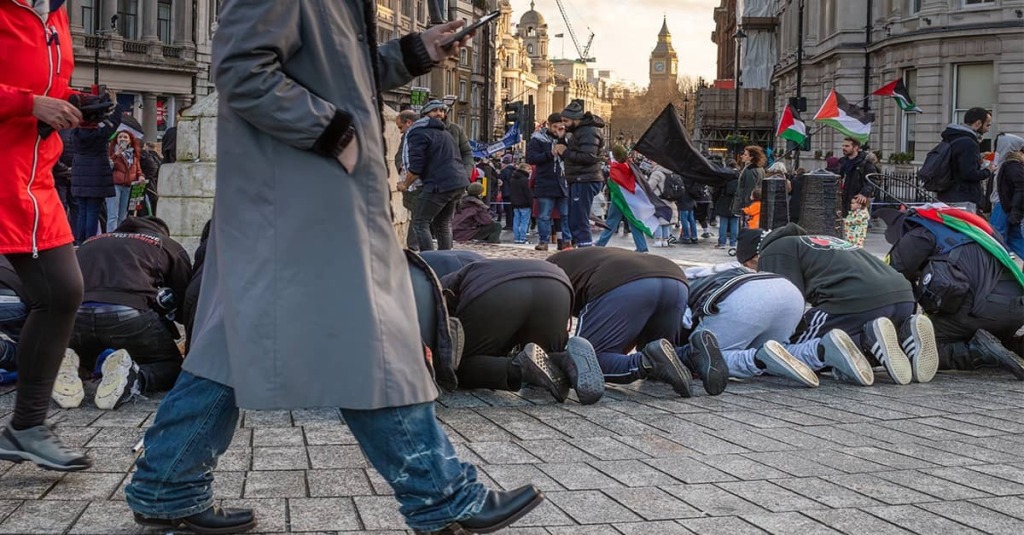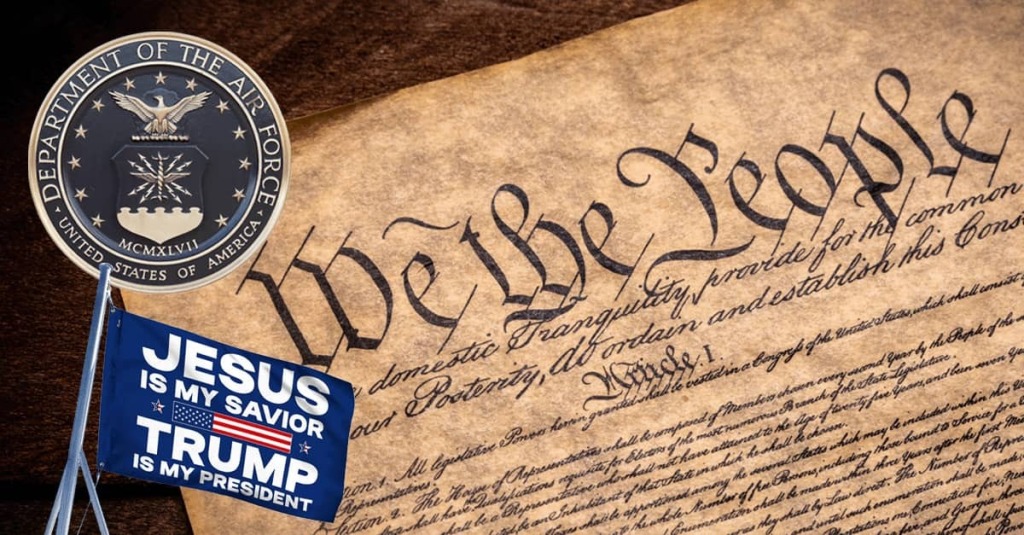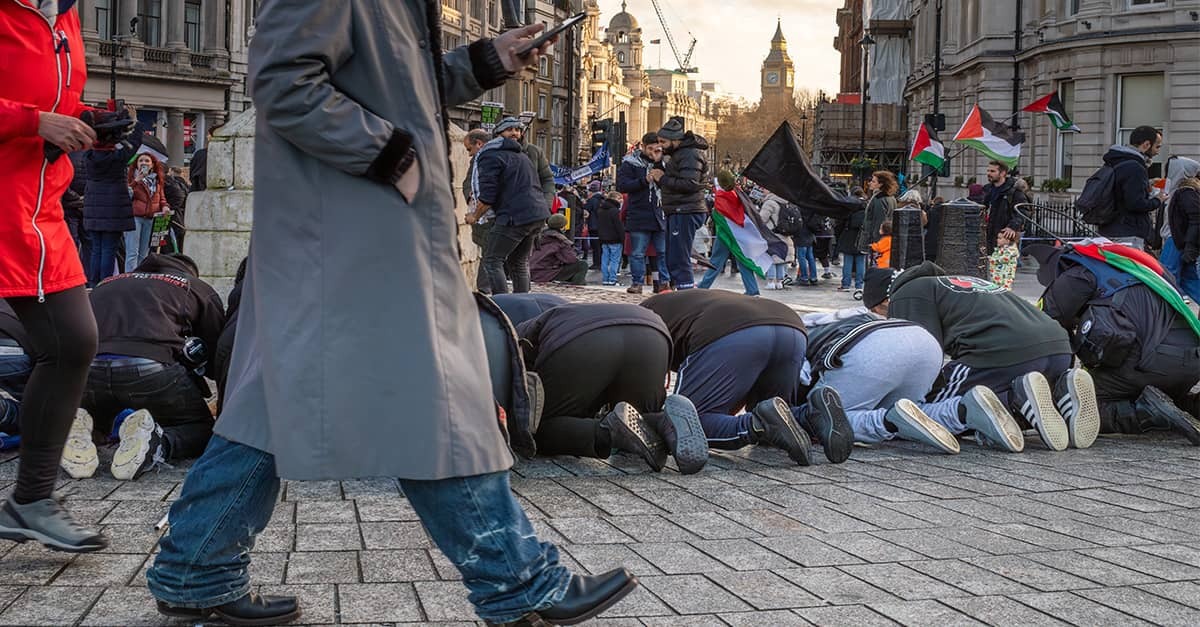
Islam is a totalizing political, militaristic, and legal system wrapped up in warm religious language that is designed to replace all other systems, including the U.S. Constitution. If we recognized that communism posed a fundamental threat to America, why can’t we recognize the same about Sharia law?
This article is a lightly edited transcript of the “Here’s the Point” podcast by Ryan Helfenbein, executive director of the Standing for Freedom Center.
Houston, we have a problem. Islam is growing rapidly in America, not just in blue states like New York, Michigan, or Minnesota but in red states like Texas. Should we be concerned about Islam’s aggressive expansion? And how should we think about Sharia law in the Lone Star State and beyond?
Today Texas is home to over 400,000 Muslims, with more than 300 mosques across the state. The Dallas-Fort Worth metroplex has seen a 30 percent increase in its Muslim population since 2010. Major Islamic organizations, including the Council on American-Islamic Relations (CAIR), have established powerful lobbying operations in Austin. Islamic day schools and madrassas are multiplying across the state, teaching children not just theology but political ideology rooted in Sharia law.
And this isn’t simply about religious freedom or cultural diversity. This is about a totalizing political ideology that seeks to supplant American constitutional law with Sharia — a legal system fundamentally incompatible with the U.S. Constitution. Make no mistake, Sharia law permits honor killings, beheadings, polygamy, the grooming of underage girls and boys, and the systematic oppression of women. These ideas aren’t fringe interpretations; they’re foundational to Islamic beliefs and practices.
Yet many today still hold to a naive view of Islam, treating it as just another religious group deserving the same legal protections and standing in American society. But that is a fundamental category error. So, how should we think about Islam and its growing influence inside America? Here are four points.
First, this isn’t just a blue state problem. It’s a red state problem too.
When we think about Islam’s political influence in America, we immediately picture Dearborn, Michigan, where the Muslim population exceeds 40 percent, or Minneapolis, Minnesota, with its large Somali community that elected Ilhan Omar to Congress. We think of Rashida Tlaib representing Michigan’s 12th district, openly calling for the destruction of Israel. These are real problems in blue states where Islamic political power has already reshaped local governance.
But what about a place like Texas? It’s a big state with a population that will surpass California by 2040. Many Americans, including conservatives, assume that the Lone Star State is immune because of its conservative political culture and its long history of patriotism and courage. Everyone remembers the Alamo, and it has defined the courage of Texas for nearly 200 years.
But Islamic immigration to Texas has accelerated dramatically over the past two decades. According to Pew Research, Texas now ranks among the top five states for Muslim population growth. Houston’s Muslim community is larger than the entire Muslim population of 32 U.S. states. The Irving Independent School District has modified its calendar to accommodate and recognize Islamic holidays. Fort Worth public schools have designated prayer rooms for Muslim students.
This population expansion brings with it political organization and influence. The Center for American-Islamic Relations (CAIR) lobbies the state legislature on issues ranging from hate crime legislation to school curriculum. Islamic advocacy groups pressure local governments to approve zoning variances for mosque construction in residential areas. They demand accommodations in public schools, workplaces, and government facilities. But the goal isn’t just religious tolerance or victim minority status — the real goal is total political power.
And if we don’t address this now, Texas could follow the same trajectory of Michigan and Minnesota, and America as a nation could follow the U.K. and Europe.
Second, Islam is a totalizing political ideology, not merely a religious category.
Here’s what many Americans, Christians included, fail to understand: Islam is not analogous to Christianity or Judaism in any way, shape, or form.
Unlike religions that distinguish between spiritual authority and civil government, Islam makes no such distinction. Sharia law governs every aspect of life — personal, family, economic, judicial, and political. It’s a complete legal system designed to replace all other systems. There is no separation of mosque and state.
President Erdogan of Turkey, a so-called secular Muslim state, said, “The mosques are our barracks, the dome our helmet, the minarets our bayonets, and the faithful our soldiers.” Lest we think this is merely a metaphor or exaggeration for effect we should look to Europe and beyond.
Consider the Communist Control Act of 1954. Congress outlawed the Communist Party because communism is fundamentally incompatible with the U.S. Constitution. Communism isn’t just an economic theory, it’s a totalizing ideology that seeks to control every aspect of society. The same is true of Islam. Just as communism demanded total allegiance to the party and the state, Islam demands total submission to Allah and Sharia law.
Both systems are inherently totalitarian. Both reject constitutional government, individual liberty, and religious freedom. Both seek to impose their ideology by force when necessary. If communism is seditious by nature, so too is Islam as a political organization. If we recognized that communism posed a fundamental threat to American constitutional order, why can’t we recognize the same about Sharia law?
The answer is we can and we should. Islam is not just a religion — it’s a political, militaristic, and legal system wrapped in warm religious language. Treating Islam as merely another faith tradition worthy of First Amendment protection is like treating communism as just another political philosophy. It misunderstands and misrepresents the nature of the threat.
Thomas Jefferson, who led our nation’s first war against Islam and Sharia law, said this: “Anything that would overturn the Constitution or the Bill of Rights is an enemy of the Constitution.”
Third, evangelicals who take the ACLU approach to Islam are making a fundamental error.
Some well-meaning evangelicals argue that defending religious liberty for Muslims is necessary to protect religious liberty for Christians. They’ve adopted the ACLU’s framework: treat all religions equally under the law, regardless of their teachings or practices. This may sound noble to some, but it’s dangerously misguided and naive.
Religious liberty is not unlimited. It never has been. The First Amendment protects religious belief, but it doesn’t protect every religious practice. Human sacrifice, polygamy, and honor killings are all illegal, even when committed for religious reasons.
Why? Because religious liberty exists within the framework of American constitutional law and Christian tradition. When a religious system seeks to replace that constitutional framework entirely, it’s no longer exercising religious freedom — it’s pursuing political conquest.
Islam explicitly teaches that Sharia must ultimately govern society. Islamic law divides the world into the house of Islam where Sharia rules and the house of war where it doesn’t.
Christians who defend Islam’s legal and political expansion under the banner of religious liberty are defending the very ideology that will ultimately seek to eliminate their own religious freedom and their own country.
Finally, Texas and the United States must ban Sharia law, root and tree.
Some propose banning only certain aspects of Sharia — honor killings, child marriage, oppression of women. But banning Sharia doesn’t ban a segment of Islam; it bans the root and tree altogether. That’s exactly what we need.
Several states have already enacted anti-Sharia legislation. These laws don’t mention Islam by name; they simply prohibit courts from applying foreign law, including religious law, that violates constitutional rights.
Such legislation is constitutional, necessary, and urgent. It protects American citizens from being subjected to legal systems that deny fundamental rights. It prevents Islamic arbitration tribunals from operating with the force of law. And it sends a clear message: Americans should be governed by the Constitution, not Sharia law.
If you like this article and other content that helps you apply a biblical worldview to today’s politics and culture, consider making a donation here.