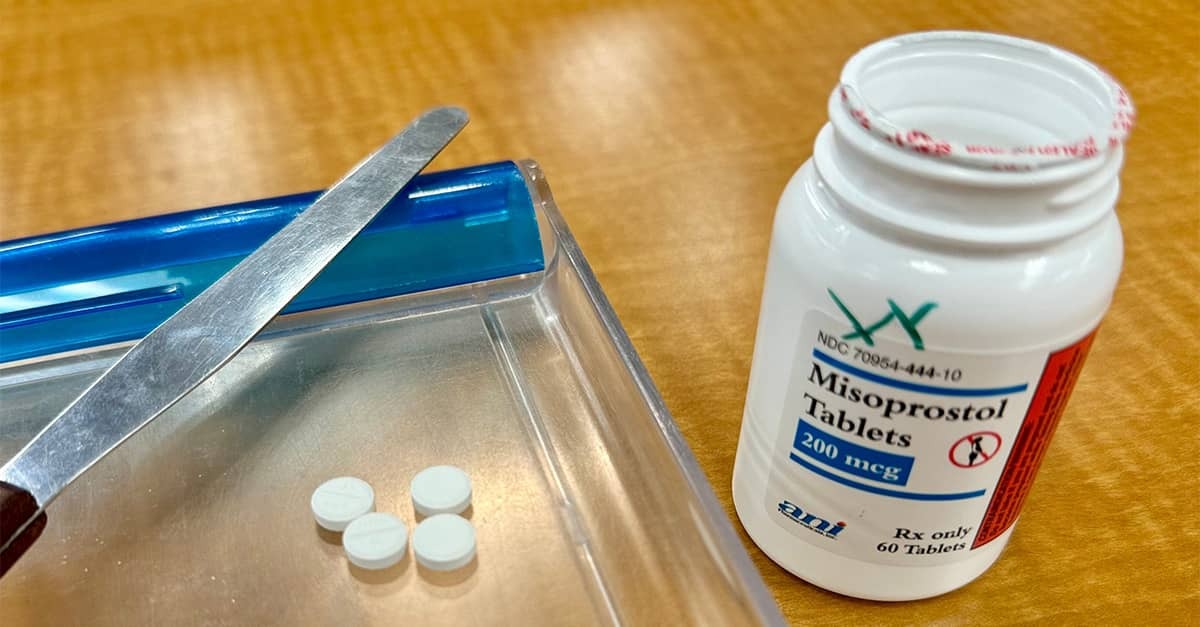
Thanks to the FDA’s decision to allow mail-order abortion pills, unethical abortionists in blue states are secretly sending drugs to patients they haven’t even examined, a situation that endangers vulnerable women and violates the Constitution’s Full Faith and Credit pact between states.
Louisiana officials are urging a federal court to reinstate an in-person requirement for dispensing abortion pills, claiming that a Biden administration policy allowing the drugs to be prescribed online and shipped by mail violates federal law and puts women at risk.
In a motion filed last month in the U.S. District Court for the Western District of Louisiana, the state challenged a 2023 Food and Drug Administration (FDA) rule that permanently lifted the requirement for patients to see a healthcare provider before obtaining mifepristone, the first of two drugs used in chemical abortions. The policy, known as the Risk Evaluation and Mitigation Strategy (REMS), allows doctors to prescribe the drug remotely and for pharmacies to mail it directly to patients, without an in-person medical examination.
Louisiana Attorney General Elizabeth Murrill argues that the change undermines patient safety, circumvents state abortion laws, and exceeds the FDA’s legal authority. The state’s motion seeks a temporary injunction while the court reviews the case, with a hearing scheduled for February 24.
The lawsuit marks one of the most significant legal challenges yet to the FDA’s mail-order abortion policy, which opponents say has created a “nationwide loophole” allowing abortion providers in states like New York and California to send pills into states where abortion is largely prohibited.
According to the complaint, REMS violates the Comstock Act, an 1873 law passed by Congress that “prohibits the use of ‘any express company or other common carrier or interactive computer service’ for ‘any drug, medicine, article, or thing designed, adapted, or intended for producing abortion.’”
The plaintiffs argue that “Because a federal agency cannot permit what federal law expressly prohibits, FDA lacked authority to permanently remove the in-person dispensing requirement.”
Louisiana Attorney General Elizabeth Murrill, wrote in a post on X that the rule exposes women to serious risks. “Unfettered and unsupervised access to these pills is dangerous. So the Biden-era rule should be enjoined,” she stated.
The lawsuit claims the FDA’s policy is designed to undermine pro-life states like Louisiana, where abortion is almost always banned. It points to data from the Society of Family Planning’s #WeCount report, which found that mail-order abortion drugs were used for an average of 617 abortions per month in Louisiana from April to June 2024, rising to roughly 800 per month by December.
“The 2023 REMS is the direct cause of extensive harm that Louisiana suffers every day that the REMS is in effect,” the complaint states, alleging that the rule was designed to “target those pro-life states like Louisiana where abortion is prohibited.”
The lawsuit outlines the medical and psychological risks associated with abortion pills, including complications for women with Rh-negative blood types and possible long-term mental health effects.
It also highlights cases of coercion and abuse made more likely when abortion drugs are obtained remotely.
Rosalie Markezich, who is a named plaintiff to the lawsuit, along with the state of Louisiana, said that her boyfriend obtained the pills online from a California doctor using her email address and then pressured her into ingesting them in 2023.
The complaint also cites the case of Dr. Margaret Carpenter, a New York physician who indirectly prescribed abortion pills to a Louisiana woman knowing that she intended to give them to her pregnant 14-year-old daughter. The doctor’s actions only came to light when the girl, who had wanted to keep her baby, went to the ER with excessive bleeding.
Louisiana has since criminally indicted both the girl’s mother and Carpenter. However, New York Gov. Kathy Hochul, D, has declined to extradite Carpenter under New York’s shield law, which was passed to protect abortionists who ship abortion pills across state lines.
Attorneys with Alliance Defending Freedom, which is representing Markezich alongside Louisiana, argue that the FDA under the Biden administration unlawfully removed key safety protections.
For 20 years prior to that, the FDA mandated that mifepristone, the first of two drugs used in a chemical abortion, could only be dispensed in-person by a certified prescriber, typically in a medical office or clinic. This requirement ensured that women were examined for life-threatening conditions like ectopic pregnancy and to determine the gestational age of the fetus. Doctors could also screen the women to see if they were being coerced to get an abortion.
In 2021, because of the COVID-19 pandemic, the FDA temporarily suspended the in-person requirement, allowing abortion pills to be prescribed via telehealth and mailed to patients. In 2023, the FDA made this change permanent with an updated REMS policy. The new rule allows mail-order pharmacies and out-of-state doctors to prescribe and ship abortion drugs without ever examining the patient.
Without an in-person exam, doctors cannot reliably determine whether a woman is too far along in her pregnancy for the pills to work safely. In states like Louisiana, women can obtain abortion pills from providers in states such as New York or California where abortion is legal. These out-of-state prescribers often lack access to the patient’s full medical history, mental health background, or living situation and are unable to provide emergency care if complications arise.
“Out-of-state abortion drug peddlers are violating the criminal laws of Louisiana and other states across the country that choose life,” Murrill said. “Louisiana’s new lawsuit seeks to hold the FDA accountable for unlawfully removing its original safeguard that ensured women receive an in-person office visit to verify life-threatening conditions, such as ectopic pregnancy, before taking high-risk abortion drugs.”
Murrill said the case seeks “to restore this basic safety standard for women’s health” and to prevent further coercion of pregnant women like Markezich. Rosalie is bravely representing many women who are victimized by the illegal, immoral, and unethical conduct of these drug dealers.”

Louisiana is absolutely right to bring this lawsuit. The state’s pro-life laws not only save unborn children but they protect women and uphold the rule of law. The FDA’s decision to permanently remove the in-person requirement for abortion pills has turned what was once a controlled medical procedure into an unsupervised mail-order transaction that invites harm and confusion across state lines.
No other controlled substance in America can be prescribed and shipped by a doctor who has never physically examined the patient and who doesn’t hold a medical license in the patient’s home state. Opioids, for example, cannot be mailed across state lines without strict oversight. Even basic antibiotics require a physical exam for proper diagnosis and dosage. Yet abortion drugs, which can potentially cause hemorrhaging, infection, and even death, are being handed out through telemedicine like over-the-counter vitamins. This double standard is clearly driven by ideology, not medical safety standards.
The FDA’s 2023 rule effectively overrides state authority by allowing out-of-state doctors to break another state’s medical and criminal laws under the protection of “shield laws” that have been passed in California, Colorado, Maine, and other pro-abortion states.
New York continues to refuse to extradite Carpenter, who illegally prescribed pushed pills into Louisiana and caused her patient serious injury. This violates the Constitution’s Full Faith and Credit Clause, which mandates that states respect each other’s laws. If a New York accountant falsified Louisiana tax records or a California pharmacy shipped narcotics into Texas, those harmed states would have clear legal recourse. Why should abortion pills be an exception?
By removing the in-person safeguard, the FDA has also eroded trust in the medical system itself. Medicine depends on accountability. Patients should know who is treating them and doctors must operate within lawful, ethical boundaries. When abortion becomes an online transaction, both women and unborn children lose protections.
Louisiana’s lawsuit is about restoring integrity to healthcare and reaffirming that federal agencies cannot bypass state laws designed to protect life and safety. The case reminds us that compassion and responsibility are inseparable and that true healthcare never treats human life as disposable nor the law as optional.
If you like this article and other content that helps you apply a biblical worldview to today’s politics and culture, consider making a donation here.