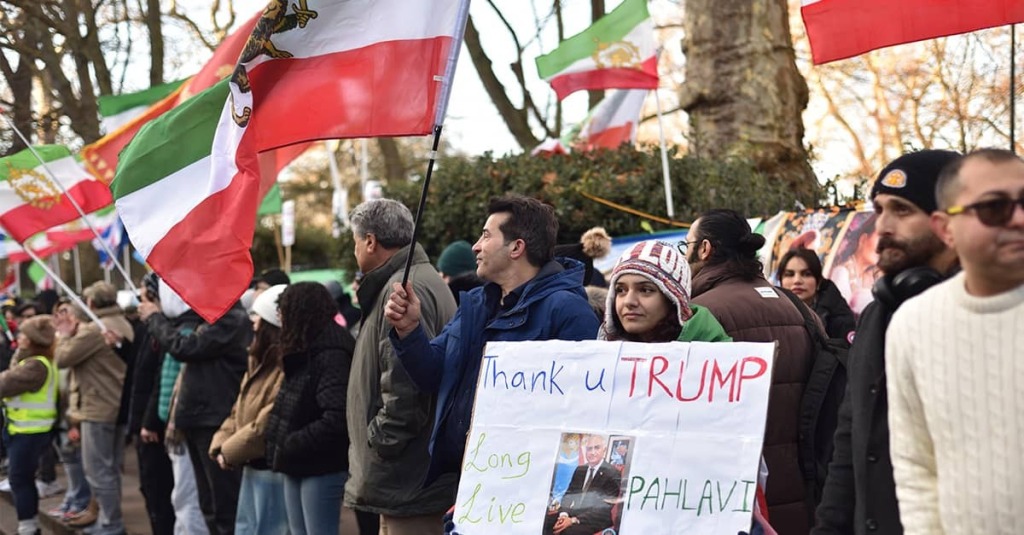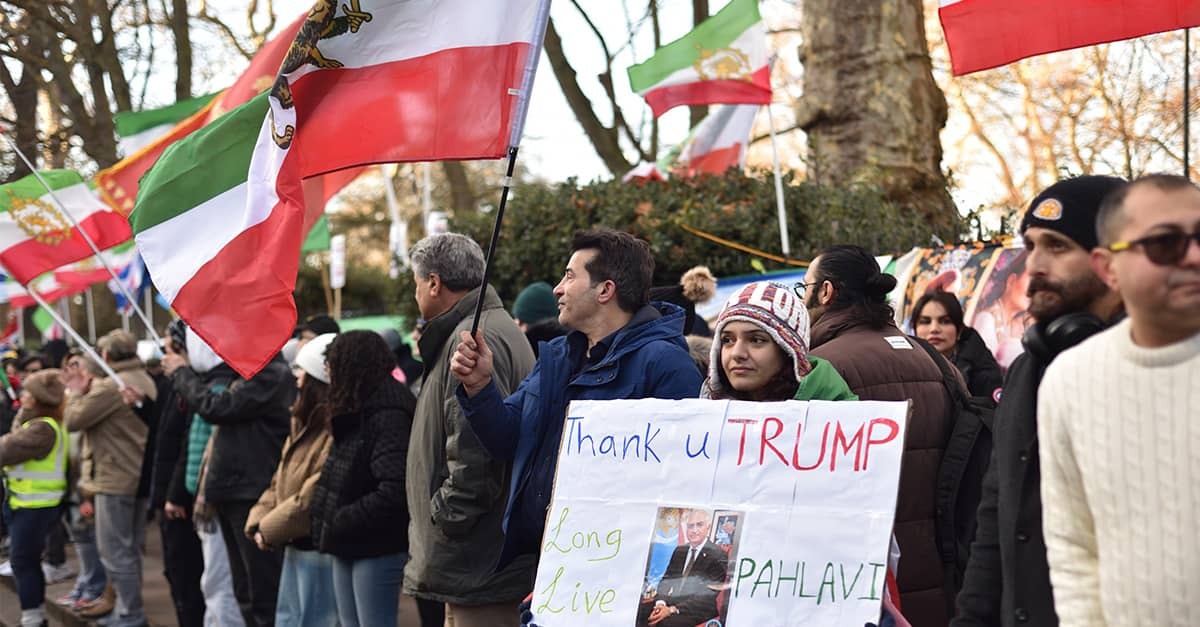
More than 45 years after a hardline Islamic regime overthrew a Westernized, free Iran, the Iranian people — including a fast-growing underground Christian church — are desperately protesting for the right to live free. Could this actually happen, and how should Christians think and pray about this situation?
This article is a lightly edited transcript of the “Here’s the Point” podcast by Ryan Helfenbein, executive director of the Standing for Freedom Center.
Over the past several weeks, hundreds of thousands of Iranians have taken to the streets demanding an end to the Islamic Republic’s authoritarian rule. The Iranian government has responded with brutal force, killing dozens of protestors and arresting hundreds more. Authorities have shut down power grids and blocked Internet access to prevent information from flowing in and out of the country.
Thanks to technology, videos have been leaked outside Iran despite these efforts. The world is watching as ordinary Iranian citizens risk their lives chanting, “Death to the dictator.”
President Donald Trump stated on Truth Social: “The people of Iran want freedom. They deserve it. The world is watching.”
Vice President JD Vance echoed: “We stand with the brave Iranian people fighting for liberty.”
Secretary of State Marco Rubio added: “The Iranian regime’s days are numbered if they continue this oppression.”
Even Elon Musk has helped, keeping Starlink available in the region.
Can a revolution actually happen in Iran? While we have many reasons to be hopeful and optimistic, we must also not be naïve. Here are three points:
First, Iran has had a long history of both Islamic control and Western involvement.
Before 1979, Shah Mohammad Reza Pahlavi ruled Iran as a Western-friendly monarch who modernized the country and maintained close ties with the United States. Under the Shah, Iran had remarkable freedoms. Women attended universities. Fashion magazines were published. Beauty pageants were held. Iranian society in the 1970s looked more like a Western nation than a Middle Eastern autocracy.
The 1979 revolution was a “red and green” alliance of Marxism and Islam working together to overthrow the Shah. This hybrid revolutionary mode, which we often see today, whether in Gaza or New York City, isn’t new.
What replaced the Shah’s regime was catastrophic. Sharia law. Forced marriages of underage girls. Public beheadings. Honor killings. Women forced into burkas. The Islamic Republic didn’t bring freedom — it brought brutal Islamic tyranny that has ruled for over 45 years.
Then-President Jimmy Carter failed to provide critical leadership the 444-day Iranian hostage crisis (precipitated when student revolutionaries stormed the U.S. embassy in Tehran in November 1979 and took 52 Americans hostage after the exiled Shah was allowed to enter the U.S. for cancer treatment). The weak and feckless leadership from the Carter administration provided a vacuum that allowed radical Islamic clerics to consolidate their power and take firm hold of the country.
The lesson? Revolutions in Iran are complex, and the outcome is never guaranteed to favor freedom. Iran had more freedom under the Shah than it has known since.
Second, there are hopeful signs of Christians coming to faith in Iran.
Dr. Hormoz Shariat, founder of Iran Alive Ministries and often called the “Billy Graham of Iran,” estimates there may be as many as 2 million Muslim converts to Christianity in Iran today. Elam Ministries, which tracks Iranian church growth, reports that in 1979 fewer than 500 Christians were known in the country. Today that number exceeds 350,000.
The Billy Graham Evangelistic Association reports that over 47,000 Iranians have indicated decisions for Christ through their online outreach, with hundreds of thousands more seeking information about Christianity. Open Doors, which ranks Iran ninth on its 2025 World Watch List of most hostile nations toward Christians, confirms that the underground church is growing rapidly despite severe persecution.
This is genuinely encouraging. But the scale, organization, and representation within the current opposition remain unclear. While hundreds of thousands are in the streets, we don’t know how organized they are or what lengths the regime will go to stop them.
Remember the 2011 Egyptian Arab Spring. The media celebrated for months — only to see the Muslim Brotherhood take power, establishing a more radical government than before. Revolutionary moments can produce worse outcomes than the tyrannies they replace. Whether it be Syria, Iraq, or Egypt, the repeated pattern in the Middle East is when one government is overthrown, something worse fills that void.
A new regime will only ever be as good as the people ushering it in.
Third, President Trump warned the Iranian government not to kill protestors or face consequences.
On January 2, Trump posted on Truth Social: “If Iran violently kills peaceful protesters, which is their custom, the United States of America will come to their rescue. We are locked and loaded and ready to go.”
Days later, speaking to oil executives at the White House, Trump added: “I tell the Iranian leaders: You better not start shooting, because we’ll start shooting, too.”
Secretary of State Marco Rubio reinforced American support, stating on X: “The United States supports the brave people of Iran.”
At a State Department press conference, Rubio made the administration’s position even clearer: “Our problem with the Iranian regime isn’t simply their desire to acquire nuclear weapons — their sponsorship of terrorism — but it’s ultimately the treatment of their own people.”
However, we should be wary of military quagmires in Iran. Trump himself clarified: “We will be hitting them very hard where it hurts, and that doesn’t mean boots on the ground.”
Trump’s best diplomacy centers around never letting his enemies know his next move.
Iran and Venezuela aren’t the same. America should support the Iranian people’s freedom diplomatically and economically — not with boots on the ground. No nation-building campaigns. No extended military occupation.
American power should support freedom movements without entanglement in another Middle Eastern conflict. Christian-style democracies don’t naturally emerge from Muslim populations. The Islamic worldview doesn’t share Christianity’s foundations for liberty, individual rights, or constitutional government.
That doesn’t mean it’s impossible — nothing is with God — but we should be realistic. Freedom requires more than overthrowing tyrants. It requires understanding human dignity, rule of law, and limited government — concepts rooted in Christian thought.
We should be hopeful, not naïve.
And we should absolutely pray for the Iranian people. Pray for their safety. Pray for the end of this government. Pray that God would use this moment to bring about genuine freedom and that the underground church in Iran would grow and flourish. Iran needs the floodgates to open for Gospel work to pour into the country.
Pray that the Gospel of Jesus Christ would advance in Iran, because that is the only foundation for lasting freedom. And pray that America would continue to show leadership and support for these brave Iranian citizens who are standing up to their government — without becoming entangled in quagmire conflicts.
One thing is for sure: 2026 is opening up many possibilities for freedom in the United States and around the world.
If you like this article and other content that helps you apply a biblical worldview to today’s politics and culture, consider making a donation here.