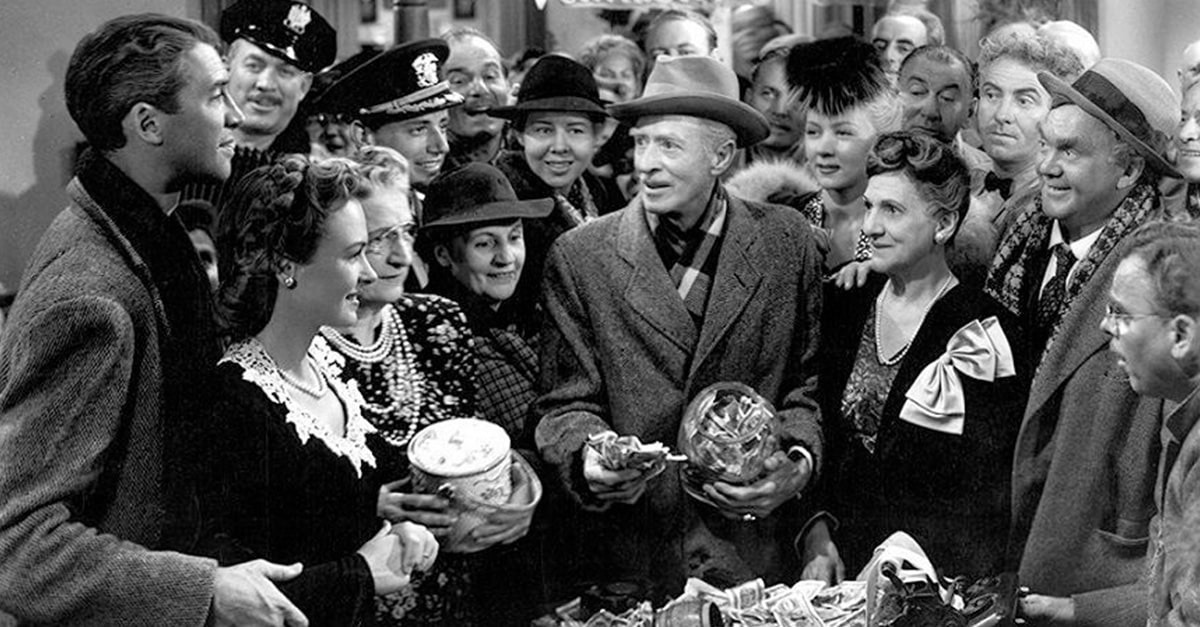
Christmas favorite “It’s a Wonderful Life” dramatizes what the Christian tradition teaches: that the highest calling of the Man of Virtue is to subordinate his will to God and carefully steward the moral ecology of his community.
Frank Capra’s beloved Christmas classic It’s A Wonderful Life has animated the Christian spirit since its release in the mid-1940s. The protagonist, George Bailey, is the embodiment of the virtuous stoic that characterized pre-war America. He is a gentle and dutiful father, not lacking in ambition, and determined to make a name for himself beyond the confines of his hometown.
The Bailey archetype is manifestly the Man of Virtue, the beneficent protector who acts as guarantor of a balanced societal moral ecology. Initially ambivalent to his hometown, the “lousy Bedford Falls,” he grows to understand the obligations required of him by his station in life.
The story is straightforward: The Bailey’s Building and Loan, run by George’s father, Peter, is the cornerstone of the town, with the rapacious Henry Potter serving as the antagonistic villain. The telos of the enterprising Bailey family is not wealth creation but communal stability and flourishing. Mr. Potter is by far the better banker. This is acknowledged by George himself, who is often bemused by his father Peter Bailey’s lousy business mind.
Potter is not, however, the better man.
It’s not until Peter’s death that George realizes the ethic his father embodied.
“The deficiency of our nature encourages us to be charitable, because no one alone is enough for himself.” So says the Swiss Reformed theologian Benedict Pictet. The people themselves are the reason for being; their vitality is paramount to a healthy moral ecology. Properly understood, a healthy society requires that each man engage with the other in good faith, orienting their collective action towards the common good.
Capra dramatizes what the Christian tradition teaches: A healthy society is one in which each man seeks the welfare of the city through layered associations, or a healthy moral ecology.
The Moral Ecology of Community
This is consistent with the thinking of German legal and political philosopher Johannes Althusius (1563-1638), who saw a rightly ordered society not as a series of impersonal contracts amongst strangers but as a communion of life.
The citizen is necessarily intertwined with his neighbor, forming interlocking layers of symbiotic dependency bound by a shared ethic.
This consociatio symbiotica, or symbiotic association, pursues the common good in which men “communicate among themselves whatever is appropriate for a comfortable life of soul and body.” These symbiotes rightly order the “things, services, and common rights” in their society, establishing good order amongst themselves.
To facilitate this good order, competent men may deploy their particular talents within the community through the building of institutions. Among these are churches, banks, and schools. These localized structures provide mechanisms for enforcing the public will.
Thus, the Bailey Building and Loan functions as the mediating institution by which the community itself can express its shared vision. The Man of Virtue is necessary to maintain these systems, ensuring all parties are able to operate from the same first principle — the pursuit of the common good as defined. In the absence of the strong mediating force, malicious actors are permitted to upend the agreed-upon order.
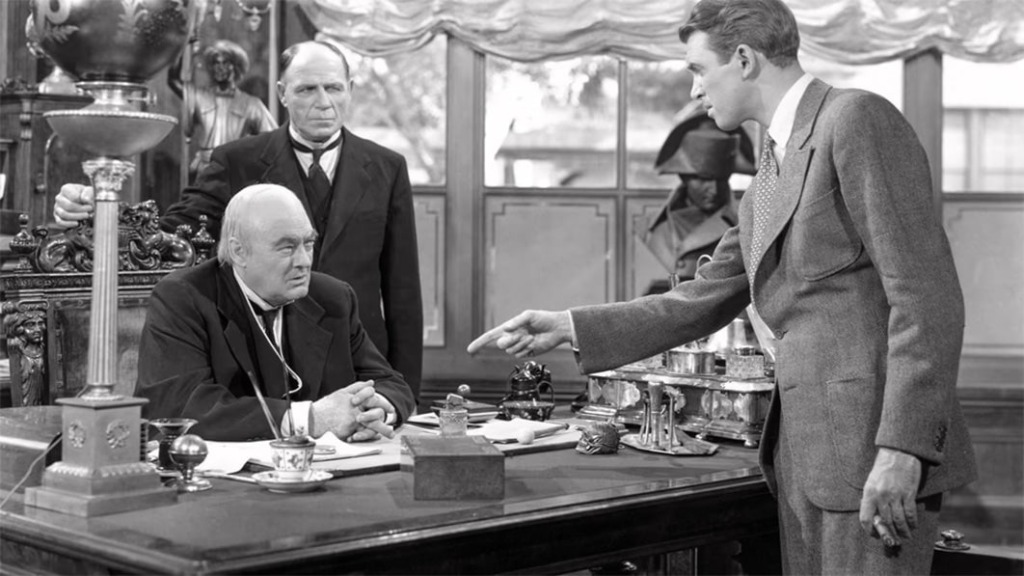
Some critique the film as a play on socialism. It is not. “From each according to his ability, to each according to his need” is an ethic predicated on compulsion. The nonconsensual redistribution of wealth removes the question of good character entirely.
The polity present in Bedford Falls is one in which the virtues of each man are bound up with the other. None can thrive in isolation, so all consent to a relationship of mutual dependency. George Bailey is a moral figure precisely because he is embedded in the social fabric of his town. He is equal parts citizen and leader. His business is not predatory, relying on usurious superabundance, but collaborative and oriented towards mutual prosperity as an end.
Thus, George Bailey, still longing for a life of renown, wrestles with his calling to serve as the Patrician of Bedford Falls. Only when he is shown a vision of the world without him does he begin to understand the importance of the role he plays.
The Mandevellian Hive
Pottersville, the dystopian expression of commoditized vice, is presented as the natural condition of society in the absence of the Bailey archetype. It is Bernard Mandeville’s Fable of the Bees made manifest — man’s proclivity to sin is channeled into a pleasure-centered, degenerative moral order. The absence of virtue becomes the economic engine upon which the community relies. Bedford Falls becomes a village of strangers, a complete breakdown of the consociatio symbiotica.
Without the Man of Virtue, the community lacks the robust social order of a unified telos, or ultimate purpose. Thus, Mr. Potter, a utilitarian, usurious tyrant, is able to exploit the high-trust society he inhabits.
The town of Pottersville is one where you own nothing, love no one, and belong nowhere. Men drown their untapped ambition in cheap liquor while women sell their purity for a night of counterfeit stability. This fragmented, low-trust society is ideal for the perfidious Mr. Potter, who sees each man and woman as a mere unit of account. A disordered community lacks the collective vigor to maintain good order in pursuit of the common good.
Potter’s contempt for the layman is palpable. He justifies his wickedness by callously reminding George that no one is compelled to borrow his money. German Reformer Wolfgang Musculus rebukes the avaricious man who sees the plight of the needy as an opportunity for enrichment, writing,
“Compelled by that cruel spur of necessity, those people come to you as wretched, and you, who are without any sense of humanity for their misery, you most shamefully render them lucrative for yourself.”
Men of low moral character are legion. It is the job of men of high virtue to keep them in check by way of mediating institutions. Virtue, as described by Pictet, is that “quality of the soul that drives us to act according to right reason and according to the law of God.” Vice is presented as its mirror.
Thus, the Bailey archetype represents the classical noblesse oblige — the obligation of virtuous men to use their wealth and status to care for and protect their community.
The Richest Man in Town
The struggle between Bailey and Potter plays out across innumerable American towns. There is no shortage of would-be tyrants who are content with dominion over their rotting fiefdom. There must be Baileys willing to cultivate a moral disposition and deploy it in their community. Yet, in the manner of all noble callings, a challenge lies woven into its very fabric. The same qualities that animate the modern Man of Virtue typically discourage him from localizing his ambitions. George spent his whole life in search of exotic dragons to slay, unaware that the Battle of Bedford Falls would be the defining moment of his life.
Early Americans understood that national service was a sacrifice — a temporary interruption from provincial life. Generally, our early statesmen were well-established, moral fixtures in their communities. Having already driven out their Potters, they were prepared for a short period of elevated responsibility. George Washington famously pined for Mount Vernon, having grown tired of the impersonal nature of national leadership. Rightly so, as one’s family and broader community are the truest expression of one’s legacy. Thus, the highest calling for the Man of Virtue is that of stewardship: the careful cultivation of his communal moral ecology.
For most of us, fame among men is not our station. Like George Bailey, we must be content to subordinate our will to that of God. We must find satisfaction and contentment in any state the world presents. We must be content to be great among our own people, the scale of which is the decision of Providence alone.
Concluding Thoughts
I’d be remiss if I didn’t provide a few of my favorite quotes from the film that so deeply impacted my own life.
In the spirit of Advent, it does us well to remember that “no man is a failure who has friends.” Friends are, after all, the indispensable element of a rightly ordered life. It is the interdependence with our fellow man that imbues us with eternal significance — a design inscribed upon us by God Himself. The Man of Virtue embodies this communal struggle towards the common good, properly shouldering the responsibility of the benevolent patrician.
In our Christian pursuit of the accolade, “Well done, my good and faithful servant,” let us also aspire to the distinction of being “George Bailey, the richest man in town.”
If you like this article and other content that helps you apply a biblical worldview to today’s politics and culture, consider making a donation here.