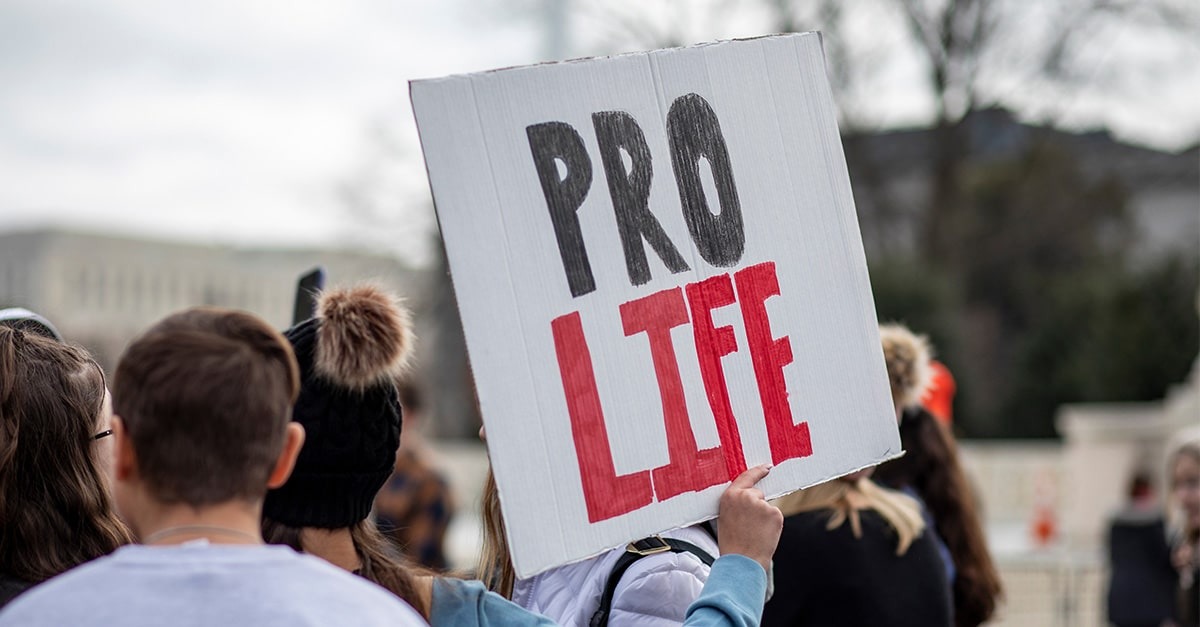
The 11th Circuit Court of Appeals cites Supreme Court precedent in striking down an ordinance in Clearwater, Florida, intended to silence the public speech of pro-life sidewalk counselors near abortion clinics.
A federal appeals court has ordered Clearwater, Florida, to halt enforcement of a city ordinance that created a pedestrian buffer zone outside an abortion clinic, ruling that the measure likely violates the First Amendment.
Passed in 2023, the rule created a vehicular safety zone that bars anyone from using a stretch of sidewalk within five feet of the driveway at Bread and Roses Women’s Health Center during business hours. City officials say they put the zone in place to improve patient safety and reduce traffic concerns.
Florida Preborn Rescue, Inc., along with four sidewalk counselors, had challenged the ordinance, arguing that it kept them from offering peaceful guidance on a public walkway.
Tyler Brooks, senior counsel for Thomas More Society, who represents the plaintiffs, had argued on filing the suit,
“This buffer zone is clearly discriminatory and meant to stifle pro-life speech. It was instituted by the Clearwater city council for the express purpose of limiting the speech and activities of life advocates taking place outside of the deceptively genteel looking Bread and Roses abortion facility.”
In a 2–1 decision, the U.S. 11th Circuit Court of Appeals agreed, reversing a lower court’s ruling and issuing a preliminary injunction on the ordinance while the case proceeds.
Judge Kevin Newsom, writing for the majority, said the restrictions run afoul of longstanding Supreme Court precedent governing speech in public forums. Citing the 2014 decision in McCullen v. Coakley, which struck down a similar Massachusetts buffer zone, Newsom wrote that the government’s ability to regulate speech on public sidewalks is “very limited” and any such restrictions must be “narrowly tailored.”
The Clearwater ordinance “seriously burdens Florida Preborn’s speech… by restricting the sidewalk counselors’ ability to distribute leaflets to patients as they arrive at the clinic,” the court said. It added that the measure also blocks clinic patients from entering the restricted area to accept literature, undercutting the city’s claim.
“The prime objective of the First Amendment is not efficiency,” Newsom wrote, again quoting McCullen, and concluded that the ordinance burdened “substantially more speech than necessary” to achieve the city’s stated safety goals.
“The loss of First Amendment freedoms, for even minimal periods of time, unquestionably constitutes irreparable injury,” he concluded.
Mat Staver, CEO and founder of Liberty Counsel, which has represented plaintiffs in similar cases, praised the decision, calling it “a significant victory for sidewalk counselors and free speech advocates.” Staver said public sidewalks “have always been protected places where people can gather to participate in the peaceful exchange of ideas,” and argued that buffer zones “collide with free speech and hinder women and girls from receiving information that could change their fateful decisions.”
The issue of whether pro-lifers have a right to share their views outside abortion clinics has embroiled American jurisprudence for years but has lately also become an international flashpoint. The U.K. began policing “buffer zones” in England in 2022 and more recently in Scotland in 2025. As a result, a number of pro-lifers have been arrested for such activities as “praying inside one’s head” or holding up signs citing Bible verses.
For example, Adam Smith-Connor, a British Army veteran, was convicted in 2024 of violating a local buffer zone ordinance after he was caught standing alone and praying silently near the abortion clinic where his unborn son had been killed.
Earlier this year, a 75-year-old grandmother was arrested for a second time and criminally charged under Scotland’s “buffer zone” law after holding a sign outside Queen Elizabeth University Hospital in Glasgow in September. Rose Docherty made international headlines when she was initially taken into custody for standing within 200 meters of the hospital with a sign that read: “Coercion is a crime, here to talk, only if you want.”

For Christians, the ruling in this case is a reminder of the extraordinary gift God has given us in a nation where the First Amendment protects both our speech and our ability to live out the Great Commission in public life. In many places around the world, believers risk imprisonment or worse for simply speaking the truth about the value of life. Here, the Constitution continues to guard a space where we can proclaim what Scripture teaches without fear.
The sidewalk counselors at the center of this case are individuals who believe that God creates every child and that every mother deserves compassion and support. Their ministry happens quietly, one conversation at a time, on a public sidewalk where the First Amendment has always been strongest.
When the appeals court affirmed that their “normal conversation” and material distribution are protected speech, it reaffirmed something Christians have long understood. The government does not grant the freedom to speak truth in love. The government recognizes it because it a natural right rooted in human dignity itself.
This ruling pushes back against the idea that pro-life speech is something to privatize. It upholds the principle that public spaces belong to the public, including those who want to offer life-affirming alternatives to women considering abortion. That matters deeply for the Church, because our calling has never been confined to sanctuaries. We are sent into the world to be salt and light in places where despair is real and hope is needed most.
The First Amendment does not guarantee that our message will be welcomed; it only guarantees that it may be spoken. This ruling is a strong reminder of that foundational principle — and a reminder that Christians should always wield that right, speaking with courage and compassion while knowing that God can use even brief encounters to change hearts and save lives.
If you like this article and other content that helps you apply a biblical worldview to today’s politics and culture, consider making a donation here.